

Reviews include Onslaught, Mayday, and Hope.
TFCA Friday: Movie Reviews for Aug. 7
August 7, 2026
Welcome to the TFCA weekly, a round-up of reviews and coverage by members of the Toronto Film Critics Association.
In Release this Week
Big Chicken: A Fast Food Conspiracy (dir. Liana Stewart)
“The ghost of Super Size Me looms large in Big Chicken as Gilligan embarks upon the journey and jets from the U.K. to the U.S.A. to chow down on greasy drumsticks whilst super-sizing his thighs,” says Pat Mullen at POV Magazine. “Even before Spurlock undertook his own cheap-n-greasy diet, however, the consequences of eating fast food were largely known. Big Chicken adds little to the conversation in that regard, but the doc also twists the circumstances somewhat. In Super Size Me, Spurlock commits himself to getting his 10,000 steps in so that his study reflects the recommendation for minimum physical activity. Gilligan drives everywhere and frequently orders calorie-logged wings and fries from his hotel room. Results may vary, but the doc doesn’t quite address the increasingly sedentary nature of the eating game in a food-app economy.”
Cookie Queens (dir. Alysa Nahmias)
“Cookie Queens is one of those terrific works of non-fiction that explores a microcosm only to uncover far broader social and political factors that emerge from what otherwise would appear to be a minor cultural event,” says Jason Gorber at POV Magazine. “Emotionally rich, terrifically paced and handsomely framed, this is an exceptional work that’s greater than its ingredients, sandwiching politics, commerce, and the joys of childhood all into one package.”
Ice Cream Man (dir. Eli Roth)
“It luxuriates in gruesome torture, decapitation and disembowelment as if it were another game kids could play. And it’s all done in bright colours, with happy children’s music under a glorious summer sky,” notes Daniel Garber at Cultural Mining/CIUT FM. “Maybe some particularly nasty 7 year olds might find all this funny, but I just found it gross. But is it scary? Again, no, not at all. Disgusting doesn’t equal scary. The plot is incredibly weak, and isn’t even consistent within its own conceit. One moment the kids are zombies, the next they’re having fun? What did I miss? Are they all part of a hive mentality controlled by the ice cream man? It doesn’t really matter.”
“The plot barely qualifies as high concept. An ice cream truck rolls into town, driven by a grinning vendor (Ari Millen) with a John Waters moustache, and the children who eat its demonic frozen wares wake up in giggling psycho mode, slicing, dicing and decapitating their parents, before moving on to their neighbours, teachers and first responders,” says Jim Slotek at Original Cin. “That’s it. For more than a solid hour without stopping. Every which way life and limb can be separated, via garbage disposals, ignited gasoline, blunt objects, bricks thrown from rooftops, people thrown from rooftops. Brain-eating, the retrieval of raw sausages from people’s bellies standing in for intestines (always cook your sausages before eating them, people!). Well before the 50th severed limb, the slaughter becomes boring beyond redemption.”
“With such a limited plot, there’s a lot of repetition with some creative variation,” agrees Sarah Gopaul at Imagery at the Movies. “The miniature maniacs employ all manner of weapons to dispatch their implausibly unsuspecting victims. From hacksaws and hammers to baseball bats and balls to Popsicle sticks and paint, they use whatever they can get their little hands on. Sometimes it’s the gory kills with blood splattering across their tiny faces that’s shocking. Other times it’s the aftermath of using the bodies in their arts and crafts or other playtime activities that’s outrageous. Roth is never short on ideas when it comes to gore in a horror movie, making it one of the picture’s rare strengths.”
Inside the Trustor Scandal (dir. Karin af Klintberg)
“With little sensationalization and cheap theatrics, director Klintberg lets her interesting material unfold naturally and effectively, as she trusts the entertaining potential of her material as well as her subject,” writes Gilbert Seah at Toronto Franco. “One of the most interesting parts of the film is how Posener, while in prison, a place where he did not belong as it was a vile place for violent criminals with fighting going on all the time, planned his next move in revenge. And this was the Trustor Affair.”
King Arthur’s Night (dir. John Bolton; Aug. 9 only)
“It goes all quite well, but the film is quite a bore to watch. It is true that one should give others than others a chance, but to sit through two hours of giving this chance can be a bit much for most people,” says Gilbert Seah at Toronto Franco. “The original songs featured in the play by Veda Hille also might not be to everyone’s taste in music. The comedy and fantasy are slight, as is the amateurish medieval pageantry.”
The Last House (dir. Louis Leterrier)
“There are many issues examined in the film that make the film work,” writes Gilbert Seah at Toronto Franco. “These include the sci-fi mystery element (no spoilers in this review), the family dynamics, the survival element (the food running out), and the magic question of how the content rain has anything to do with the families trapped in houses.”
One Night Only (dir. Will Gluck)
“Whenever writer/director Will Gluck has tackled the awkward sex comedy genre, the results have been at best….uneven,” admits Dave Voigt at In the Seats. “For every intelligent Easy A there’s a generally banal Friends With Benefits which means he should probably stick to making Peter Rabbit movies, but we’ll at least give him a partial pass here. Gluck didn’t write a word in the script from Travis Braun which is broad, plays to the lowest common denominator when it comes to people’s relationships with sex. It’s actually kind of offensive, not only because it has no actual faith in humanity, but more importantly because it’s not really funny. You’d expect a sex comedy to have a little more zing to it, but considering Braun’s previous credits that are mostly children based we’re maybe not all that surprised. It’s an attempt at social satire that just ends up being mean spirited.”
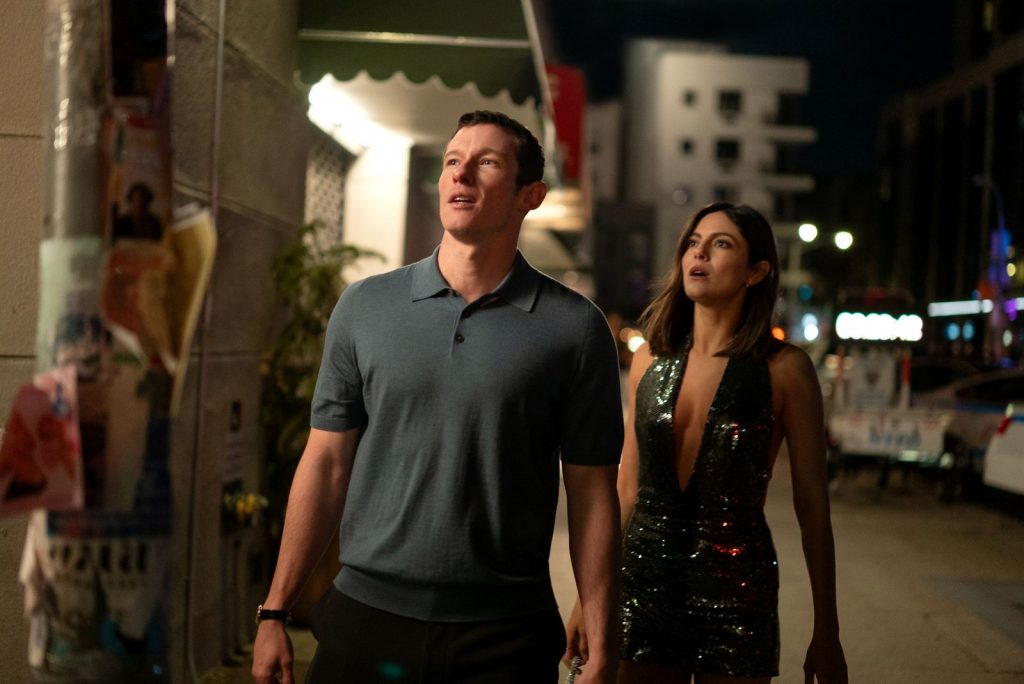
“Written by Travis Braun, whose credits mostly include children’s animated television, the script is full of witty barbs and one-liners that consistently land. Allie and Owen stand out among their peers as two people who still value romance and courtship, something the government has stripped away from society. Of course, they’re not above making the most of their one night a year either,” says Rachel West at That Shelf. “A sex comedy with heart, One Night Only is surprisingly sweet. The entire concept hinges on Turner and Barbaro’s chemistry, and they have plenty of it. We all know how rom-coms like this end, but watching these two weave in and out of each other’s orbit makes every encounter feel like a new meet-cute.”
“Will-they-won’t-they is a hackneyed way to string an audience along, but it worked 100 years ago in It Happened One Night, and it’s still got some life in it, with the right people (watch for a couple of surprising cameos from the Star Trek universe) and a few good tunes,” notes Chris Knight at Original Cin. “One Night Only is equal parts stupid and silly, but 50-50 turns out to be enough to keep an audience hooked. Besides, if this romantic comedy does well, I look forward to its crossover with The Purge, when sex and murder become legal on the same evening. Bring protection in both cases.”
“Mainly, the film takes the night at face value and plays it for laughs. We see people making out outrageously, practically having sex on the streets. And then there’s condoms or rather the lack of them,” observes Marc Glassman at Classical FM. “One of the ways our couple, Allie and Owen, interact is over who gets one of the few remaining condoms in New York City. This is, of course, before they realize that they’re in love—and their fight over the prophylactic is one of the funnier bits in the film.”
“One Night Only is a largely unoriginal and nonsensical — but cute! — romcom. There are lots of cameos: LeVar Burton, Molly Ringwald, Julia Fox, Pete Davidson… but it relies on Callum Turner and Monica Barbaro, who, fortunately have good chemistry,” says Daniel Garber at Cultural Mining/CIUT FM. “They use each other, both as foils for their jokes — often slapstick and bawdy — as well as potential love or sex partners. I like the physicality; there are some very funny chase scenes, and pratfalls, and lots of half-naked embarrassments.”
“One Night Only is a supposedly romantic comedy that spells disaster all the way,” says Gilbert Seah at Toronto Franco. “The main culprit is the outrageous, stupid premise about this one-night sex mandate, then has the whole film follow two people trying to score sex. The people they find range from a thief to a stupid singer who falls off the piano to some club celebrity, all of whom deliver predictable situations. One knows that the two will eventually come together as a couple, but it takes a whole movie before this happens. The film is tedious, boring, and plain dumb, not to say it is not funny at all, unless one can laugh at any silly thing.”
“The script also strives to answer some important questions about how the country got here,” says Sarah Gopaul at Imagery at the Movies. “Refreshingly, they don’t use a dystopian cause like over-population or food shortages. They put most of the blame on politicians ignoring their constituents. An ironic interview with Chinese media includes an American representative explaining the policy. On the other hand, the science behind monitoring and enforcement isn’t sound, but it’s good enough to not have the question looming over the whole film. However, since sex is only allowed between married adults, it does make one wonder how this government overreach has affected marriage and divorce rates.”
The Samurai and the Prisoner (dir. Kiyoshi Kurosawa)
“Much of this effect the product of beautifully patient, classical composition, in which layered staging and subtle editing allow performers to chew the meticulously designed interiors, all the while engrossing you in each breathy pause, pointed verbal jab, and breathtaking betrayal,” writes Prabhjot Bains at Range. “At the heart of it, lies the dynamic, intricate interplay between Motoki’s stoically impassioned lord caught in an impossible situation and Suda’s sly, tragic tactician who opines in riddles and haikus.”
“The Samurai and the Prisoner is a wonderful film. Kurosawa has created a work that appears totally unlike him: historical, stately, almost formal,” notes Marc Glassman at Classical FM. “Yet it works so well that one wonders what else he might have achieved in the past and what he could still do in the future. Kurosawa has made a film that is surprisingly slow and complex—and wholly worthwhile. Viewers who are intrigued by Japanese culture and history will truly enjoy it—and this departure for the director. I recommend it for everyone who wants to experience something different this August.”
“The Samurai and the Prisoner, the latest film by the prolific Japanese director Kiyoshi Kurosawa, is intelligent entertainment, based on a 2021 historical mystery novel by Honobu Yonezawa and, as with Kurosawa’s anxiety-charged previous thrillers (Cure, Pulse, Cloud), follows chain-reaction social disasters,” adds Liam Lacey at Original Cin. “There’s an echo of that serial approach in the nested puzzles that make up the movie’s plot though the tone here is classically restrained. The setting is a series of minimally furnished rooms, adjoining corridors, and courtyard of the castle, almost resembling a stage set or, perhaps, a game board, illuminated by shafts of overhead light and the intensity of the performances.”
Wild Inside (dir. Penny Lane; Aug. 8 only)
“As Wild Inside charts Flaco’s adventures throughout the city, his flights bring him to the many different cages that people erect for themselves. There’s something refreshingly romantic, too, about the joy and passion that his encounters inspire within city dwellers. Lane’s film captures an inherent affinity that exist between humans and non-human counterparts. As interviewees discuss their relationships with animals beyond Flaco and express concerns for the hawks, raccoons, and even rats with which they share the city, Wild Inside invites audiences to consider the responsibilities entailed with being at the top of the food chain. There’s a world of animals that one can’t unsee after spotting them,” says Pat Mullen at POV Magazine. “If any doc inspires audiences to give a hoot about their neighbours, this is it.”
File Under Miscellaneous
At the Toronto Star, Peter Howell picks five films to keep an eye on during August, including Ridley Scott’s The Dog Stars with Jacob Elordi and Margaret Qualley: “Scott and his A-list cast are enough to make this a must-see, but there are literary reasons, too,” says Howell. “The 2012 Peter Heller book the film adapts was a bestseller, winning Novel of the Year on Apple iBooks and best-of list nods by The Atlantic and Publishers Weekly.”
At Queer Horror Movies, Joe Lipsett endures Ryan Murphy’s latest series, The Shards: “It’s pretty packaging standing in for actual substance and no amount of coke or ’80s needle drops can save it.”
A Festival of Festival Coverage: TIFF Previews
At POV Magazine, Pat Mullen gets the scoop on the TIFF Docs line-up and speaks with programmers Thom Powers, Jason Anderson, and Kelly Boutsalis about this year’s selections, which include new works from heavyweights like Alex Gibney, who is back in town with Musk: “Alex Gibney is one of our greatest investigative documentary filmmakers taking on subjects over the years, like Scientology in Going Clear or Theranos in the Elizabeth Holmes film [The Inventor: Out for Blood in Silicon Valley]. In Musk, which he’s been working on for nearly four years, against a backdrop of constantly evolving headlines about his main subject, this is arguably his most ambitious work about a figure whose reach extends everywhere these days,” says Powers. “If there’s any subject that cries out for greater scrutiny today, I would say it’s Elon Musk and that Alex Gibney is the right person for that job.”
At Cultural Mining, Daniel Garber highlights TIFF selections that pique his interest, including Stuffed (“about a taxidermist who wants to stuff an actual human, and gets a volunteer… but everything gets messed up when love enters the picture”) and Bitter Christmas (“a time shifting comedy drama about an ad exec’s turbulent Christmas. And it’s by Pedro Almodóvar, whose movies are always worth watching”).