The critics were busy at this year’s Toronto International Film Festival! From our annual pre-festival party, this year held at Hotel Le Germain Toronto Mercer and generously sponsored by Redbreast Whiskey, to scurrying from screening to screening, our members can attest that TIFF was in full swing. This year again held an abundance of riches, […]
TFCA Friday: Movie Reviews for Feb. 6
February 6, 2026
Welcome to the TFCA weekly, a round-up of reviews and coverage by members of the Toronto Film Critics Association.
This week’s roundup begins with Johanna Schneller remembering the life and career of the late, great Catherine O’Hara for The Globe and Mail: “From the moment in 1974 that she appeared in Toronto’s Second City comedy troupe, she did what all great comedians do: She committed. She had glorious tools – her wide, elastic mouth; her voice that slid from breathy to brassy; her springy physicality; her unerring choice of the right wig, earring or shoulder pad – and she used them in everything she played. But she was also so subtle. She understood that one hair sticking up could be funnier than a whole tangled rats-nest, that one muttered aside could be richer than a full monologue.”
In release this week!
Dracula (dir. Luc Besson)
“This is one of those films that really has most if not all of the tools that it needs to succeed but it just…doesn’t,” writes Dave Voigt at In the Seats. “Besson injects it all with way too much (or too familiar) visual flare that will certainly draw you in but also doesn’t give the legacy or the lore of the character anything that was genuinely new. It’s all very ‘been there, done that’ especially if you’ve seen a movie made before the turn of the century (particularly Francis Ford Coppola’s Dracula).”
“Writer-director Besson also wastes what is supposed to be a major role played by Christoph Waltz as an itinerant vampire-slaying Bavarian priest who carries a briefcase of lethal tools,” says Peter Howell at the Toronto Star. “Waltz’s character doesn’t get much screen time or even a name; he’s just listed as ‘Priest’ in the credits. Yet it’s one of the most fascinating roles Waltz has had in a while, a sort of Columbo-meets-Indiana Jones figure who doesn’t say much but stares down danger like a champ.”
Kokuho (dir. Lee Sang-il)
“The film educates the audience on the world of kabuki with all the lavishness and splendour of the disciplined choreography, costumes, makeup up and voices,” says Gilbert Seah at Afro Toronto.
The Moment (dir. Aidan Zamiri)
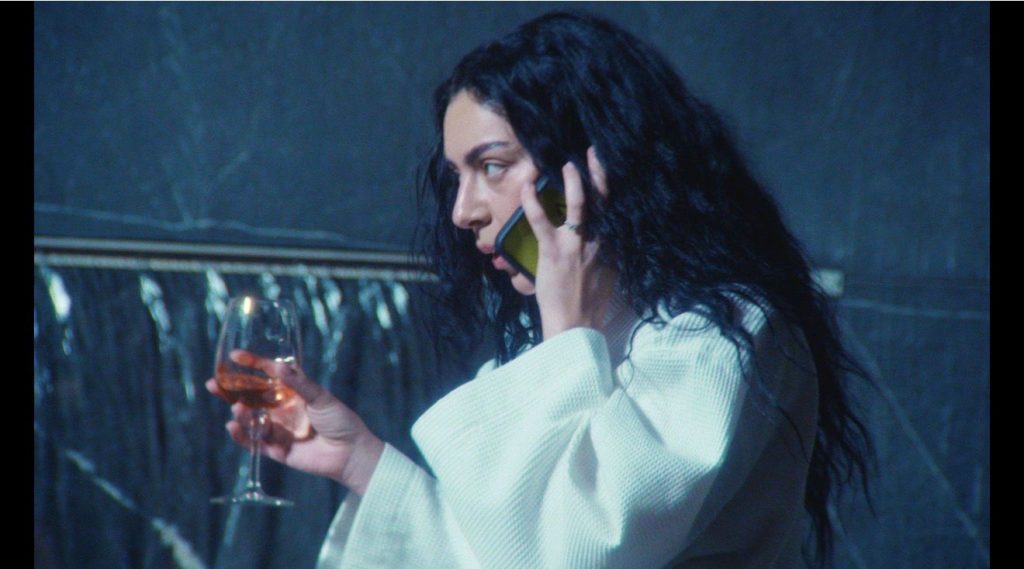
“Charli’s performance of who she is in The Moment isn’t always a flattering one,” writes Kathleen Newman-Bremang at Refinery 29. “When she blows off her creative director (played excellently by Hailey Benton Gates, giving a nuanced, exasperated yet restrained performance that sometimes outshines its material) in the middle of tour rehearsals to go to a wellness spa in Ibiza, Charli XCX is being a brat — and not in the coked-out, absurdist chic way she intended. Charli is running from fame, and she runs into Kylie Jenner, naturally (Rachel Sennott and Julia Fox also deliver strong cameos). It’s a bit on the nose to include a Kardashian, the first family of being famous for fame’s sake, but somehow it works.”
“The Moment is a bit of a cautionary tale, sometimes funny and often entertaining, but it’s not that original an idea: This is Spinal Tap, and all that. And The Moment falls into the ‘did-we-need-this?’ category of filmmaking,” says Liz Braun at Original Cin. “It will be catnip for fans of the music star; others will find various aspects — such as the psychedelic flashing title cards — hugely annoying. Charlie XCX however, comes off well, feisty and self-deprecating. She never plays the victim.”
“XCX is no Beyoncé. As we learn following her around the awkward meet-and-greets, stilted ‘What’s in my bag’ interview rooms and self-conscious rehearsals for her ongoing tour, our star started this whole thing in the kind of scenario she finds most comfortable: no oversight, no expectations and with a focus on capturing the messy club esthetic where she feels most at home,” says Jackson Weaver at CBC. “Unfortunately, the celebrity — talented, though still in no way trusting of the spotlight suddenly shone on her — isn’t actually all that sure she knows what she’s doing.”
“As it is, the bizarre, genre-blending hybridity of the film is easily its best feature. The Moment has something to offer a broad range of audiences, regardless of whether you celebrated Brat summer or you can’t tell Charli from Sabrina Carpenter or Olivia Rodrigo,” says Joe Lipsett at Queer Horror Movies. “It’s a surprisingly clever, occasionally confronting, unusual slice of media satire.”
“The only truly bratty thing here is how The Moment looks, sulking across the screen in a smear of shaky cam. It looks like crap, as if it were shot with a first-edition smartphone passed between actors like a furtive joint. By the end, The Moment doesn’t play like a tour prep chronicle so much as a month-long celebrity hangover,” says Peter Howell at the Toronto Star. “One thing the film gets exactly right is its depiction of the drudgery of backstage life, promotional chores and relentless touring. As the Beatles discovered in ’66, and Charli XCX learns here the hard way, even pop revolutions end in exhaustion.”
“Directed by celebrity photographer Aidan Zamiri as if he is channelling both the Lonely Island crew behind Popstar and This Is Spinal Tap’s Rob Reiner on a coke binge, The Moment feels alternately janky and staid, as if a late-stage Vice magazine photo spread came to life,” zings Barry Hertz at The Globe and Mail. “Wisely, Zamiri keeps Charli in almost every frame of the film, allowing the audience to grip onto something real: a star with genuine presence. But not even the world’s biggest brat can save an experiment that falls flat.”
“The Moment is a satire/mockumentary on the British singer/songwriter known as Charli XCX,” notes Gilbert Seah at Afro Toronto. “It is brave and innovative, sometimes too much, and it takes a while, like the first half of the film to get its footing. This reviewer hated the first half. The first half is quite bad, but the second half of the film redeemed itself with its freshness as well as weirdness.”
A Poet (dir. Simón Mesa Soto)
“A Poet, in the Un Certain Regard section, won the Jury Prize, the film revolves around Óscar Restrepo, an aging poet who once had hopes of literary success but whose life has since drifted into obscurity, melancholy, and self-destructive habits,” says Gilbert Seah at Afro Toronto. “A loser in life, but he tries to do something about it, with disastrous effects. Nothing seems to go right! One of the best of the TIFF last year and one of the best neglected international films of 2025.”
Queen of Chess (dir. Rory Kennedy)
“What lifts director Kennedy’s doc above other docs and other films is that the film is not just a chess documentary,” says Gilbert Seah at Afro Toronto. “Just like chess moves—it is about moves the subject Polgár’s moves she made in her life and about determination, gender barriers, and excellence under pressure. It celebrates not only Polgár’s technical skill but also her role in reshaping perceptions of women in competitive sports.”
Scarlet (dir. Mamoru Hosoda)
“In truth (and without giving too much of the plot away), Scarlet suffers the most where it departs furthest from the original. That’s not to say that Hosoda’s take is bad; just that it’s hard to outdo the Bard,” notes Chris Knight at Original Cin. “And the visuals are incredible — an impossibly large dragon passing overhead like a living lunar eclipse; a trippy sequence to rival the stargate from 2001: A Space Odyssey; and some beautifully expressive animated faces, not least that of the protagonist, who can shift from dead-eyed dour to astonished and then on to battle ready in a heartbeat. For an animated character, Scarlet feels remarkably real.”
“The film explores heavy themes like vengeance, forgiveness, healing after loss, and the cycle of hatred — all filtered through a fantastical narrative inspired by Shakespeare’s Hamlet,” observes Gilbert Seah at Afro Toronto. “Though animated, the heavy, leaden themes would make the film unsuitable for younger audiences. The film, however, suffers from a weak narrative. One can predict where the film is heading – that vengeance is not everything that would satisfy the sword-wielding princess, and that she has a lot to learn about the good of mankind.”
The Strangers: Chapter 3 (dir. Renny Harlin)
“The film is a slow-burning dread, stalking, and inevitability, rather than lore-heavy explanations,” says Gilbert Seah at Afro Toronto. “The violence without motive (‘because the victims happen to be at the wrong place at the wrong time’)—is expected to remain intact with no explanation of the killers in a conventional way.”
Sway (dir. Charlie Hamilton and Zachary Ramelan)
“The script contains a few interesting though not groundbreaking ideas,” notes Gilbert Seah at Afro Toronto. “The fight against crime is duly established and serves as the main goal of the protagonist in the storyline. The success of the film depends mostly on the script, which tends to be stage-bound.”
“[T]he film’s real secret weapon is Lovell Adams-Gray as Richie, Sway’s man on the ground, the one who brings news from the streets and absorbs the fallout when that news isn’t what Sway wants to hear. Adams-Gray brings a warmth and groundedness to the role that the film badly needs,” writes Thom Ernst at Original Cin. “Sway is a smart, contained thriller with a social edge, even if it doesn’t always hit every note as sharply as it aims to. The noir trappings are sometimes more aesthetic than structural, and the film occasionally leans a little too hard on the idea that tight spaces automatically equal high tension.”
Whistle (dir. Corin Hardy)
“In the end, Whistle is a perfectly serviceable piece of genre machinery. It’s fun. The deaths are creative. The premise is clever enough to sustain a feature. It just doesn’t have much to say once the blood dries. Between the kills, there’s a sense of narrative idling—characters waiting around to discover whose fate is next to be fast-forwarded,” says Thom Ernst at Original Cin. “As a cursed-object movie, it fits neatly into the current trend cycle. As a horror film with something deeper on its mind, it never quite finds the nerve to dig in. Entertaining, occasionally inspired, but ultimately content to stay on the surface—where the bodies pile up, and the ideas have come to die.”
“Whistle is the typical cheesy horror teen flick that delivers its scares in the typical, yes, clichéd form, including jump scares, with one huge sound that should jolt everyone out of their seats,” suggests Gilbert Seah at Afro Toronto.
Yoh! Bestie (dir. Johnny Barbuzano)
“South Africa is no stranger to romantic comedies, and Netflix has quite a few already released,” writes Gilbert Seah at Afro Toronto. “African rom-coms are often a fun mix of heart, humour, culture, and local flavour — often lighter than Hollywood rom-coms, more fluff than anything else. In fact, one of the more successful ones also deals with best friends and romance, also starring Tiffany Barbuzano called Seriously Single in 2020. Yoh! Bestie treads no new waters and is a mix of being too pleasant and boredom.”
A Festival of Festival Coverage: Best of Sundance
At the Toronto Star, Peter Howell picks the best films from Sundance, and agrees on Grand Jury Prize/Audience Award winner Josephine: “The powerful sophomore feature from Beth de Araújo introduces Mason Reeves as an eight-year-old who becomes the sole witness to a brutal rape in San Francisco’s Golden Gate Park after getting separated from her father (Channing Tatum) on a jog,” says Howell. “The violence is incomprehensible to the child, but it shatters her innocence, splitting her life into a stark before and after. Tatum delivers a career-best performance as a devoted dad unequipped to help his daughter process what she’s seen. Her mother (Gemma Chan), a ballet dancer, is also adrift. As the adults navigate the moral and legal fallout, Reeves anchors the film with a heartbreaking, remarkably mature performance that announces her as a major new talent.”
At POV Magazine, Pat Mullen and Jason Gorber debate the documentary line-up. “I think it ended up being a pretty good year for the docs, but not on par with some of the other years. There was no Come See Me in the Good Light for me this year. Were we spoiled the last few years?” asks Mullen. They agree, though, that Nuisance Bear is best in show. “It is a glorious film and one of absolutely the most impactful things that I saw for sure this year. But more importantly, it actually asks complicated questions and allows us as an audience the space to come to terms with them,” says Gorber.