The critics were busy at this year’s Toronto International Film Festival! From our annual pre-festival party, this year held at Hotel Le Germain Toronto Mercer and generously sponsored by Redbreast Whiskey, to scurrying from screening to screening, our members can attest that TIFF was in full swing. This year again held an abundance of riches, […]
TFCA Friday: Movie Reviews for April 24
April 25, 2026
Welcome to the TFCA weekly, a round-up of reviews and coverage by members of the Toronto Film Critics Association.
In Release this Week
APEX (dir. Baltasar Kormákur)
“If for nothing else, the film would be watched for its most suspenseful and exciting first 15 minutes, with the mountain climbers facing the Troll Wall in Norway,” writes Gilbert Seah at Afro Toronto. (The wall is now banned from climbing.)”
Erupcja (dir. Pete Ohs)
“With Rob being a stick in the mud and both women embodying a kind of mutually magnetic cosmic force, Erupcja runs with an intriguing premise that speaks to contemporary attitudes about fidelity and polyamory,” says Pat Mullen at That Shelf. “Namely, if you could have a guilt-free, consequence-free affair whenever fate allows, would you take it? Natural performances from the three stars keep the complicated drama light and engaging, although the trio overall proves too dramatically limited to make one feel anything in this messy whirlwind if broken relationships. Góra fares the best with her sly take on Nel, but Charli xcx’s flat affect doesn’t make for the most engaging lead. She’s not exactly Lady Gaga, although Bethany hardly offers A Star Is Born material.”
Fuze (dir. David McKenzie)
“[A] thrill-a-minute action heist film that doubles and triples back on itself,” says Joe Lipsett at Queer Horror Movies.
I Swear (dir. Kirk Jones)
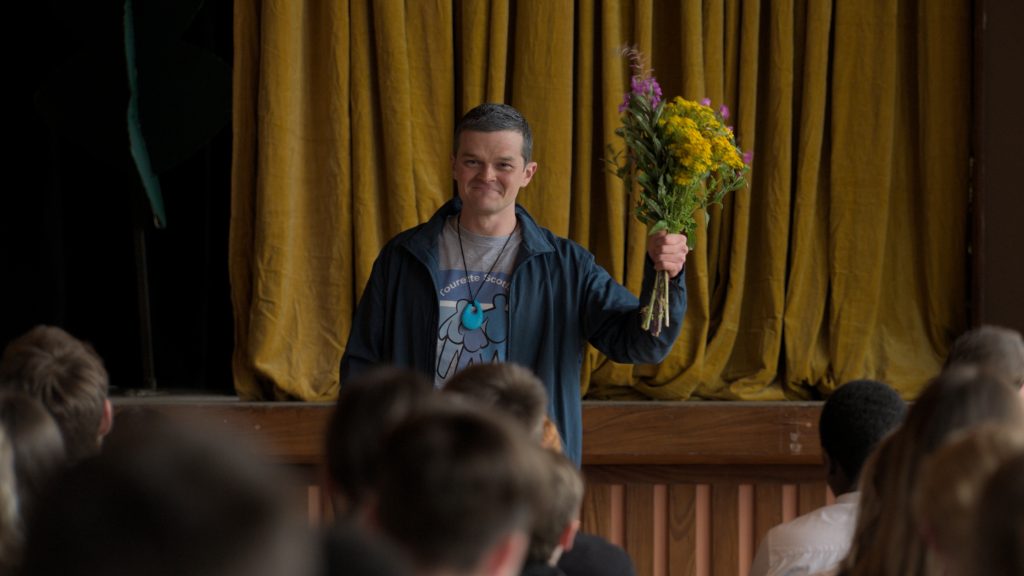
“Aramayo is revelatory as John,” writes Rachel West at That Shelf. “Aside from contending with the physical manifestation of Tourette Syndrome in his performance, Aramayo deftly delivers a full and likeable character. His frustration and exasperated sighs when he can’t control his outbursts are heartbreaking to witness, as is the lack of understanding from his own family. John is more than his Tourette’s and together with the script and Aramayo’s performance, viewers are treated to an exceptionally full-rounded human portrait.”
“In the film, John and his mentor strive to learn more about Tourette’s syndrome, just as the audience does,” says Gilbert Seah at Afro Toronto. “But the film does not really paint a true picture of it, but it highlights the intensity and severity of it. Still I Swear is a brave film, promoting awareness with strong performances from the actors playing both John (young and older) and the mentor.”
“His is a fascinating life. But somehow, I Swear, a biopic about him, is disappointing — a formulaic, plodding bit of cinema. The film has some great moments, no question, and a moving third act, but the storytelling can only be described as heartfelt, and we don’t mean that in a good way,” writes Liz Braun at Original Cin. “A spectacular performance from Robert Aramayo as Davidson is very likely the reason I Swear has won so many big awards.”
Lainey Wilson: Keepin’ Country Cool (dir. Amy Scott)
“At best, the doc shows how much hard work goes into becoming well-known as well as a country star,” says Gilbert Seah at Afro Toronto. “Lainey sacrificed and moved to Nashville, living in a trailer with a mentor, Jerry who with Lainey, wrote many of her song. Jerry passed away, sadly, from cancer. Lainey’s had a tough part of her life, but she stuck it out, owing it to both Jerry and to herself to keep moving on.”
Michael (dir. Antoine Fuqua)
“Michael does not venture further into Jackson’s life. It’s an odd mix of fact and fantasy (and prosthetics), and heavy on the fantasy — there were already big cracks in the veneer by the time the Victory tour rolled around, almost a decade before Jackson became a tabloid scandal fixture,” writes Liz Braun at Original Cin. “Anyway, Michael is the sort of movie critics hate and most others feel a guilty pleasure in enjoying. It’s a fan’s dream. Your faith in Antoine Fuqua will not be tested too severely.”
“Colman Domingo is riveting as bad dad Joe, but Long’s Katherine is woefully underwritten,” observes Peter Howell at the Toronto Star. “And the film’s omissions are not merely glaring, they’re revealing. We don’t see Michael’s sister Janet Jackson, his Hollywood confidante Elizabeth Taylor, his 1980s girlfriend Brooke Shields or Paul McCartney. The latter was first a friend and songwriting collaborator, then an enemy after Jackson cannily purchased the Beatles’ song catalogue behind McCartney’s back. That particular betrayal was one of the most audacious power moves in pop history.”
“[I]t does what the music biopic is increasingly designed to do. That is, turn their heroes into Jesus,” admits Jackson Weaver at CBC. “It’s a failing seen in Bob Marley: One Love, Springsteen: Deliver Me From Nowhere, partially defied in Bob Dylan biopic A Complete Unknown but now back in Michael. That in the unfortunately audience-appetizing world of “authorized” biographies, you’re more likely to encounter brand-management than incisive and honest character examinations.”
“Jaafar Jackson plays Michael as an adult trapped in a child-like persona. His voice is soft and doesn’t sound adult at all,” says Marc Glassman at Classical FM. “His eyes mirror the innocence of the voice. When Michael Jackson isn’t switched on as a pop star, the audience sees him revert back to a time when he was very young—almost a baby. The film never explores Jackson’s obsession with children, which has been interpreted sexually, but one can see it as an expression of his solitude and desire to understand what most people have—but he didn’t: a normal childhood.”
“The film is definitely a feel-good piece, especially when there are three Jackson spirited performances of ‘Beat It,’ ‘Thriller,’ and ‘Billie Jean’ all back-to-back in the middle of the film,” notes Gilbert Seah at Afro Toronto. “But this cannot hide what is eventually a basically hollow piece that dodges the real story behind Michael Jackson. The film can basically be described as performances interspersed with family drama between Michael and his father, Jordan.”
Mother Mary (dir. David Lowery)
“Mother Mary won’t be for everyone, but it is atmospheric, gorgeous, and well performed,” says Joe Lipsett at Queer Horror Movies.
Pretty Ugly: The Story of the Lunachicks (dir. Ilya Chaiken)
“The Lunachicks were unique,” says Gilbert Seah at Afro Toronto. “The band did not make much money, but nobody could be them. They carved a name or themselves as a female group that takes no hits. The doc, at its best, achieves the notion. The Lunachicks were not super intelligent or super intriguing, but they managed to create a bond for their followers, often gay, feminine boys or butch girls.”
The Take (dir. Aisha Jamal)
“The result is a film that shifts the way we tend to see Afghanistan,” says Thom Ernst at Original Cin. “Not just a place defined by war, but one with deep, layered histories that rarely make it into the conversation. The Theft isn’t just about stolen objects; it’s about who gets to tell history, and who gets left out of it. Or, as one of the film’s threads suggests, how even the smallest act of resistance can begin with thought.”
A Festival of Festival Coverage: Diving Into Hot Docs!
At POV Magazine, Susan G. Cole offers a backgrounder on Carole Pope and festival opener Antidiva: “UK-born, she grew up in Don Mills and, living with a father who abused her mother, couldn’t wait to get out of there,” writes Cole. “Then, Toronto’s Yorkville became a hippie haven and a place for Pope to escape to. There she met Kevan Staples and they began performing and writing together, later forming full-on bands. They began appearing on stage in bondage trappings and from these beginnings developed their edgy, sexually aggressive stage attitude which they put into full gear in 1973 when they coalesced into the queer-forward band Rough Trade, still with Staples creating the music and Pope the lyrics.”
At the Toronto Star, Peter Howell picks 10 films to see at the festival, including the Toronto-centric The Tower: “You’d have to be in your 50s, at least, to remember how dull Toronto was before the CN Tower became its dominant symbol as both telecom necessity and tourist magnet, reigning for decades as the planet’s tallest free-standing structure…If the film gets a little too rah-rah at times, remember the CN Tower taught us to reach for the stars.”
At POV Magazine, Pat Mullen chats with lead programmer Gabor Pertic about this year’s line-up: “What I love about working in documentary is there’s the programmers, there’s the critics, there’s also the filmmakers who are going to stand on stage and talk to our audiences, and they’re ready. I love those conversations, and these filmmakers are ready to talk. We weren’t necessarily making some agenda. It’s just that this is what’s happening in the world, so let’s have a conversation about it,” says Pertic.
At Original Cin, Jim Slotek chats with Maya Annik Bedward about her premiere Black Zombie: “We went to Haiti, we went to the Dominican Republic, and then we couldn’t return to Haiti once the president was assassinated. Things became very difficult and dangerous to shoot. The country remains in a state of violence with armed gangs and a political vacuum.” The Original Cin team also previews 33 films at this year’s festival.
At Classical FM, Marc Glassman explain this year’s festival: “The festival is divided into showcases for various subjects and styles. My recommendation is to decide which categories of film appeal to you and then make your decision. Among the Hot Docs subjects are: Artscapes (creativity and artistic pursuits), Persister (Women speaking up), Made in Brazil and Digital Witness (about technology and the human spirit). There are also surveys—like the Canadian Spectrum and World Showcase, where one can assume that the festival’s programmers chose films that most of us will like.”