Reviews include Onslaught, Mayday, and Hope.
TFCA Friday: Movie Reviews for August 14
August 14, 2026
Welcome to the TFCA weekly, a round-up of reviews and coverage by members of the Toronto Film Critics Association.
In Release this Week
American Doctor (dir. Poh Si Teng)
“Despite the pressing issues examined in the doc, it runs out of steam quite quickly, especially in the middle,” admits Gilbert Seah at Afro Toronto. “The pacing is likely the culprit, as so much good information is presented at the beginning, so that there is not much more surprise to show after a while. Still, getting the doctors to tell their story firsthand is better than reading the news firsthand. The doc does surprises at the end, delivering a punch. The doc also emphasizes that most of the news heard around the world is censored news and news that Israel wants the world to hear, and not what really happens.”
“While American Doctor demands that audiences bear witness to these atrocities, it weaves back and forth between the frenzied action in the hospitals and the frustrating on-camera sessions with western media. But while the doctors understand the limited effect that their words may have on the violence they face daily, they make the most of their platform to sway public opinion back home. The film observes the slow progress of public perception on the genocide,” writes Pat Mullen at POV Magazine, who gets some words with director Poh Si Teng: “People are not afraid. We can see it for what it is, what’s going in Gaza,” says Teng.
“Watching American Doctor, running a fast-paced 93-minutes, is a vertiginous experience, not only for the images of wounded bodies onscreen, but because of its fractured timeline. The film includes two different visits for the doctors into Gaza,” observes Liam Lacey at Original Cin. “In the hospital, we see the American doctors interacting with their Palestinian colleagues. An anesthetist describes how his own daughter died while he was unable leave the emergency ward. We see scenes of unconscious toddlers carried on parents’ shoulders or surrounded by a medical team on the operating table. There are drone shots of acres of buildings reduced to grey rubble across Gaza, contrasted with the gleaming towers of Chicago or Washington.”
A Child of My Own (dir. Maite Alberdi)
“A Child of My Own is an intense watch with events occurring at a solid pace, with rarely a dull moment,” says Gilbert Seah at Afro Toronto. “Director Alberdi also shows the pressures women face, in society’s acceptance that every mother should bear the family children. In this case, problems and disasters result.”
The End of Oak Street (dir. David Robert Mitchell)
“[W]hile Oak Street is at times genuinely fun and somewhat original, there seems to be something missing from what’s been widely crowned as the summer blockbuster we’ve all been waiting for,” observes Jackson Weaver at CBC. “Instead, it’s more a going-through-the-motions type film that seems very aware of how classic Spielberg films looked and felt — but isn’t necessarily aware of the artistic intent behind them. It’s the exact type of movie you’d expect to find at the centre of a controversy involving an AI-version of the family’s dog being used to advertise the film on a fake podcast. An interpretation of Jurassic Park that begins and ends by looking up through brachiosaurus legs — but features none of the hubris of man, critique of capitalism stuff. A fascination with the kids-on-bikes-solving-mysteries aesthetics of E.T. — but without any awareness of the anti-xenophobia, government paranoia theme it all rests on.”
“The End of Oak Street delivers a love letter to 80s cinema, with an undeniable mean streak. The first half-hour plays out like Poltergeist, with an all-American family basking in the warm glow of the American dream, unaware of the everyone-for-themselves nightmare descending upon them,” says Victor Stiff at That Shelf. “Charming performances across the board invite the audience to root for the Platts long before the first dinosaur shows its ferocious mug. Once the story steps into horror-sci-fi territory, the film delivers nonstop edge-of-your-seat menace. The best part is that Mitchell isn’t afraid to make his audience squirm — he’s the It Follows filmmaker after all. Much like The Temple of Doom or Gremlins, the film delivers a sweet PG-13 atmosphere that quickly sours into scares capable of inflicting emotional scarring on younger viewers.”
“Anne Hathaway’s aspiring novelist Denise finds a rifle and her inner Annie Oakley while McGregor’s whisky-swigging Greg swings both bat and sledgehammer with conviction. Maisy Stella and Christian Covery play the teens, Audrey and Brian, whose bad decisions further the logic-free plot, which, as an IMAX ride, is easy (and often enjoyable) to go along with as big and gnashing summer escapism,” notes Toronto Star critic Peter Howell’s Night Vision. “What’s disappointing, though, is the contrast of its most genre-twisting, Spielberg-subverting sequences and its too-tidy ending. It lands as if Mitchell, after the confusing chin-scratcher that was Under the Silver Lake, was reined in considerably for a big commercial comeback.”
“Mitchell’s film revels in one intensely engrossing sequence after another, his sharp lens taking hold of the audience with Hitchcockian command as he cements himself a masterful orchestrator of suspense and set-piece construction,” says Prabhjot Bains at Range. “He seamlessly navigates from tense, spine-tingling lows to exuberant, crowd-pleasing highs, punctuated by grave, out-of-left-field twists that make anything feel possible—even the death of a principal character. Sumptuous split-diopters, creeping tracking zooms, slick overheads, and impeccably choreographed unbroken takes create an immersive visual experience that feels like Steven Spielberg by way of Brian De Palma. It’s a rich, rewarding endeavour at every scale, attentive to the tiniest details—a knife in colossal python clattering against a window, for instance—as much as its most expansive displays of spectacle.”
At Queer Horror Movies, Joe Lipsett calls it, “Silly, entertaining and disposable. The perfect late summer blockbuster.”
“The audience’s anticipation is what makes the film work. One immediately realizes, as the filmgoer, the absence of cell phones and other modern gadgets. The year 1982 is not mentioned till the last quarter of the film,” says Gilbert Seah at Afro Toronto. “But the 1982 song ‘Valerie’ by Steve Winwood, heard early in the film, a song released in 1982, gives audiences a first clue. Director Mitchell is daring enough to blend horror and gore (a dinosaur chomping off half a victim’s leg) with comedy (dinosaurs mating) with good effect. The plot twist also works well and is placed at optimal points in the story.”
“This movie is Jurassic Park unleashed,” adds Sarah Gopaul at Imagery at the Movies. “Something transports everyone within a two-mile radius to the dinosaurs’ natural habitat. As a result, the reptiles aren’t doing the adapting — they’re just discovering another food source. On the other hand, everything people once relied on is now obsolete or useless. Even their guns have little effect on most of the creatures. Unfortunately, not all the suburbanites’ survival instincts kick in. As a result, the family looks out their windows to see the intuitionless running around, only for dinosaurs to chase them down and eat them.”
Green Valley (dir. Morgan Tams; Aug. 15)
“Filmmaker Morgan Tams adopts the naturalistic style of the farmers’ work ethic as he chronicles their labours over two years. Although the homesteaders work at a much different pace than urban dwellers, it’s not a life of leisure to be found in the Green Valley,” says Pat Mullen at POV Magazine. “As Henry and his younger co-habitants, including couples Max and Heidi and Sam and Anne, and their two kids, share while Tams observes their daily duties, living off-grid requires a radically new approach. Life and work are one and the same. A homesteader easily puts in as many or more hours per week than a Bay Street workaholic. Regardless of one’s lifestyle choices, though, Green Valley offers a thoughtful consideration of sustainability with this handsome, unhurried observation of off-grid life.”
Hellcat (dir. Brock Bodell)
“The main problem of this film is to keep the audience interested,” writes Gilbert Seah at Afro Toronto. “But there is little to go on. Left with too many unanswered questions, even at the 30-minute mark when the audience is still clueless, one’s patience is much tested.”
Nimrods (dir. Lee Kirk)
“Nimrods is not a remarkable addition to any genre, but the music enhances the story and keeps audiences head-banging along,” says Sarah Gopaul at That Shelf. “In fact, the trio’s infectious energy and the familiar track list ensure there’s never a dull moment. Early 1990s skater punk culture also drives the picture’s aesthetic, from the casual and comfortable wardrobe to the positive vibes at grungy field concerts. And even though viewers know the road trip will end in disappointment, it’s an entertaining coming-of-age journey.”
The Rivals of Amziah King (dir. Andrew Patterson)
“There are inherent problems with director Patterson’s storytelling, causing the film to be not only difficult to follow but also leaving the audience with unanswered questions,” notes Gilbert Seah at Afro Toronto. “Crucial to the story is the unexplained disappearance of Amziah’s character halfway through the film. Did Amziah die? The Amziah character is also seen at the start of the film to be a beekeeper and honey producer; a respected member of the local community; the leader of a loose-knit bluegrass band with Amish singing and stamping his foot; and a surrogate father figure to people around him. But no effort is made to link the 4 characters together. Each personality is seen separately and distinct.”
“The Rivals of Amziah King marks a welcome return for Matthew McConaughey, who stars as the titular man with a band of nefarious outlaws on his tail,” writes Pat Mullen at That Shelf. “It’s a great performance with McConaughey’s sun-baked folk hero providing one of his better turns in recent memory, especially as he belts a tune remarkably well, all while keeping a Southern boy’s manners in check with Amziah’s lick of rapscallion charm. But Amziah King is not your typical cowboy. He’s a beekeeper and musician, a man who enjoys harmony with the land by day and strums songs of love and brotherhood by night. His story packs an unexpected sting while proving that fresh voices in American independent film are alive and well.”
“The first half of the movie is lively and heartfelt, focusing on love, community and music. Bringing Kateri back into the fold and making her feel at home again becomes Amziah’s top priority,” says Sarah Gopaul at Imagery at the Movies. “It’s obvious Kateri sees Amziah as a safe place, which is a feeling he instils in many people. When he teaches her the wordless part of a song so she can sing along, viewers swept up in the camaraderie will want to join in to be a part of the beautiful, carefree moment. Music is their life blood and it’s incredibly uplifting, whether they’re playing a gig or a spontaneous jam session.”
“Held in staggering contrast to McConaughey’s King though is LookingGlass’ Kateri. As one of King’s former foster children, her story is one that carries deeply rooted hurt. (Not towards Amziah, of course, but towards the systems and situations that have made her who she is.) As Kateri, LookingGlass brings focus and fire to her role. Determined to honour King, her actions throughout the film aren’t always agreeable but she ensures that they have purpose,” says Steve Norton at ScreenFish. “In some ways, she’s the anti-Amziah. But, somehow, she maintains King’s value of humanity (sort of).”
Sex and Death at Camp Miasma (dir. Jane Schoenbrun)
Calling the film “as funny as it is bloody,” Peter Howell speaks with Jane Schoenbrun at the Toronto Star and learns how Miasma is their first “post-transition” film: “It’s like a medication and all of the bad side effects come first. You have to wait a bit for the good to kick in. This movie comes from a place of the good having kicked in,” Schoenbrun tells Howell. “It’s a movie about the strange and beautiful and tender process of, for the first time in your life, in your 30s, experiencing what most people do in their teen years, which is (growing) into a body and a sexuality … it’s also about undoing a lot of the trauma of just not being right in those ways.”
“Schoenbrun’s film mainly deals with desire—the fear of it and its ultimate embrace,” adds Marc Glassman at Classical FM. “That’s true of the classic horror films of the Eighties and Nineties, Halloween and Friday the 13th being the prime examples. Here, Schoenbrun dramatizes the hidden dimensions of the genre, giving audiences the chance to enjoy the cheap thrills while contemplating its true meaning. Lovers of French will enjoy Schoenbrun’s ‘explanation’ of the hidden joys of slasher films. Williams is meant to have made her reputation with a film called ‘jouissance,’ which is French philosopher and psychologist Jacques Lacan’s term for physical and moral pleasure. And the killer in the Camp Miasma film is Little Death, which in French is “la petite mort”—orgasm.”
To the Max aka La Fiera (dir. Salvador Calvo)
“Director Salvador Calvo brings a strong visual sense to the material,” writes Gilbert Seah at Afro Toronto. “The excitement of the sport comes through in the film, coupled with the bond of friendship among the participants. The real question of the reason behind these people being so interested in extreme sports is only slightly touched. Perhaps they are lunatics seeking attention.”
Tony (dir. Matt Johnson)
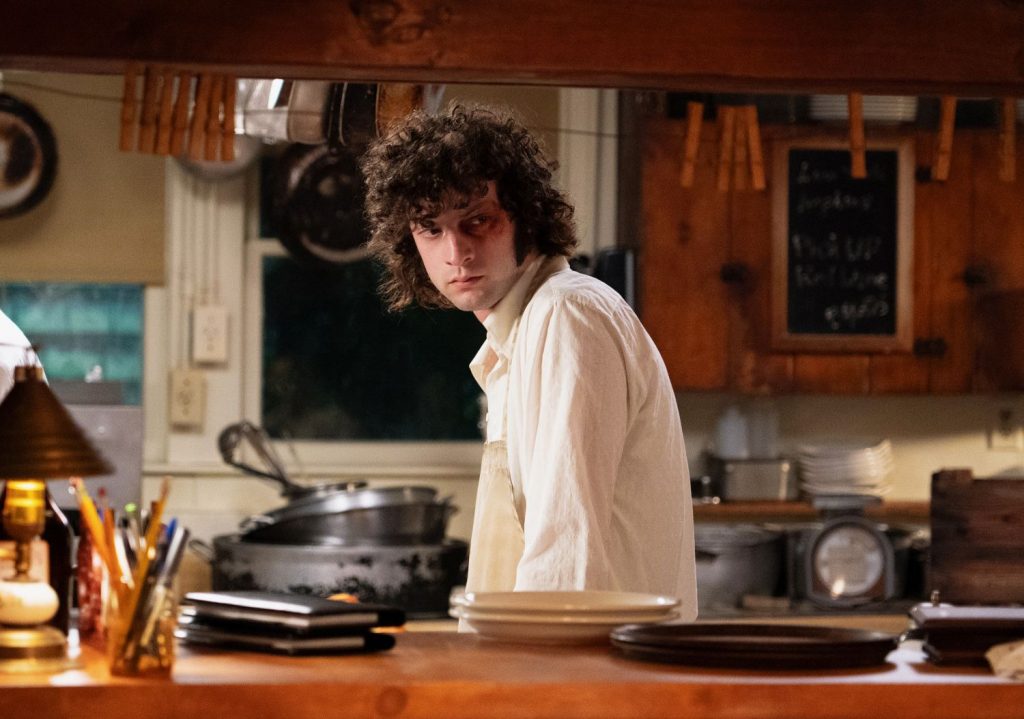
“The result is a propulsive, no-moment-wasted storyline, as Tony runs away from his milquetoast parents and never stops. One thing leads to another so effortlessly that to remove even one page from the screenplay (co-written by Johnson) would be like skipping a course during a prix fixe; you’d be hungry for more,” says Chris Knight at the National Post. “Of course, much of it is made up, either by Johnson and company directly, or by Bourdain, whose wildly popular writings about the greasy underbelly of gastronomy were true to the spirit if not to the letter of his life.”
“Bourdain’s struggle to define himself taps into this filmmaker’s thematic obsessions. Johnson is drawn to certain personas: people reckoning with the vast spaces between who they are and who they strive to be,” says Victor Stiff at Exclaim!, who speaks with Matt Johnson about bringing the chef’s story to screen. “There’s so much hazing. There’s so much teasing and really pushing new people as far as you can, in a way of testing to see if they’re trustworthy, to see if they can hang with you, to see if they’re going to break when things get difficult,” Johnson says.
“Miraculously, as if to the manner born, he pulled it off with easy-going grace, re-shaping Bourdain’s origin story into a charming, feel-good summer treat that opened last week in the U.S. to a solid consensus of positive reviews,” writes Brian D. Johnson at Zoomer. “The key to Tony‘s success, and its very existence, was the casting of 23-year-old American actor Dominic Sessa, who fulfills the promise of his breakout role as a boarding-school brat in The Holdovers (2023) with a star-making performance as the young Bourdain. It was Sessa who inspired Matt to make the movie after the director initially turned down the project.”
“In Johnson’s hands, the young Bourdain’s story is a quite fun, funny and ultimately touching watch,” admits Jim Slotek at Original Cin. “It’s also about 50% BS, which shouldn’t surprise anybody because it’s a movie, not a documentary. But we live in a time when a summer box office champ has Greek gods and monsters and is criticized for not being historically accurate. So, it’ll be sacrilege to some that a young Bourdain is seen cutting his hand while learning how to shuck an oyster – when the real Bourdain was taught how to shuck them as a child by his uncle in France.”
“Tony is a lovely late summer film. It won’t attract the audience of The Odyssey or the new Spiderman movie, but it deserves to be a hit,” says Marc Glasman at Classical FM. “If you go on dates, this is a charmer for you and your partner. It will deservedly aid the careers of Matt Johnson and Dominic Sessa, two quirky talents whose films will be worth tracking in the future.”
The Wrong Girls (dir. Dylan Meyer)
“The problem falls squarely on the script. The film, written and directed by Dylan Meyer, is a muddled, jumbled story that keeps undermining itself. It’s not that the film doesn’t have funny ideas or moments that are funny — in fact, it’s overstuffed with interesting ideas — it’s just that most of them don’t land,” admits Karen Gordon at Original Cin. “Dumb comedies are so much fun when they work, and the elements of what make them work are present here: the film is good natured, but the overcomplicated plot is too much and just not funny enough. The Wrong Girls is proof that films that may look like they were casually put together aren’t so easy to pull off.”
“The film is a classic example of taking too much on one’s own plate,” agrees Gilbert Seah at Afro Toronto. “Taking on various issues like the female best friend relationship, crime and chase by drug gangsters from switched suitcases, stoner comedy, and hallucinatory effects of new drugs, most of the humour falls flat and consists of loud screaming (as when the two girls question the validity of their relationship. The much simpler stoner comedy, Gregg Araki’s Smiley Face has a simpler premise with Anna Farris in the title that works. The Wrong Girls does not work.”