
Reviews include Onslaught, Mayday, and Hope.
TFCA Friday: Movie Reviews for August 28
August 28, 2026
Welcome to the TFCA weekly, a round-up of reviews and coverage by members of the Toronto Film Critics Association.
In Release this Week
Buddy (dir. Casper Kelly)
“Though not without flaws, Buddy’s plusses far outweigh them, including being a compelling watch from start to end, with its smart, funny, and creepily scary satire that unfolds in episodes, just like a children’s show on a Saturday morning,” says Gilbert Seah at Afro Toronto. “Buddy is this year’s best fucked up movie comparable to last year’s Weapons.”
Coyote vs. Acme (dir. Dave Green)
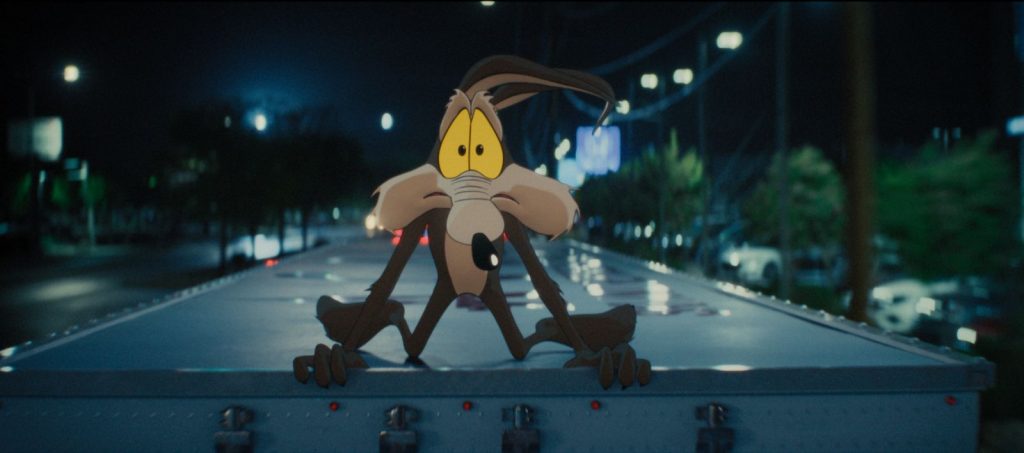
“Coyote vs. Acme makes its case for existence with a riotous plot about hapless Road Runner chaser Wile E. Coyote. With assistance from his earnest lawyer, Kevin Avery (Will Forte), he’s suing Acme Corp. after suffering decades of pain from its defective rockets, anvils and other tools that have repeatedly backfired in his pursuit of the speedy bird,” writes Peter Howell at the Toronto Star. “The film is a satirical missile aimed at corporate greed and corruption, especially apt targets these days, given WBD’s own well-publicized boardroom battle: Netflix sought to acquire WBD’s studios and streaming operations but not its linear-TV networks; Paramount Skydance, by contrast, won with a bid for the entire company and all of its assets.”
“I’m sorry to say but it landed on me like a boulder, squishing my body into a wheezy accordion. I waited a lifetime for this? What a maroon! It’s earnest, hopeful, and ambitious. But it’s a misfire on par with Acme’s rocket-powered roller skates,” admits Chris Knight at the National Post. “Director Dave Green and writer Samy Burch (who has another film in theatres, the excellent Late Fame with Willem Dafoe) should have focused more on cartoon antics and inanity, and less on courtroom capers. As funny as it is to watch Luis Guzman as a judge banging a squeaky gavel, it can’t hold a candle to the sort of physics-defying comedy of a classic Road Runner cartoon.”
“It’s an adorable, light hybrid comedy — seamlessly mixing live action and animation— with a goofy premise, and themes of corporate corruption and betrayal, and friendship and courage,” adds Karen Gordon at Original Cin. “As per the cartoon, Wile E. Coyote doesn’t speak and communicates directly by holding up signs…But he also uses his physicality. The animators clearly had fun conveying his emotions, with facial expressions, physical posture and his ears! Coyote may be a wild creature, but he’s also wildly creative. He’s a master of inventing Rube Goldberg machines, which he continues to create in his hotel room, and uses in high level legal meetings.”
“The premise is a neat concept, but it is still only one joke extended throughout the movie,” says Gilbert Seah at Afro Toronto. “The humour’s quite cartoonish, with the live subjects having to share the same scenes with the cartoon characters. The special effects and animation are nothing short of stunning, though they lack humour. There is too much effort put into creating a joke, and the hit-and-miss ratio for this film is quite high.”
“The magic in the film is the seamless transitions between animation and live action, which was mainly handled by the company DNEG (Double Negative). Working with Green and the rest of his crew, we watch as Coyote interacts with his Avery lawyers in a fashion that almost seems credible,” says Marc Glassman at Classical FM. “It allows us to focus—to some extent—on the plot which attacks Acme and its arrogant, if charming, leader Foghorn Leghorn. If making Leghorn a potential villain isn’t delicious enough, the filmmakers have cast Elmer Fudd as an ineffectual verbose Senator—a perfect role for one of Warner Bros. finest characters actors (admittedly in the cartoon category). Also, well cast is a cartoon Peter Lorre as a mysterious scientist—an ingenious addition to the film’s main characters.”
“Nonetheless, there are so many Easter eggs and cameos designed for Looney Tunes fans, it’s impossible to catch them all in a single viewing,” says Sarah Gopaul at Imagery at the Movies. “There’s even a secret invention that is a fitting acknowledgement of a problematic personality, while keeping within the light-hearted spirit of the movie. In addition, it never seemed like anyone ever commiserated with Wile E. and his many catastrophes, regardless of his resilience. But this film is his ultimate redemption as many people try and fail to catch the Roadrunner, proving trapping him is as difficult as it’s always looked.”
The Dog Stars (dir. Ridley Scott)
“Thematically it says some important things about the darker elements of human nature but the script kept it a little too obscure simply making the film’s ‘antagonist’ these faceless roaming hoards for most of the movie, until the final act of the film where it feels the true face of the worst parts of human nature is comedically borrowed from a film that was worked on by Terry Gilliam and Eli Roth in a very gloomy pairing for what this worlds truly dystopian vision is supposed to look like,” says Dave Voigt at In the Seats.
“When it comes to the Ridley Scott-directed adaptation, it is more about a Jacob Elordi-shaped cardboard cutout version of Hig, stoically bearing the world on his shoulders with a sideways smile. Carrying the flame of humanity all on his own, in whichever hand isn’t already tightened around a hammer, wrench or plane yoke to yet again save someone else’s day,” writes Jackson Weaver at CBC. “It’s about a 20-something-year-old, virile Everyman upon whose shoulder we sit, to be ferried from gun battle to maudlin monologue and back again. About the after-school-special style of hope in the face of horror…In essence, it’s about the same thing as every other, more successful post-apocalypse films you’ve seen, but this time without the guts or energy to make it believably harrowing.”
“Director Scott inserts some quirky sequences as well,” notes Gilbert Seah at Afro Toronto. “When Hig, together with Pops (Guy Pearce) and Cina (Margaret Qualley) enter the Grand Junction, they enter a new world they never expected. The Grand Junction is the physical manifestation of Hig’s hope that he’s not the last person left who still wants to live rather than merely survive.”
“While The Dog Stars competently creates the atmosphere and setting, it often finds itself caught in a struggle between cliché and originality,” says Pat Mullen at That Shelf. “The ‘others’ that threaten Hig and his fellow survivors play a bit too uncomfortably into old cowboys and Indians tropes as nameless ruffians ride in from the hills hooting and hollering whilst adorned with war paint and tattoos. Alternatively, a late-act touchdown in a surreal oasis of ‘civilization’ completely surprises—in large part thanks to a truly deliciously over-the-top, if borderline strange, turn by Allison Janney. Her jovial stewardess evokes that all-too-familiar creepiness and malice that hides behind a smile.”
Finding Emily (dir. Alicia MacDonald)
“As directed by Alicia MacDonald, and propped up mightily by its leading man’s nice-guy energy, Finding Emily has great fun letting Owen continue his quixotic quest with Emily Raine as his Sancho Panza,” says Chris Knight at Original Cin. “Owen’s earnest attempts earn him the ire of the rest of the school’s Emilys, and the film is self-conscious enough to note that ‘gotta go here’s my (wrong) number’ is a technique women use to ditch creeps, while also making it clear that ‘our’ Owen is pure of heart. It’s basically a two-hander, but there are some nice supporting roles including Minnie Driver as the mom (I mean the dean; same diff!), Prasanna Puwanarajah as Emily’s morose professor, and Nadia Parkes as a student podcaster who sees Owen’s story as her ticket to fame — and the worse it looks, the further she can travel on it.”
“Much more happens in this fast-paced comedy that features a lot of Manchester pub music and witty banter,” says Marc Glassman at Classical FM. “Suffice it to say that the ambiance of the film is exemplary—meaning, it’s fun to watch if you like British youths at play. The first Emily shows up—and it turns out that she’s named Amelie, so she never received Owen’s email. And she’s no match for Emily Raine. There’s a great deal of byplay with a campus TV show which serves as a forum for the Emilys while giving one a sense of a lively university life.”
The Last Salute (dir. Kushal Srivastava)
“The documentary uses interviews with pilots from different generations to tell that story, including current and former senior Air Force officers,” writes Gilbert Seah at Afro Toronto. “This is where the documentary becomes much more personal, especially when the pilots repeatedly describe the feeling of flying the MiG-21.”
The Salt Path (dir. Marianne Elliott)
“It’s a bit of a redemption story, a tale about love, the reinvention of self, and the indomitable human spirit. Sadly, it doesn’t work. The storytelling in The Salt Path is dodgy and disjointed, with a confusing first half hour that flashes back and forth in time but never establishes exactly why these people are hiking or why we should root for them,” admits Liz Braun at Original Cin. “An hour in, this viewer still didn’t know enough about Mr. and Mrs. Winn to care about their fate, although the pleasure of watching Anderson and Isaacs put in terrific performances is not thereby diminished.”
“The film is shot across some of the most stunning coastal landscapes in England (from Somerset to Dorset),” adds Gilbert Seah at Afro Toronto. “Mother Nature serves as a third central character in the film, and not always in a good way. Besides the beauty that is seen on screen, there are the tough storms, unpredictable tides, and wind that wreak havoc on the couple’s journey. The ever-changing weather and majestic natural beauty of the English coast play an integral role in Ray and Moth’s journey, testing them with both difficult and beautiful experiences while providing a space for reflection, connection, and acceptance.”
The Secret Woman (dir. Den Hemmelige Kvinde)
“Claes Bang, the Nordic scenery, and the solid mystery make this Danis Netflix film a pleasure to watch,” says Gilbert Seah at Afro Toronto.
The Whisper Man (dir. James Ashcroft)
“The film is well-paced and intriguing for the investigation operating on two levels: The present: Find Jake before it is too late,” explains Gilbert Seah at Afro Toronto. “The past: Determine whether the original Whisper Man—or someone connected to him—is responsible for the new crimes.”
A Festival of Festival Coverage: Top Picks for TIFF!
At That Shelf, Pat Mullen, Rachel West, Sarah Gopaul, and Jason Gorber join local writers to pick their most anticipated films at this year’s festival. For Mullen, it’s Elsinore (“Is Andrew Scott the man of the hour this year?”). For West, it’s Wild Horse Nine (“A new dark comedy from Martin McDonagh is what we both need and deserve”). For Gopaul, it’s Drifter (“Follows a custodian [Kang] who has a chance to fulfill his dream of competing in a pro drifting event”). And for Gorber, it’s The Stunt Driver (“As much a patriotic obligation as it promises to be a thrilling ride”).