

The critics were busy at this year’s Toronto International Film Festival! From our annual pre-festival party, this year held at Hotel Le Germain Toronto Mercer and generously sponsored by Redbreast Whiskey, to scurrying from screening to screening, our members can attest that TIFF was in full swing. This year again held an abundance of riches, […]
TFCA Friday: Movie Reviews for June 5
June 5, 2026
Welcome to the TFCA weekly, a round-up of reviews and coverage by members of the Toronto Film Critics Association.
In Release this Week!
Affection (dir. B.T. Meza; June 9)
“Affection is eventually betrayed by its own internal logic that at times seems inconsistent and difficult to follow, at least by me,” says Thom Ernst at Original Cin. “Ultimately, this is Affection‘s greatest frustration. Beneath its science-fiction detours, horror influences, and increasingly elaborate mythology lies a far more compelling story about grief, control, the scars left by abuse, and the complicated obligations we owe the people we love. The mystery grows larger as the film progresses, but the emotional core grows smaller.”
Carolina Caroline (dir. Adam Carter Rehmeier)
“A romantic bank-robbing film featuring a pair of dynamite lead performances,” notes Joe Lipsett at Queer Horror Movies. “The film works as well as it does in large part because of Gallner and Weaving’s respective performances. The pair have great onscreen chemistry and manage to elevate their slightly shallow characterizations above stereotypes.”
“Things work thrillingly well until, of course, they don’t though the story makes room for themes of agency and independence even if one is left questioning why Caroline bought into this unambiguously unlawful lifestyle so quickly, and how Oliver got there in the first place,” writes Kim Hughes at Original Cin. “In the end, writer-director Adam Carter Rehmeier’s Carolina Caroline — the odd title a play on the protagonist’s name and the state that magnetically draws her toward it — succeeds in blending the buoyancy of a road movie with the urgency of a crime caper, propelled by a pair of attractive bandits having a blast, at least initially.”
“The first half is extremely slow and boring to sit through, especially when the two characters are slowly introduced to audiences in the film. The film picks up in the second half,” adds Gilbert Seah at Afro Toronto. “There are flaws in the film, such as the total absence of Oliver’s background. Oliver is initially shown as a conscious good guy who cares for the innocent person, but in the second half of the film, he goes on to kill innocent people who stand in his way.”
The Marked Woman (dir. Gabe Ibáñez)
“The film blends both the solving of a crime and a crime mystery,” says Gilbert Seah at Afro Toronto. “Things do get a bit confusing, especially at the beginning of the film, when one wonders what the beginning airport scene has to do with the woman found in the containment. Also, the women all look the same; it takes time to figure out who is who. Other than that, the film also works like an European noir film with international intrigue.”
Masters of the Universe (dir. Travis Knight)
“He-Man wasn’t born out of a labour of love, but children around the world still grew to love him. So how does a filmmaker faithfully adapt a Masters of the Universe IP that never took itself seriously in the first place? The film’s director Travis Knight has the answer: you pull an 8 Mile,” writes Victor Stiff at That Shelf. “Knight’s Masters of the Universe reboot plays like a live-action version of the original series. It’s colourful, wacky, ridiculous, and unabashedly off the rails. The trick here is that Knight treats these qualities as a feature of He-Man, not a bug. By acknowledging all the juvenile names and arcane lore, the film accepts the baked-in silliness, while still treating the source material with reverence.”
“Realizing the origin of the character, the filmmakers have therefore opted for a friendlier, more comical flair,” notes Gilbert Seah at Afro Toronto. “There is a certain goofiness in the film, which provides humour for the family despite some really nasty adult humour, like a character called Fisto (Jóhannes Haukur Jóhannesson), so-called because he fists people, and He-Man has a dangling sword. The childishness might be a put-off for adult audiences, but one must understand the target audience for this movie, and with this respect, the film succeeds.”
Mexico 86 (dir. Gabriel Ripstein)
“Director Ripstein’s film benefits from being timely with the FIFA World Cup just weeks away, and also a timely controversy on FIFA, with this political satire showing the business and occasional crooked part of the sport. Diego Luna delivers a nuanced performance of an all-too-eager-to-succeed, at all costs personality similar to the character in Marty Supreme,” writes Gilbert Seah at Afro Toronto.
The Murder of Rachel Nickell (dir. Lucy Bowden)
“There is more to the plot that will not be revealed, safe to say that there is much more to this true crime drama. Director Bowden keeps her film well-paced and intriguing throughout, in what is a solid mystery, with details how the police go about doing their work diligently to find the killer,” says Gilbert Seah at Afro Toronto.
Poldi (dir. Nicolas Berse-Gilles, Simone Schillinger and Kai Sehr)
“The film can be praised for presenting a more personal portrait of football legend Lukas Podolski rather than a conventional sports documentary. Instead of focusing heavily on goals, trophies, and statistics, the documentary explores his family life, Polish-German identity, business ventures, and uncertainty about retirement,” observes Gilbert Seah at Afro Toronto. “He retires at the age of 40, when this doc begins. The film benefits too from Podolski’s good looks and natural charisma.”
Power Ballad (dir. John Carney)
“It says something about our times that a filmmaker known for light, heartwarming stories about plucky underdog musicians, love and the search for happiness would be considered something of a unicorn,” notes Jim Slotek at Original Cin. “That this would existentially torture someone is not exactly a revelation. But it’s a perfect turn for Rudd, who oozes good intentions and good-natured bro-hood in everything he does (who else could have starred in a movie called I Love You, Man?). But even saints have a breaking point, and that’s the task at hand for Rudd in Power Ballad, playing with the possibility that, awash in existential bitterness, he could lose his family, friends and everything else he’d loved and had taken for granted.”
“The film ultimately lingers on whether a song belongs to its creator, its performer, or the people who give it meaning,” adds Rachel West at That Shelf. “The whole of Power Ballad hinges on ‘How to Write a Song (Without You)’ actually being a good song. Written by Carney and Gary Clark, it’s a pretty, polished ballad with a sincere, soaring chorus that you could easily imagine being a nostalgia-hued Top 40 hit for a band like Matchbox Twenty or Snow Patrol. Essentially, it sounds like something a middle-aged man with a popular early-2000s rock band might release in 2026, not a No. 1 hit for a 20-something solo artist.”
“This is a story that covers several issues, the main one being a famous artist being sued or questioned in this case by someone who claims to have written the song,” writes Gilbert Seah at Afro Toronto. “The rest of the film follows Rick’s struggle to reclaim recognition for his work. What begins as a story of revenge gradually becomes a more nuanced examination of artistic ownership, friendship, ambition, and what success really means. At best, the film cleverly explores how both men are trapped by their own insecurities and desires for validation.”
“Like the best power ballads, the film soars by unabashedly tapping a sentimental sweet spot,” notes Pat Mullen at That Shelf, who chats with Paul Rudd and company about making great music. “Rick, he’s kind of discovering things along as the story progresses and really coming to a place of understanding where he was when he wrote it, what it was about,” says Rudd. “What he really does learn [is] about music being for the people listening to it and what it can mean for them. All of these things that he realizes along the way make me look at those lyrics a little differently. And so the song has, I think, a little bit more emotional resonance when I look at it through Rick at the end of the movie versus Rick at the beginning of the movie.”
Scary Movie (dir. Michael Tiddes)
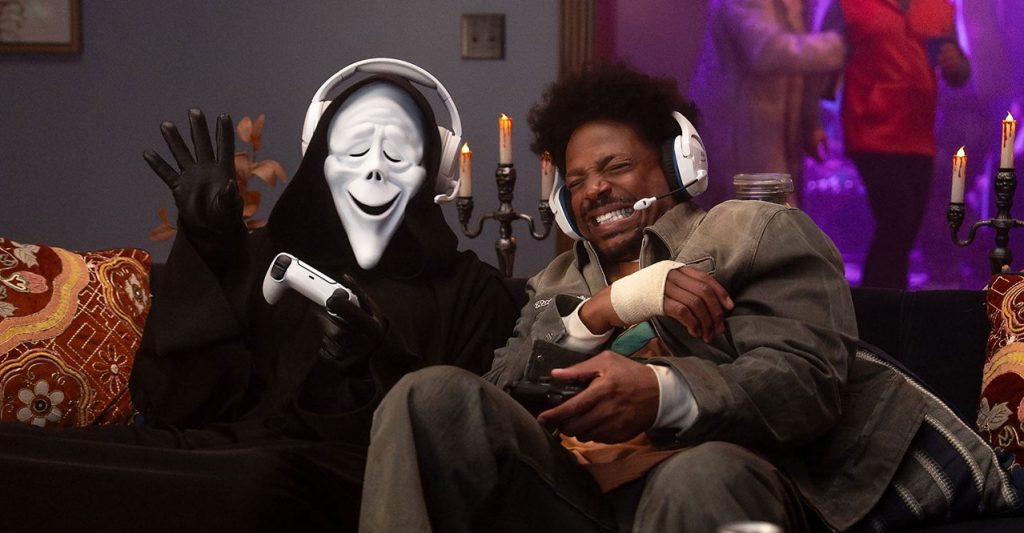
“Anna Faris leans back into Cindy Campbell hard here actually going more Jamie Lee than Neve but it works, while Marlon Wayans, Regina Hall, Shawn Wayans, Cheri Oteri, Lochlyn Munro and many others take great pleasure in reminding these young whipper snapper audiences looking for fresh faces on their screens, are in for a surprise,” writes Dave Voigt at In the Seats. “Don’t mess around with the people that actually made this shit funny in the first place.”
“Such quibbles might not matter if the laughs were stronger. The plot is the usual dog’s brunch, stitched together to showcase stoner Shorty, confused Ray, jittery Cindy and take-no-prisoners Brenda, now joined by an assortment of thinly sketched newcomers along with some welcome oldtimers,” says Toronto Star critic Peter Howell at Night Vision. “What’s more surprising is how hard the film strains to provoke. Jokes aimed at #MeToo, DEI, wokeness and other cultural flashpoints feel less like boundary-pushing and more like box-checking, begging the audience to react. It’s occasionally amusing but more often forced.”
“It’s the same sex and drug jokes as the original,” agrees Joe Lipsett at Queer Horror Movies. “There are the obligatory mentions/jokes about #MeToo, Black Lives Matters, the Epstein files, and the COVID pandemic, among many others. Sadly these, as well as parodies of films like the aforementioned Halloween reboot, Ma, Get Out, The Substance and Sinners, all tend to land with a bit of a thud.”
“The plot is mostly a framework for gags rather than a coherent mystery. Not every parody lands well, and the humour can be extremely hit-or-miss depending on the viewer’s taste,” echoes Gilbert Seah at Afro Toronto. “But as they say, a good laugh-out-loud joke covers a dozen flaws, and SCARY MOVIE has quite a few of these moments.”
Wetiko (dir. Kerry Mondragon; June 9)
“As the film progresses through its first 30 minutes, which is the film’s best third, before it transcends into the typical horror film of a person trying to escape some cult, with supernatural forces at hand. The film is based on a true story, as the words indicate at the start of the film,” says Gilbert Seah at Afro Toronto.
The Year Before the War (dir. Davis Sivanis Jr.; June 9)
“It should be noted that the narrative can be difficult to follow, especially if one is unfamiliar with the historical figures. As director Sivanis’ film deliberately avoids a conventional plot at the film feels like a dream or hallucination whe[r]e nothing is real, and incidents are deliberately blurred and confusing,” says Gilbert Seah at Afro Toronto.
File Under Miscellaneous
At the Toronto Star, Peter Howell salutes the legacy of Marilyn Monroe on what would have been the star’s 100th birthday: “On screen, Monroe possessed the rare ability to make the camera lean in. Her every glance and every hesitation exposed a character’s longing without ever announcing it. Nevertheless, she struggled for industry respect. She never walked the red carpet at Cannes or received an Oscar nomination, although she did win a Golden Globe for Some Like It Hot,” says Howell. “Monroe was as much the creator of her own mythology as she was captive of it. She was a global sex symbol but also an inveterate reader, with a personal library of more than 400 books. She approached every photo shoot as if she were a film director, and her few minutes in The Asphalt Jungle and All About Eve in 1950 were less bit parts than unabashed auditions for future bigger roles.”
At Original Cin, Liam Lacey previews the Toronto Jewish Film Festival with a look at Dust Bowls and Jewish Souls: Another Side of Woody Guthrie: “Not surprisingly, Guthrie had numerous Jewish connections in the music business, including his manager, Harold Leventhal, and Moses (Moe) Asch of Folkways Records, who recorded many of Guthrie’s songs,” writes Lacey. “And there were his famous Jewish musical acolytes, Robert Zimmerman of Hibbing, Minnesota and Ramblin’ Jack Elliott (a Brooklyn surgeon’s son, born Elliott Charles Adnopoz.) The film does not mention one of his important political mentors, Ed Robbin, a radio host and editor with The People’s World, a Los Angeles communist newspaper.”