
The Toronto Film Critics Association is saddened to learn that Elle-Máijá Tailfeathers has chosen to return her award. We were proud to recognize her work, which was both deserving and meaningful
TFCA Friday: Movie Reviews for Nov. 14
November 14, 2025
Welcome to the TFCA weekly, a round-up of reviews and coverage by members of the Toronto Film Critics Association.
In Release this Week
After All (dir. Kerstin Karlhuber)
In this role, Christensen is called upon to be simultaneously selfish, damaged, vulnerable and capable, a redemption she makes entirely believable throughout — yea, though she often walks through the valley of the shadow of melodrama,” writes Liz Braun at Original Cin. “Mind you, filmmaker Karlhuber has said in an interview that After All is based on real events; it’s interesting, as the story unfolds, how the absence of men seems to improve everything. Just an observation.”
Being Eddie (dir. Angus Wall)
“The doc has Murphy talking to the screen a majority the time talking about his acts and his life,” says Gilbert Seah at Afro Toronto. “This adds to the authenticity of the doc as well has the humour, as Murphy is a very funny guy. An easy-going doc with clips from the comedian’s funny moments that should keep audiences entertained.”
Beyond the Gaze (dir. Jill Campbell)
“Campbell remained steadfast and became in the scheme of things, a cultural leader. She didn’t intend to be,” notes Anne Brodie at What She Said. “Campbell was in her mid-nineties when the documentary was made and tossed off this bon mot: ‘Old age is a HOAX. It’s what you make of it. It is beautiful. I still have fight in me.’ And guess what? This stalwart creator was always lowest paid Sports Illustrated editor all her 32 years. One heck of a yarn. Not to be missed.”
Come See Me in the Good Light (dir. Ryan White)
At POV Magazine, Pat Mullen calls it “the best film of 2025” and says, “The best films that deal with death turn their attention to life and this film is no different. In doing so, it provides refreshing space to experience grief, joy, and heartache, but above all: love.” He also chats with director Ryan White about navigating the film’s nimble sense of humour. “That is a real tight rope act of emotions to be able to walk that fine line,” White says. “That was a lot of experimentation that Bernice was doing with the humour. I think we felt so comfortable with Andrea and Megan, and we’ve been friends with Tig for a long time—she does this in her comedy so brilliantly: taking those dark moments that can also be so funny.”
In Your Dreams (dir. Alex Woo)
“The power lies in the film’s mature handling of the anxiety around separation, teaching kids that differences are normal and that the crucial elements are continued communication and unconditional love — even amidst the messiness,” writes Marriska Fernandes at CBC Arts. She also speaks with star Simu Liu about voicing his character: “He’s such an eternal optimist,” Liu says. “He’s passionate about what he does and the music that he makes, and so he wants to do what he loves.”
Jay Kelly (dir. Noah Baumbach)
“Clooney is at his smoothest in Jay Kelly, but the best thing about the film is its generosity toward supporting stars, especially Sandler, Dern and Crudup. The unlikely MVP is Sandler, reteaming with Baumbach after 2017’s The Meyerowitz Stories, notes Peter Howell at the Toronto Star. “It’s a rare dramatic turn for Sandler, and he nails the many emotions felt by Ron as his loyalty to Jay is abused and diminished. He winces at Jay’s cruel crack that their friendship runs not on love but on a 15 per cent manager’s commission. Sandler’s performance has sparked early Oscar speculation for supporting actor, with obligatory nods for Clooney and Jay Kelly as well. It would be deliciously ironic if Baumbach’s film about the perils of celebrity brought Oscar gold to Sandler, a comic actor Hollywood has long counted out.”
“An alternative title to the film could be A Family Story as it is a story about Jay Kelly and the relationship with his family,” observes Gilbert Seah at Afro Toronto. “The wife is noticeably absent in the film, and the wife is never mentioned at all in the story. Another hit from Baumbach, Jay Kelly demonstrates how one can be lost with not only family but with oneself.”
Now You See Me: Now You Don’t (dir. Ruben Fleischer)
“Lifting a page from a great heist franchise—the Oceans films starring George Clooney and Brad Pitt—this Now You See Me film places its robberies and massive confrontations in glamorous locations: in a chateau in the south of France, a prestigious European hotel and a sports car rally in Abu Dhabi. Races are run, escapes are performed, and the villains are humbled—which is all one can hope for in a film like Now You See Me: Now You Don’t,” says Marc Glassman at Classical FM. “Will this reborn franchise continue to amuse audiences? Absolutely. And will the world become better for the poor and disenfranchised? Surely you jest.”
“As someone who has been a fan of the franchise since its debut, the expectations were high and this one fell short. While the film takes us for a ride with the ensemble cast and successfully captures the fun, kinetic energy of the franchise, it sadly isn’t as smart as it thinks it is. The magic itself isn’t as clever or intricate as in previous entries, and the movie fails in comparison, settling for a convoluted storyline,” writes Marriska Fernandes at Exclaim!. “It’s a blink-and-miss magic trick that we’ll forget as soon as the credits roll.”
The Running Man (dir. Edgar Wright)
“Directed by Edgar Wright, the film serves as a showcase for Powell, who does his own stunts, hangs from just about almost anything and looks good while doing it (including a scene wrapped in nothing but a towel that eventually falls off) — cheeky. It’s easy to see why Powell has been referred to as this generation’s Tom Cruise,” says Marriska Fernandes at Exclaim!. “It’s no easy feat, but Powell consistently amps up the energy, making sure audiences experience the spectacle as Wright fuses the film with big action set pieces. For fans of Glaser’s film, Wright’s film includes a couple Easter eggs and nods to the Arnold Schwarzenegger-led film, earning a genuine chuckle.”
“By sticking tightly to the novel, Wright may have crafted a faithful adaptation of The Running Man. But in doing so, he’s also constructed one of his least inventive films. It’s a noble effort but the risk of devotion is that fidelity can look a lot like caution,” notes Thom Ernst at Original Cin. Ernst also chats with Wright about adapting Stephen King: “Sometimes you feel like you’re making a film for an audience of one—you have to be the biggest fan of your own movie,” Wright tells Ernst. “But because Stephen King was involved and read the adaptation, it added new pressure. Now you’re trying to live up to the movie in his head as well as your own. So, in some ways I was making this film for an audience of two: myself and Stephen King.”
Calling the film “a visceral, no-shortcuts action spectacle that is truly meant for the big screen,” Marriska Fernandes speaks with star Glen Powell for Sharp: “He’s a guy with a short fuse… his superpower, as I say, is his anger,” Powell says. “We all have fire in our belly and I’ve been doing this a long time. I’ve had a lot of people that have tried to push me down. I hate a bully. It’s definitely my trigger as a person. And really, that’s what Ben Richards hates the most as well.”
“The set pieces are choppy and flavourless, the dialogue often too sitcom-level hacky and the characters – who just need a little bit of energy to enliven their stock familiarity – are alternately boneheaded or just plain dull,” writes Barry Hertz at The Globe & Mail. “Powell is an exceptionally charming presence onscreen, dashing and slick, but the film makes the crucial error of asking him to also be the angriest man on the planet – and the guy who might be the next coming of Tom Cruise cannot convincingly do ‘mad,’ at least not yet. There is a barely visible but still aggravating smirkiness to Powell’s work here that vaporizes the righteous fury that Ben is supposed to embody.”
Sentimental Value (dir. Joachim Trier)
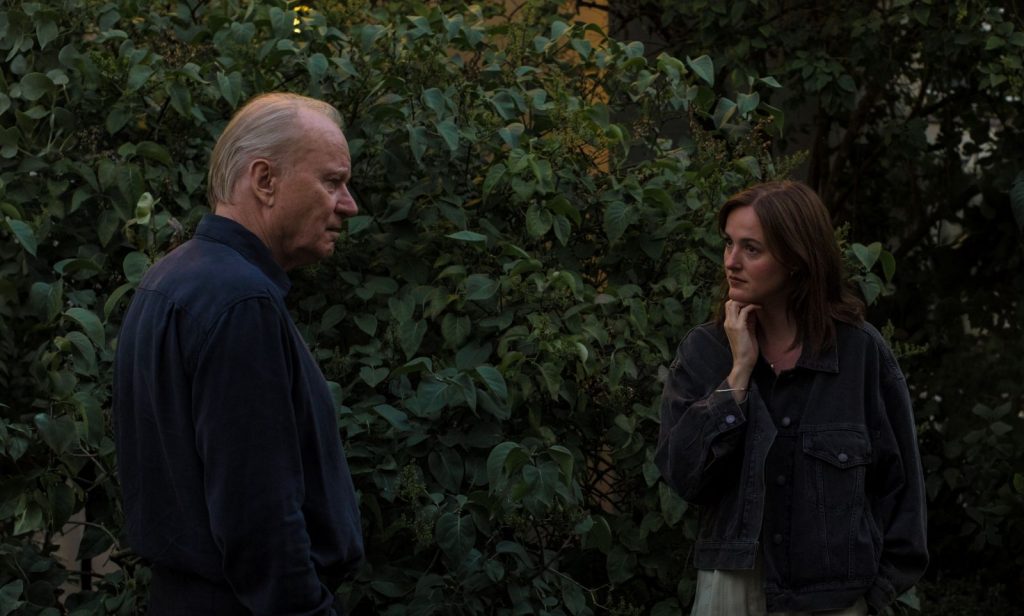
“Sentimental Value, written and directed by Joachim Trier, is a gorgeous, insightful Scandinavian family drama about two adult sisters who reunite with their absent father after their mother dies, and about how difficult it is for any of us to say what we mean,” writes Johanna Schneller at The Globe and Mail. She also chats with stars Renate Reinsve and Elle Fanning about bringing this family portrait together: “Nora and Gustav don’t know how to talk,” Reinsve says. “She’s stuck in something that is too close to her. You have to find a distance to be able to process things. We all know what should happen in their scenes, how their relationship could be healthy, but they can’t do it. I love how much she knows about herself, and still how much she chooses not to get into. Even though, like Gustav, she went into her profession to try to understand things.”
“Sentimental Value, one of the year’s best films, is an absorbing, beautifully drawn family drama that walks lightly, but goes deep,” says Karen Gordon at Original Cin. “As in [Trier’s] previous film, the Oscar nominated The Worst Person in the World (which also starred Reinsve), Sentimental Value is, at times, melancholy, but it’s not melodramatic, or tragic. Trier doesn’t manipulate us for dramatic value…There’s a real craft in the way he tells stories. There’s an emotional honesty and an integrity to the film. It’s complex. It’s human. It is what Trier does so beautifully. Sentimental Value is a sophisticated, wonderful film, and more proof that Trier is one of the best young filmmakers in the world.”
“The crack has been there for generations, we’re told, but don’t worry: The home is too sturdy to crumble,” notes Barry Hertz at The Globe & Mail. “And every member of the cast – including Reinsve, now a three-time Trier collaborator, and Skarsgard, who headlines the film with such profoundly amusing cocksure confidence that it is a total farce the film’s producers are campaigning him as a “supporting” actor in the Oscar race instead of a lead – is fully locked in, committed for the long emotional haul.”
“Renate Reinsve and Elle Fanning are like two sides of a golden coin in Joachim Trier’s tangled family drama, in which a celebrated filmmaker (Stellan Skarsgård) tries to use his art to reconnect with the family he abandoned long ago,” raves Peter Howell at the Toronto Star. “When his daughter (Reinsve), a stage actress, turns down a role in the film she deems too close for comfort, it’s taken up by an American star (Fanning), who doesn’t realize the doppelgänger dynamics she’s getting into. Fantastic performances across the board — especially by Reinsve and Fanning — and a keen sense of the meaning of the title make this film a bittersweet pleasure to watch.”
“This film, which flies by at 135 minutes, deftly reveals itself with raw emotion as the theatricality of the performances-within-the-performances invite the actors to reveal layers while the actors they play discover the characters’ inner lives, pains, and motivations,” says Pat Mullen at That Shelf. “This is Skarsgård’s show, though. After playing brooding baddies in films like The Girl with the Dragon Tattoo and Dune, he brings heart and humour to this performance. It’s a veteran’s showpiece that resonates with years of experience gleaned not only from film sets, but from the generational spark of having sons like Alexander and Bill in the business. There’s a tangibly playful element of art imitating life as the seasoned actor and Reinsve spar over years spent on film sets instead of at home.”
Tatsumi (dir. Yoishio Shoji)
“Director Shoji keeps his film in focus, keeping the atmosphere constantly tense with some violent (arguably more violent than necessary) action scenes though there are a few slow spots in the film,” writes Gilbert Seah at Afro Toronto. “It is basically a tough and uncompromising revenge gangster film.”
Tee-Yai: Born to Be Bad (dir. Nonzee Nimibutr)
“This is a drama/crime action film, with heists, outlaw lifestyle, loyalty, and betrayal,” says Gilbert Seah at Afro Toronto. “At best, the creation of the Bangkok of the ’70s/’80s, the underworld, street scenes, and retro style is impressive.”
File Under Miscellaneous
At What She Said, Anne Brodie catches up with Guillermo del Toro’s Frankenstein now that it’s on Netflix: “Del Toro’s magnificent art direction is full on Victorian Gothic fantasy and reason alone to see the film, but it’s outré handling of an already horrifying tale left me more moved by the look than the feel of the thing.” Brodie also remembers Sally Kirkland, just as her final film opens (in the USA only): “Our hearts go out to her who in her eighties craved another Hollywood chapter, a remote possibility, attending auditions and pondering a space thriller role written by a porn filmmaker. You’ll love her toughness mixed with vulnerability, revel in her new friendship with Zach and he in his.”
At Original Cin, Thom Ernst reports from the Guelph Film Festival: “The Guelph Film Festival isn’t here to scold you about the state of the world, but it won’t let you off the hook either. The films—shorts and features alike—tackle weighty subjects: addiction, abuse, environmental collapse. But they do so with wit, empathy, and narrative drive. These aren’t lectures disguised as documentaries; they’re stories alive with conflict and insight.”
TV Talk/Series Stuff
At Original Cin, Karen Gordon checks out The Beast in Me with Claire Danes: “Danes is one of the most intense and focused actors on TV while Rhys digs into his character’s Machiavellian instincts and takes his character to some dark places.”