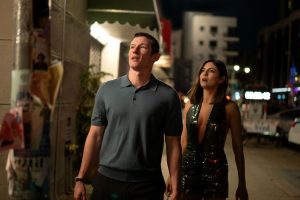
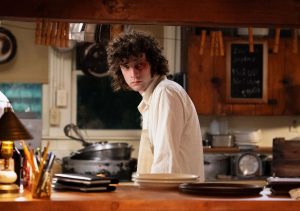
Movie reviews include Tony, The Rivals of Amziah King, and American Doctor.
TFCA Friday: Week of July 25
July 25, 2025

Welcome to the TFCA weekly, a round-up of reviews and coverage by members of the Toronto Film Critics Association.
In Release this Week!
AJ Goes to the Dog Park (dir. Toby Jones)
“The director has mentioned that his friends and himself have always been obsessed with a good gag,” says Gilbert Seah at Afro Toronto. “Growing up in Fargo, North Dakota, they had spent weekend after weekend creating videos – be it a local access show or a miniDV feature – with the sole purpose of making each other laugh. Nothing was ever as satisfying as coming up with something impossibly absurd and putting it on tape, regardless of our complete lack of resources. The act of making something completely unchecked, with no concern for appealing to anyone other than ourselves, felt like a rebellious and cathartic act. The last sentence summarizes the film. The film is all over the place, though it is occasionally extremely silly AND funny, and one thing that has to be said is that the film is fresh, original and one-of-a-kind.”
Angela’s Shadow (dir. Jules Arita Koostachin)
“Warring traditions and desires, under pressure and the impending birth add to the film’s rocky richness. It is the second in a film trilogy from Koostachin, the second exploring trauma induced by colonialism and the possibility of healing. Also stars Renae Morriseau, Mahiigan Koostachin, and Asivak Koostachin,” notes Anne Brodie at What She Said.
“At best, the film touches on issues such as survival, defiance and ancestral power,” notes Gilbert Seah at Afro Toronto. “But the blend of sci-fi, drama, supernatural and thrillers does not particularly work, though the indigenous stories are timeless, vital and have the power to reach beyond our own, the power fails to come across on screen.”
The Fantastic Four: First Steps (dir. Matt Shakman)
“No one can blame Feige and the other Marvel execs for handling First Steps with kid gloves,” admits Rachel Ho at Exclaim!. “The film feels like a make-or-break point for the studio where every aspect of this movie has to land, and we can feel that delicacy as an audience. From the imagery to the performances, everything in First Steps is deliberate and, in turn, safe, even by Marvel standards. Unlike Marvel films before it, this one contains no big explosions — even the more action-packed moments between Sue and Galactus or Johnny and Silver Surfer are quiet. In exchange, we have greater attention to detail: as a certified hater of Marvel’s wanting VFX efforts in the past, Galactus actually looks incredible, and the sound design on Ben’s every movement is superb. It’s as if Marvel wants to gently bring audiences back and prove that they’re now about the quality, not quantity.”
“Shakman has given us a Fantastic Four that has the appeal of Lucas’ early Star Wars,” says Marc Glassman at Classical FM. “We’re there to root for the characters, who are likeable—almost loveable—in their sincere appreciation of themselves and love for humanity. As Reed Richards admits about the fateful space mission, which went awry, turning the quartet into freakish heroes: he chose the “best” astronauts—his wife Sue Storm (now Invisible Girl), brother-in-law Johnny Storm (now The Human Torch) and best friend Ben Grimm (now The Thing). They’re family, and in 2025, post-COVID, that’s the social unit we embrace.”
“The film is essentially a live-action cartoon, not unlike the earlier summer ’25 hits How to Train Your Dragon and Lilo & Stitch, although this one is part of the Marvel Cinematic Universe, which has been struggling with battle fatigue lately,” says Peter Howell at the Toronto Star. “After too many superhero movies where the main objective seems to be to introduce myriad morose characters and multiple convoluted plot lines (I’m looking at you, James Gunn’s Superman), it’s refreshing to experience one that just wants to remind you of the simple pleasure of reading a comic book.”
“[T]erribly boring and a ridiculous story and events that make no sense,” counters Gilbert Seah at Afro Toronto.
“The Fantastic Four: First Steps is a lot like walking into a fast food restaurant that got a fancy new remodelling and redesign,” notes Andrew Parker at The Gate. “You’re curious to check out everything while it looks new and shiny, before it all gets run into the ground over the next decade; before the next redesign or inevitable closure of the shop. It’s kind of awe inspiring to see something this familiar with a new coat of paint. Then you get the meal and you realize it’s just the same thing it always was; the same food in better ambiance. The surroundings elevate things slightly, but not enough to distract from the fact that nothing tangible has changed. It’s kind of a cheat. So while there’s nothing terrible about The Fantastic Four: First Steps, there’s also nothing inspiring about it beyond the visuals. It’s not contemptible, but it’s annoyingly basic stuff with fresh coats of blue and white paint.”
“[T]he action in The Fantastic Four: First Steps is more like the glue that connects scenes of bickering. Reed and Sue argue over how committed a father he’s going to be. Johnny and Ben argue over who makes better pasta sauce. This is between scenes where the four of them give press conferences,” writes Jim Slotek at Original Cin. “The bickering often seems forced, like an attempt to mine the vibe of Guardians of the Galaxy, and usually slides into sentimentality (also forced). But in a very non-Marvel less-than-two-hours, The Fantastic Four: First Steps practically races the clock to get us to accept the unbreakable bond between these four cosmic heroes.”
“The film’s screenplay provides the foundation for a great adaptation, but its core cast of actors are why First Steps leaves a lasting impression. The main cast has great chemistry that makes you believe you’re watching characters who have known each other for a lifetime,” says Victor Stiff at That Shelf. “Watching the film felt like I was jumping into season three of a great TV show, at the point where the writers have worked out all the kinks and found their groove.”
Four Letters of Love (dir. Polly Steel)
“Pierce Brosnan, Helena Bonham Carter, and Gabriel Byrne lead the cast of Four Letters of Love, an Irish romance set in the western wildlands of Counties Donegal & Antrim. They’re by the ocean, a romantic setting that’s dangerous but exciting and endlessly beautiful,” writes Anne Brodie at What She Said. “Filled with desperation, heightened emotion and longing for a better life, the characters are journeying, physically and spiritually. The film’s tuneful and very pretty but never really gels, it’s messy and could use a hard edit.”
Happy Gilmore 2 (dir. Kyle Newacheck)
“Like the first film, this kind of thing isn’t rocket science or high art, but much like Happy’s iconically ludicrous swing, it gets the job done,” admits Andrew Parker at The Gate.
“The magic question is whether Happy Gilmore 2 is funnier than the original,” notes Gilbert Seah at Afro Toronto. “Number 2 is as crass, childish and funny to some, just like the original. Better than the first is the question up to Sandler fans to decide. Happy Gilmore 2 is, as they say, it is what it is, and those who expect a cussing Adam Sandler bumbling comedy will get what they expect.”
The Home (dir. James DeMonaco)
“The Home has neither haunting atmosphere nor paranoid madness to recommend it; it’s just a weak story, badly executed and dragged along until it launches into a blood-spatter bonanza in the last five minutes,” says Liz Braun at Original Cin. “Some questions: What is the mystery of the fourth floor? Why are constant warnings about an incoming hurricane and environmental disaster playing on TV news in the background? What’s the deal with horror films and toolbox dentistry? Who came up with that deus ex machina ‘scientific’ hocus-pocus to explain things?”
Marlee Matlin: Not Alone Anymore (dir. Shoshannah Stern)
“Almost as destabilizing as some of the ridiculous questions she was asked by clueless media, included here. Some things never change,” says Kim Hughes at Original Cin. “Heartrending bombshells like those propel Stern’s doc, which aims to strike a balance between hagiography and unobstructed view of a unique and complex woman’s life. Stern, who is also Deaf and an actor — and thus, particularly dialled into Matlin’s experience — conducts her interviews with Matlin using sign language, which gives the film a particular intimacy.”
At POV Magazine, Pat Mullen calls the film “radically groundbreaking” and also discusses the doc with Marlee Matlin and director Shoshannah Stern. “I do enjoy watching actors working, but when we’re talking about hearing actors, I can enjoy them through captions, but I can’t hear their voices the same way,” Matlin tells Mullen. “You can hear their voice, the tone, the emotion that they express—whatever it is, how they choose to express themselves. But when I watch a Deaf actor, I’m absolutely mesmerized to see them express themselves through Sign, because that’s my version of sound: the hands. I learn a great deal from them in different ways.”
“Beyond the obvious profiling of its subject, Marlee Matlin: Not Alone Anymore is the rare example of a biographical documentary that’s as formally interesting and stylish as it is informative and blunt,” says Andrew Parker at The Gate.
Monster Island (dir. Mike Wiluan)
“Two enemies forced to work together, stranded on an island, is a premise also used in the John Boorman film Hell in the Pacific, in which Two Enemies, a Japanese soldier (Toshiro Mifune) and an American (Lee Marvin), are stranded on a deserted island,” says Gilbert Seah at Afro Toronto. “It takes half of the film to establish the settings before the film becomes a monster vs. two prisoners film. But there is hardly anything fresh in the film, which ends exactly as one would have expected.”
Mr. Nobody Against Putin (dir. David Borenstein, Pavel ‘Pasha’ Talankin)
“Talankin wants to share their work in painstaking detail because he believes that showing love for one’s country and community requires a citizen to admit there are problems, not showing blind loyalty,” writes Andrew Parker at The Gate. “It’s brave and dangerous for someone like this to go public in such a way, but also uniquely cathartic to process Talankin’s methodology.”
“It brings us inside this community with rare sensitivity and care,” says Jason Gorber at POV Magazine. “Borenstein does well to keep the film on target, but this is obviously Pasha’s story to be told, and his footage and perspective drives the entirety of interest. The result is an absolutely stellar look at how much a country at war, particularly one like Russia given both its vast territory and vast history of conflicts, can be reshaped away from the front line. This is a brilliant film, accessible yet profound, and already easily one of the best of the year. It’s sure to generate conversation well outside Pasha’s toxic yet paradoxically wonderful home town.”
A Normal Woman (dir. Lucky Kuswandi)
“A Normal Woman can be described as a slow-burning thriller, though it comes across as quite stylized, though many might complain about the film’s pace,” says Gilbert Seah at Afro Toronto. “The story is told from Milla’s point of view, which means it has a feminist slant, which is a good thing, with females being more in the movie industry, but it could be said as one-sided, depending on one’s point of view.”
Oh, Hi! (dir. Sophie Brooks)
“What happens as Oh, Hi! appears to go off the rails is a darkly comic send-up of contemporary dating and relationships, an exaggeration of the pitfalls available in meeting online but living in the real world. How do you determine who the crazy girls and the soft boys are before it’s too late? Relationship goals don’t seem to have changed that much, but everything else has — how to figure it all out?” asks Liz Braun at Original Cin. “Life and love are hella messy, something rarely shown in our perfectly-curated Instagram world.”
“Can’t remember the last time a film made me feel queasy and then Oh, Hi! happened,” admits Anne Brodie at What She Said. “Sophie Brooks’ unflinching look at love and cruelty stars Molly Gordon as fun loving but intense Iris… Things just get weirder and become sickening, suggesting you may never know the truth about people until it’s too late.”
“Perhaps the problem is that the young couple, Iris (played by writer-actor Molly Gordon) and Isaac (Logan Lerman), aren’t that interesting,” observes Marc Glassman at Classical FM. “One of them has never seen Casablanca and the other doesn’t read books. What do they have in common? Sex, of course, and being naïve? Isaac isn’t clever enough—though he is reading Nobel Prize winner Saramago’s Blindness—to decide that breaking up with Iris while handcuffed isn’t a good idea. And Iris can’t think of any way to persuade Isaac to fall in love with her besides pancakes and storytelling.”
Samia (dir. Yasemin Samdereli)
“While it’s an imperfect retelling of Omar’s life and struggles as an athlete living under some of the most oppressive conditions in the world, Samia comes out a winner by showing what can be accomplished by believing in oneself when few others will,” notes Andrew Parker at The Gate.
(trailer not available)
Sunday Best: The Untold Story of Ed Sullivan (dir. Sacha Jenkins)
“Sunday Best: The Untold Story of Ed Sullivan is a wonderfully entertaining doc on Ed Sullivan highlighting his fight against black racism while showcasing the best of these performers,” says Gilbert Seah at Afro Toronto. “Bring on the nostalgia!”
Unicorns (dir. Sally El Hosaini, James Krishna Floyd)
“A sweet and charming, albeit familiar, romance with a sour third act twist,” says Joe Lipsett at The Queer Gaze. “As a romantic drama, there’s a lot to like here. But…the film’s refusal to unpack its characters decisions frustrating.”
File Under Miscellaneous
At The Globe and Mail, Barry Hertz reflects upon the multiplexes’ shift towards projectionist-less screenings, and what that means for moviegoers who don’t get films ruined by teenage punks like him: “But whoever inside Cineplex decided that it was a good idea to hand over hundreds of thousands of dollars’ worth of studio property to the unskilled hands of a teenage army made a decision that cost so many audiences the pleasures of a proper, professionally presented night at the movies,” writes Hertz. “It was the greatest job that a high-school movie fanatic could have, and I was terrible at it.”
A Festival of Festival Coverage: TIFF Rolls Out the Selections
At The Globe and Mail, Barry Hertz reports on the local efforts of indie film group MDFF to boost the next generation of talents through a series at TIFF Lightbox: ““There are fewer and fewer opportunities for student filmmakers to get their work out there. You would think the internet would help, but it’s easy to get lost in the noise,” MDFF’s Kazik Radwanski tells Hertz. “But the No. 1 thing is that all 10 of the filmmakers are attending the event, so the opportunity for them to just connect is crucial. For someone in B.C. to see what’s going on with the student-film community in Quebec. We want the cinephiles to meet each other.” Hertz also looks at one of TIFF’s announcements this week—its Platform competition line-up—and considers how the series sort-of reflects its origins on its 10-year anniversary.
At Variety, Jennie Punter speaks with Hubert Davis about his new drama The Well debuting at Fantasia: “Several years ago, we were living in a remote place north of Toronto and the idea for ‘The Well’ emerged from the feeling of being isolated with family and imagining what that would mean in a dystopian near-future,” Davis tells Punter. “When you’re raising your kids, who do you trust besides yourself? You need other people in order to survive. For your kids to grow, they have to get out in the world, but there is danger in that; in other words, it came from my own anxiety.”
TV Talk/Series Stuff
At CBC, Marriska Fernandes chats with the stars of Washington Black, Sterling K. Brown and Ernest Kinglsey, Jr., along with author Esi Eduygan on whose award winning book the mini-series is based. “For me, one of the most important parts of the novel to write was the sections that are in Nova Scotia and this is because I really wanted to explore some of our own slave histories,” says Eduygan. “During my research, you’re reading about Canada as the terminus for the Underground Railroad and how incredible that was, but you’re also reading about how difficult it was for so many of those formerly enslaved people to establish real lives free of conflict.”
At The Gate, Andrew Parker binges Washington Black: “It heralds the arrival of a new, Black hero that young people can look up to and call their own, like Indiana Jones, Robin Hood, or Luke Skywalker,” says Parker. “Washington Black is something truly special, and if people turn up to watch it, this show could spark a huge legacy of its own.”
At Original Cin, Liam Lacey throws the book at Washington Black: “The new eight-part Hulu series, Washington Black (on Disney+ in Canada), produced by Sterling K. Brown and created by Selwyn Seyfu Hinds, shares the bones of the narrative and the novel’s focus on Black excellence and achievement, rather than histories of trauma,” says Lacey. “But otherwise, the series — apparently targeting a young adult audience — is a popularizing downgrade from its source material. The writing team has toned down the book’s violence and moral ambiguity, characters’ motives are simplified, and adventures and romantic complications pad out the running time.”
At What She Said, Anne Brodie takes interest in Code of Silence starring Rose Ayling-Ellis: “This is the promising start of a series that could go any which way given this headstrong young woman.” Meanwhile, the short Charmin Wipes Out a Forest “details the devastating impact of huggably soft toilet paper on the environment.”