
Movie reviews include Tony, The Rivals of Amziah King, and American Doctor.
On Reveries and Encounters at Coimbra’s Caminhos Cinema Português
December 11, 2025

By José Teodoro
For the past quarter century, Portugal’s modestly scaled but tremendously fertile cinema has been a kind of phenomenon, generating mainstays of the festival circuit that occasionally break through into arthouse distribution or boutique platforms. It has supplied several darlings of TIFF’s influential experimental Wavelengths program, such as Pedro Costa, Miguel Gomes, and João Pedro Rodrigues, auteurs engaged with narrative, form, and politics, each with distinctive directorial signatures and a shared sensibility that tends to merge past and present in mischievous ways. I jumped at the chance to join the FIPRESCI jury at the 31st edition of Caminhos Cinema Português in Coimbra, where our competition consisted exclusively of contemporary Portuguese films. I’d like to tell you about some of the best of these.
Before screening in Coimbra, our prize winner, Maureen Fazendeiro’s The Seasons (As Estações), premiered at Locarno and was a personal favourite of mine among this year’s Wavelengths selections. Photographed in Portugal’s Alentejo region, famous for its ancient megaliths, The Seasons is oneiric nonfiction, meditative place study, and cinema as archeology. Fazendeiro incorporates voiceover excerpts from the journals of archeologists Vera and Georg Leisner, who explored the region in the 1930s and ’40s, while observing land and animals, labourers and residents, in the present with scrutiny and tenderness. In keeping with the title, the film possesses a bucolic cadence highly responsive to the rhythms of its location and that, for me, often recalls the writings of British polymath John Berger (To the Wedding): a goat is born, a woman sings a saia, children’s hands stroke a rabbit, men peel bark from cork trees as though skinning animals, and more than once our gaze is drawn to an apparition of the moon in daylight. Everything is rendered with equal emphasis on the sensual and the ephemeral.
An equally arresting evocation of place opens Leonor Noivo’s Bulakna, as a small fishing boat sets out before first light. We hear waves lapping its sides, the rustle of nets, paddles breaking water, then a synth score drifts in as though it always belonged there. We’re in the Philippines, in a village whose economy is dependent on fishing, which means many of its denizens leave, often to become domestic workers in wealthier countries. Bulakna alternates between village life, with its abundance of simple pleasures and dearth of financial opportunities, and the lives of those who leave this place, often for years without seeing their families, to keep house, cook meals, and care for other people’s children. These tasks are undertaken with the understanding that, “the more invisible you are, the better you have done your job.” There are also sequences involving a theatre company developing a work that celebrates the historical Indigenous heroes who fought off the Spanish colonizers. This all sounds much more bluntly polemical than the film feels: while smart about its politics, Bulakna brims with playfulness and colour. It depicts its young heroine’s decision to leave home as a process at once universal and particular to her culture’s story.
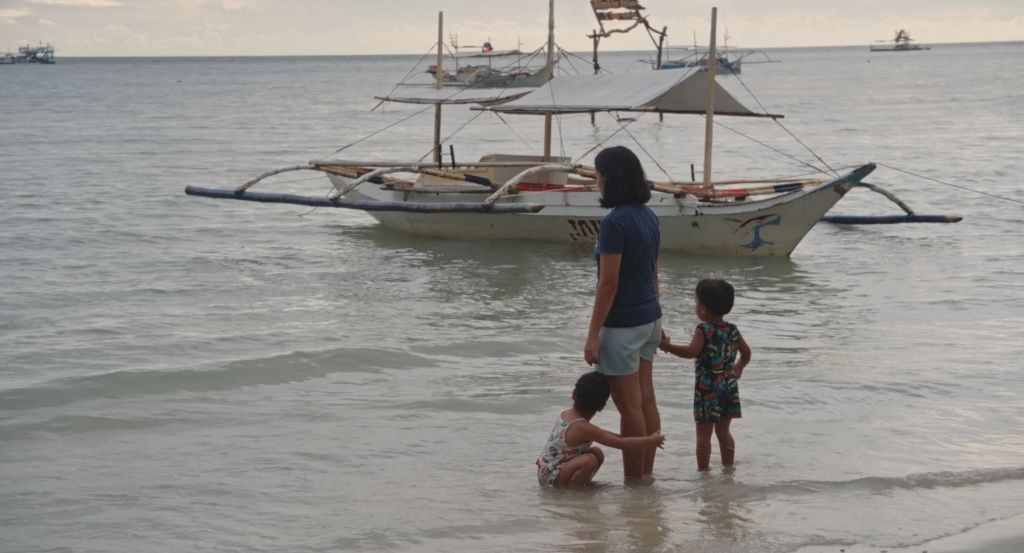
Kopal Joshy, the director of We Are Two Abysses (Somos Dois Abismos), was also young when she left her home in India to study film in Lisbon. Her feature debut was prompted by her discovery of a photograph of a lake in the Portuguese countryside. The lake is surrounded by mountains, while at its centre is a mysterious hole. She travelled to find this lake and, in a nearby village, was told of an old man who knows the path to get there. This man, Carlos, whose voluptuous mane is as white as the snow that blankets the aforementioned mountains, invited Joshy to stay in his house, first for days, then for weeks. A friendship bloomed. In We Are Two Abysses, Joshy’s storytelling most often inhabits a hushed, chiaroscuro space, weaving hauntingly beautiful impressions of alpine landscapes with Carlos’ readings of the journals he’s kept since the death of his beloved spouse Trudi, as well as images of Carlos’ photo albums crafted in homage to Trudi. There are also scenes of Carlos and Joshy undertaking quotidian tasks, such as roasting food on an open fire or hanging socks on a line. At the time when most of the film was made, Joshy spoke little Portuguese, and Carlos’ English was rusty, but the language barrier makes this already immensely moving film only more poignant: each are forced to reach to communicate, and that reaching, across age and experience, across language and culture, across approaches to grief, fortifies their bond.
Lastly, I’ll mention director Pedro Pinho’s I Only Rest in the Storm (O Riso e a Faca), which in the five-and-a-half-hour version screened for our jury, plays like a novel, with fully realized storylines branching out from its root, Sergio (Sérgio Coragem), a naïve young environmental engineer who travels to Guinea-Bissau to assess the impact of a proposed road project. There are encounters with inhabitants of still-remote villages, NGO representatives who seem eager to congratulate themselves and depart, all-male work crews with too much alcohol and too many firearms, wealthy investors gently petitioning Sergio for their interests, and, above all, a ragtag group of flamboyant friends who are happy to invite Sergio to their parties but close the door when he presumes genuine intimacy. Each episode in our protagonist’s journey reflects a different aspect of the postcolonial 21st century, where allegiances are hazy and identities dependent on context. Coragem is annoying but perfectly cast as the eager, well-educated European who’s also a kind of rube, while his co-stars Cleo Diára and the stupendously charismatic Jonathan Guilherme provide some of the most beguiling performances I’ve seen this year.
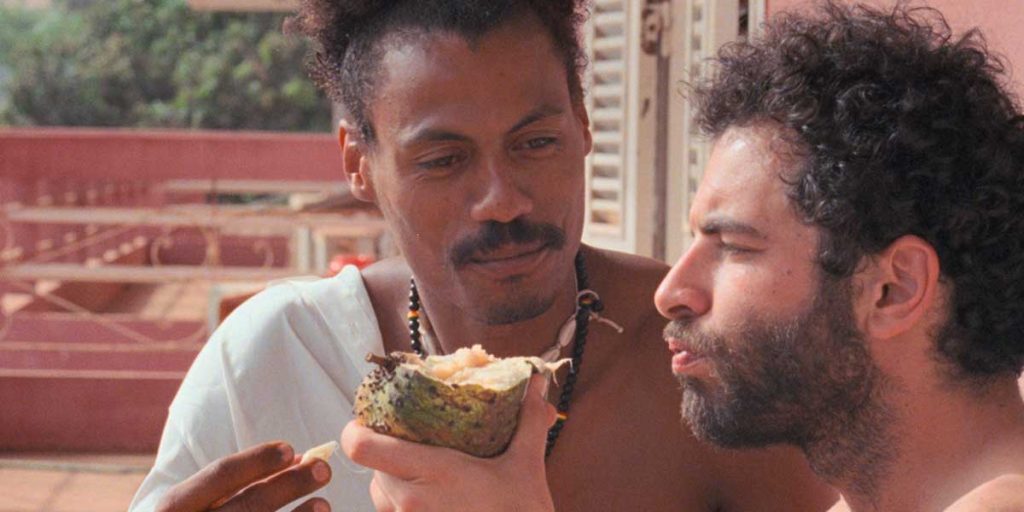
I Only Rest in the Storm will be screened in its truncated version (a mere three and a half hours) as this month’s installment of MDFF Selects at TIFF Lightbox on Dec. 18, and you should go see it, though I strongly suspect the longer version is superior. Not because it’s without flaws—there are way too many scenes where the characters turn into mouthpieces, spelling out themes rendered with absolute clarity through the story—but because the longer version offers a rare opportunity to immerse yourself in a rich, sprawling narrative that demands to be experienced not as a start/stop marathon on your television, but in the collective contract of the cinema.