
Reviews include Insidious: Out of the Further, Late Fame, and Spa Weekend.
TFCA Friday: Movie Reviews for February 13
February 13, 2026
Welcome to the TFCA weekly, a round-up of reviews and coverage by members of the Toronto Film Critics Association.
In Release this Week!
An American Pastoral (dir. Auberi Edler)
“In capturing how easily civil liberties can be erased in real-time, An American Pastoral effectively hits home just how much people have been radicalized since the pandemic. When one individual remarks ‘it’s so wild that our minds focus on this now. It’s like Covid just changed everything,’ it is equally as disturbing as the misinformation he and his fellow book banning colleagues spread,” writes Courtney Small at POV Magazine. “While Edler’s documentary shows that dark clouds are descending across the American landscape at a rapid rate, she does present slivers of light still fighting to break through.”
“The future of Elizabethtown in Pennsylvania is at stake. In a quiet Pennsylvania town, a storm is brewing over the soul of its public schools. What begins as a debate over library books quickly reveals a deeper battle — one over religion, democracy, and the future of American education,” says Gilbert Seah at Afro Toronto. “A surprise thought-provoker.”
Cold Storage (dir. Johnny Campbell)
“Liam Neeson is always up for a little bit of fun in a genre romp like this and you can tell he’s leaning into the material and allowing himself to be the straight man of it all who can quietly chew the scenery when things get a little goofy,” says Dave Voigt at In the Seats. “On top of all that I’ll admit that it was pretty fun to not only see Vanessa Redgrave and Lesley Manville show up in this one to fight invading contagion while cracking wise and occasionally kicking some ass.”
“Director Jonny Campbell makes effective use of a fungus-eye view of the innards of human capillary systems and lungs as the malevolent mushroom makes its way to the brain with the speed of an F1 driver,” writes Jim Slotek at Original Cin. “Unfortunately, in Cold Storage, the first act sets too high a bar to maintain, and the rest, though watchable, is busy-ness punctuated by green splatter.”
Crime 101 (dir. Bart Layton)
“Hemsworth makes the believable transformation from invincible action star to emotionally scarred crook,” says Victor Stiff at Exclaim!. “At a glance, Mike may seem dull and flat, but he’s an intentional cipher. He fixates on committing crimes to distract himself from his own inadequacies — chasing wealth takes him further away from his tortured past. Mike’s insecurities form the engine that drives the plot, and Hemsworth gives the character a tragic vulnerability.”
“What follows is a cat-and-mouse game that is sometimes thrilling, sometimes just a little too laborious, especially once the story ropes in a handful of supporting characters, including a random working stiff (Monica Barbaro) who has a meet-cute with Mike, a psychotic looter who is eager to usurp Mike’s next gig (played by today’s psychopath expert, Barry Keoghan), and an insurance broker (Halle Berry) who might be the key to Mike’s one last job,” notes Barry Hertz at The Globe and Mail. “Also, Jennifer Jason Leigh pops up for a few welcome minutes as Lubesnick’s dissatisfied wife before too quickly disappearing.”
“Yes there are elements of Crime 101 that are playing like Michael Mann-lite, but they are doing it really well,” admits Dave Voigt at In the Seats. “Writer/director Bart Layton dives head first into the moral code that’s required to survive and keep a sense of one’s self in a modern Gomorrah like Los Angeles where the ideas of a social and moral code are occasionally more suggestion then they are something to be practiced.”
“One of the better action flicks opening this year, with three protagonists instead of one, directed by the one who made the awesome documentary The Imposter,” says Gilbert Seah at Afro Toronto.
Finch and Midland (dir. Timothy Yeung)
“Through simplicity, humour, and charm, the film effectively explores themes of belonging, identity, sacrifice, cultural displacement, and the cost of chasing the ‘better life’ in a new country, which in this case is Canada. Each story is equally interesting, and Director Yeung connects well with his audience through his characters,” says Gilbert Seah at Afro Toronto.
“Full credit is due to Yeung for a film filled with vivid performances and fluid, moody aesthetic, but with one reservation. The ending of Finch & Midland feels truncated rather than resolved,” observes Liam Lacey at Original Cin. “There are parallel culminating scenes of each of the characters, all of which involve a moment of physical touch. But we leave these four dreamers marooned between resignation and acceptance.”
Good Luck, Have Fun, Don’t Die (dir. Gore Verbinski)
“The digital red flags start flying immediately, with Verbinski opening the film by having Sam Rockwell deliver an unhinged but not especially amusing monologue railing against humanity’s addiction to screens,” notes Barry Hertz at The Globe and Mail. “It doesn’t take long for Rockwell’s nameless character, dressed up like a vagrant in a budget Terry Gilliam film, to announce that he’s from the future, and here to save the world before AI destroys us all.”
“There’s a slather of dark comedy over everything, like the shot of a guy who’s been stabbed in the head with a meat thermometer. It reads a perfect 98.6 F. Or Sam’s retort when someone comments on his homeless guy looks: ‘I come from an apocalypse. This is the height of apocalypse chic!’ exclaims Chris Knight at Original Cin. “I won’t reveal any more, except to say that Robinson and Verbinski have uneven filmographies. The director’s last film was 2016’s A Cure for Wellness (execrable) and he made The Lone Ranger, starring Johnny Depp as a Comanche. But hey, he also helmed 2005’s The Weather Man (excellent) and the three best Pirates of the Caribbean movies, which is to say the first three.”
The Last Sacrifice (dir. Rupert Russell)
“The Last Sacrifice should be seen, not only for the reason that is quite the well put-together film, but is also very nostalgic when the audience watches the old Hammer horror films that many loved an grew up with, including watching many segments involving horror masters Peter Cushing and Christopher Lee.
Montreal, My Beautiful (dir. Xiaodan He)
***Winner: TFCA Awards – Outstanding Performance in a Canadian Film: Joan Chen***
***Runner-up: Outstanding Supporting Performance in a Canadian Film: Charlotte Aubin***
“Joan Chen delivers a quietly masterful performance as a Chinese immigrant wife and mother who begins a long-delayed rebirth in Xiaodan He’s Montreal, My Beautiful,” writes Rachel West at That Shelf. “Intricate and restrained, this is Chen’s film to carry, and she does so beautifully, having learned French phonetically to inhabit the role with remarkable nuance. While Jun could easily be framed as a caricature of a hard-nosed immigrant with a strong work ethic, he functions instead as a reflection of the expectations placed on dutiful wives, but also on the ‘breadwinner.’”
“All this plays out against a city that sparkles throughout — multicultural, accepting, beautiful to look at. At one point Feng Xia compares the city’s parks to jewels; at another, the women join an outdoor dance lesson and dance with joy and abandon. The movie ends with a loving glance at the city skyline,” remarks Liz Braun at Original Cin. “Montreal, My Beautiful is understated and touching, and the storytelling inspires great affection for the characters.”
“Though explosive in its emotional material, director He keeps the tone of the film subtle and pensive, reflected by the city of Montreal, often filmed in soft hues,” says Gilbert Seah at Afro Toronto. “The film’s pace is unhurried and smooth, though never boring, as if something is not happening on screen, there is definitely emotion that is being felt by the characters.”
“The actress’s powerful and fiercely committed performance is also key to unlocking the potential of He’s film, which loses focus every second Chen is off the screen,” observes Barry Hertz at The Globe and Mail. “Every time that He’s film gets stuck in a narrative or emotional rut, though, Chen lifts the entire thing back up to a level that balances sensuality with sincerity. Watching her navigate Feng’s journey from roles of repression – wife, mother, shopkeeper – to a free, weightless person pursuing nothing more than pure desire can be a captivating, even beguiling experience.”
Mr. Nobody Against Putin (dir. David Borenstein, Pasha Talankin)
Calling the film “thrilling and at times unbelievable,” Barry Hertz chats with director David Borenstein at The Globe and Mail about securing co-director/participant Pasha Talankin. “Pasha had been recording these propaganda classes as part of a government program for patriotic military education – he was required to do so, and upload it to some sort of database to prove that these programs were being taught. But he didn’t want to delete it afterward, he wanted to send it to the West to expose the brainwashing that was happening,” says Borenstein… “His footage brings you into this kind of flux of daily life in the school, giving this first-person perspective.”
“It brings us inside this community with rare sensitivity and care,” notes Jason Gorber at POV Magazine. “Borenstein does well to keep the film on target, but this is obviously Pasha’s story to be told, and his footage and perspective drives the entirety of interest. The result is an absolutely stellar look at how much a country at war, particularly one like Russia given both its vast territory and vast history of conflicts, can be reshaped away from the front line. This is a brilliant film, accessible yet profound, and already easily one of the best of the year. It’s sure to generate conversation well outside Pasha’s toxic yet paradoxically wonderful home town.”
“What is seen in this docs nothing really surprising, but what is most interesting are the reactions of the students and fellow teachers,” says Gilbert Seah at Afro Toronto. “As also expected, but must to be seen to be believe, is the fear everyone experiences and to obey so that they do not get into trouble.”
My Father’s Shadow (dir. Akinola Davies Jr.)
“The film looks simple, but do not be fooled, as there is a tremendous amount of work, thought, and talent that went into this piece of work,” says Gilbert Seah at Afro Toronto.
Nirvanna the Band the Show the Movie (dir. Matt Johnson)
***Nominee: Rogers Best Canadian Film***
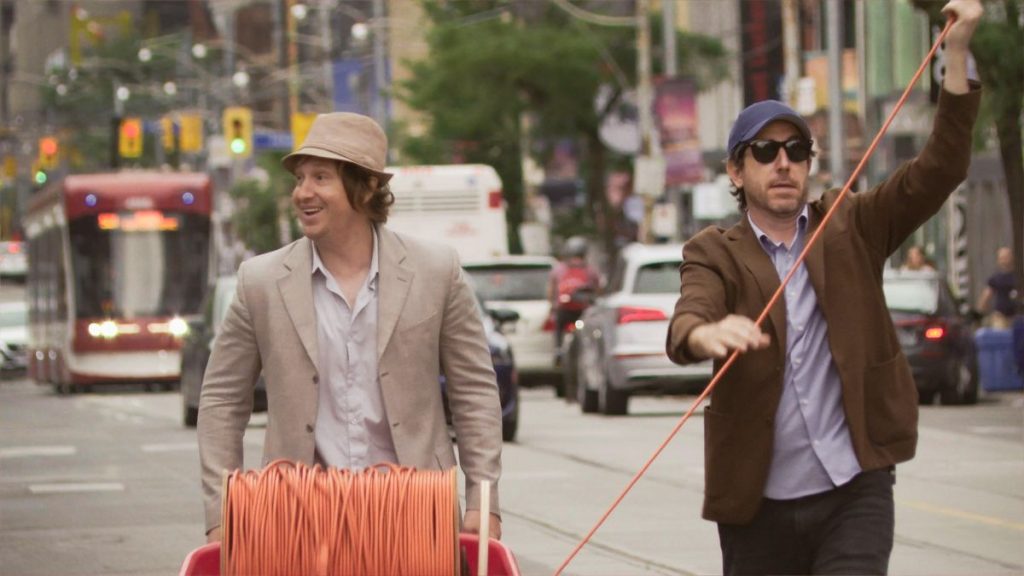
“The film has great fun reminding us of public figures and casual slurs that passed muster not so long ago, before turning its attention to goofier matters — namely, Matt and Jay needing to infiltrate their own apartment to pilfer a discontinued Canadian soda brand called Orbitz from their younger selves,” writes Chris Knight at Original Cin. “Along the way, the boys remain obsessed with playing the Rivoli, and willing to do whatever it takes, breaking laws constitutional, commercial, paradoxical, physical and even narrative. It’s all in good fun, and it’s all very, very funny.”
“Matt Johnson (BlackBerry) and Jay McCarrol’s cult web series (and later TV show), about two doofus bandmates desperate to land a gig at Toronto’s Rivoli club, becomes a time-travelling movie thriller about friendship, ambition and outrageous copyright violations,” says Peter Howell at the Toronto Star. “As amusing as the film is for the way it brazenly Toronto-izes the plot of Back to the Future (plus a bit of Hot Tub Time Machine), it’s also a marvel for its clever mix of archival footage, new material and spontaneous onlooker involvement. They’re still trying to get into the Riv, but returning to the right decade – and maintaining their friendship – become more pressing concerns after a high-flying publicity stunt becomes a leap into the unknown.”
“The two actors have a blast both as their schlubby present-day versions and their slightly altered (in Jay’s case much altered) selves, sometimes improvising with people on the street and inserting themselves into real-life scenarios. One ingenious sequence was captured after the high-profile shooting last summer at Drake’s mansion in the Bridle Path,” says Glenn Sumi at Go Ahead Sumi. “The best thing about the film? Like those Back to the Future movies, not long after watching it you’ll want to see it again.”
“There is an emotional trajectory to Nirvanna the Band the Show the Movie, which creates an arc for the film. The friendship between Matt and Jay is severely tested by melodramatic circumstances in the slightly twisted time travelling plot. Will the two come through as best bros for life?” asks Marc Glassman at Classical FM. “Of course, this reviewer won’t answer that question, but he will say that this is one of the sprightliest and most entertaining Canadian films of the year. Nirvanna the Band the Show the Movie is a cure for the winter blahs.”
“A wonderfully chaotic concoction that will leave even the grumpiest moviegoer rolling in the aisles, Matt Johnson and Jay McCarrol’s epic is a time-travel comedy that uses an assaultive barrage of boys-will-be-boys gags to deliver a genuinely meditative interrogation of friendship, maturity, fame and whether destiny is predetermined or the great lie that we tell ourselves in order to mitigate life’s many disappointments,” declares Barry Hertz at The Globe and Mail. He also chats with Matt Johnson and Jay McCarroll about putting on the show the movie.
“It’s a testament to the gonzo go-for broke gumption that the guys of Nirvanna The Band the Show the Movie bring us along for the ride so riotously well,” says Pat Mullen at POV Magazine. “However, they commit so hard to the bit and the film’s mockumentary aesthetic that I frequently gasped, winced, and held my breath, wondering if stars were going to be arrested, maimed, or worse during a shot. The film straddles the imperceptible line between artistry and lunacy to deliver a bonkers tale of enduring friendship, rooted firmly in the lived experience of Torontonians in the (mostly) present moment.”
Pillion (dir. Harry Lighton)
“By the point that Pillion, whose title references the secondary seat on a motorcycle, reaches the moment in which Colin asks Ray for something that the latter cannot quite accommodate – or at least has never allowed himself to imagine – even the most Netflix-gagged romcom fan will realize that Lighton’s film is exactly the shot in the arm the genre needed,” notes Barry Hertz at The Globe and Mail. “May we all live so happily ever after.”
“Pillion, which won the Best Screenplay prize in Cannes’ Un Certain Regard section as well as prizes at the British Independent Film Awards and Gotham Independent Film, has been praised for its ‘non-judgmental’ view of BDSM. I don’t really buy it,” admits Liam Lacey at Original Cin. “Heterosexual kink has already enjoyed positive public relations in such films as Babygirl or the Fifty Shades of Grey franchise. And the pragmatic details of the rough same-sex coupling in Pillion are more comic than erotic. “Get a butt plug. You’re too tight,” orders Ray, to which Colin breathlessly replies, “Yeah, lovely. That sounds like a plan.”
“Pillion is a different romantic film that opens around Valentine’s Day,” says Gilbert Seah at Afro Toronto. “The film is described in the press notes as a romantic black comedy. But more important, it is a film which rides its story outside the box, where a BDSM themed film turns both charming and still maintains its uncomfortable yet erotic sexiness.”
“There’s pure magnetism, too, in the rapport between Melling and Skarsgard,” says Pat Mullen at That Shelf. “As partners and lovers, they’re completely believable—even Ray’s attraction to Colin sells itself convincingly as the casting smartly pits the doughy Melling to be shaped by Skarsgard’s Adonis. Melling brings a sense of youthful innocence and naïveté to the part as Colin emerges from his bashful slumber. So much of Pillion plays out on Melling’s face as Harry meekly follows Ray’s commands. There’s wide-eyed joy and pleasure in making the master happy with hopes of being rewarded, like a dog thrown a bone. This dynamic also is also what makes Pillion so incredibly, insanely hot. The payoff here isn’t the sex, but the anticipation of it.”
Sirāt (dir. Oliver Laxe)
***Winner: TFCA Awards – Best International Feature***
***Runner-up: Best Director – Oliver Laxe***
“Though the film can hardly be described as entertaining, it provides a fresh, occasional, experimental, and emotional raw look at what it is to be human and how to relate with one another,” writes Gilbert Seah at Afro Toronto. “The film is in full serious mode except for one comical segment where Tonin improves a musical number using his leg stump to perform a sort of puppetry show.”
“But just when you think that things might work out, everything goes spectacularly awry,” says Marc Glassman at Classical FM. “Death, depression and dark drama ensue. Laxe creates a genuinely astonishing set-piece in the Moroccan desert where the rave is supposed to be taking place. Instead, the ravers and Luis find themselves on an abandoned mine field primed for multiple explosions. Vans are sent out driverless towards the neighbouring hills, where safety looms. But explosions upon explosions dominate the landscape as death abides. Some survive against all odds—but not all.”
“Sirāt defies easy categorization. It will draw comparisons to Wages of Fear and Sorcerer or Mad Max: Fury Road in its thrills, but at the same time, it has elements of a comedy, a road trip, and a family drama,” says Rachel West at That Shelf. “Visually transformative, the wide open desert spaces captured on Super 16mm film by cinematographer Mauro Herce leave room to wander in thought in the silence that punctuates Laxe and co-writer Santiago Fillol’s script. Much of Laxe’s focus is on the wide open spaces that are integral to the story without being a distraction. There is as much emphasis on the desert mountains as there is on his characters.”
“Oliver Laxe’s road movie is a jolting experience drawing inspiration from Henri-Georges Clouzot’s classic highway thriller The Wages of Fear – but the volatile cargo is grief rather than nitroglycerine,” notes Peter Howell at the Toronto Star. “Sergi López arouses curiosity and sympathy as Luis, a questing father adrift with his son and a ragtag band of hippies in the Moroccan desert, all searching for a missing daughter as the world teeters on the brink of calamity. Laxe’s film pulses with apocalyptic energy, spiritual longing and jump-from-your-seat plot turns. Everyone’s going to a rave tonight on Desolation Row.
“Sirāt is a sonic boom of a movie and a singular, exhilarating film experience,” says Pat Mullen at That Shelf, who speaks with director Oliver Laxe about his Oscar nominee. “We worked on a dimension of the structure and the texture of the sound and of the image,” says Laxe. “And that’s why the image and the sound grasps you: you feel it. You feel it in the body, the image and the sound.”
State of Fear (dir. Pedro Morelli)
“State of Fear is an above average high octane action packed thriller with colourful characters and set in the exotic Rio de Janeiro in Brazil,” notes Gilbert Seah at Afro Toronto. “The film succeeds primarily for its intense visuals and sweeping single-shot sequences that heighten the urgency of the story.”
This Is I (dir. Yusaku Matsumoto)
“The film could have been just made with the promise of the rise to fame of a pop idol who happens to be trans,” writes Gilbert Seah at Afro Toronto. “Instead, the film is brave enough to include controversial issues like [transitioning] as well as display the underground gay culture of Osaka in the ’70s. There are insights and displays of incidents not known to Western audiences, all of which lift the film above the ordinary.”
Wuthering Heights (dir. Emerald Fennell)
“Fennell is a brainy and deliberate filmmaker with a talent for conjuring mood and atmosphere. Her movies are always slightly subversive, beautiful to look at and entertaining at face value. They often deftly mix drama with moments of genuine humour. And there’s a darker undercurrent to her films, always something that might rattle you. Those elements are present here,” says Karen Gordon at Original Cin. “Wuthering Heights is a sensual feast. But, while there’s plenty to admire and lots of passion and heat, the film doesn’t quite add up in a way that brings the feels.”
“Better to accept it for what it is: a gleefully watchable tale of reckless love so shamelessly trashy you almost wish for an ejector button to toss it to the curb when it’s over,” advises Peter Howell at the Toronto Star. “Parody worthy, meme ready and as randy as a goat, Fennell’s version of the tale digs deep into the sado-masochistic subtext of Brontë’s prose. The main romantic couple, blond and blue-eyed Cathy (Margot Robbie) and shadow-etched Heathcliff (Jacob Elordi) look sculpted by lust and doomed by ego. They’re perfect of body but flawed of heart, so determined to love according to their own capricious rules, they don’t care who they hurt, and that includes themselves.”
“[T]his is not a normal adaptation. Instead, it’s a re-creation of memory, a stylized evocation of an experience the Saltburn director had reading the book as a starry-eyed fourteen-year-old. The result is a dreamlike, visually stunning — if emotionally stunted — re-interpretation,” writes Jackson Weaver at CBC. “Which would be an impressive swing if the changes to the source material were written with any intention of reinventing the story for modern day, instead of — at best — misreading what the book was trying to say, or, at worst, turning Fennell’s Wuthering Heights into something that isn’t Wuthering Heights at all.”
“I would take faux titillation over what goes on in the film’s second half, which asks its audience to fall head over heels for a lush tragedy between two remarkable monsters,” argues Barry Hertz at The Globe and Mail. “Unsure how to reckon with Heathcliff’s vengeful side – after being spurned by the selfish Catherine for a wealthy neighbor named Edgar (Shazad Latif), the film’s ostensible hero takes Edgar’s naïve sister Isabella (Alison Oliver) as his tormented bride – Fennell dives headfirst into a noxious and shallow swamp of doomed-romance swooning. The resulting affair ensures that moviegoers will have a slam-dunk class-action suit against Fennell for causing bodily harm: you’ll roll your eyes so hard that you’ll injure your head.”
“Three movies into her filmography, and Fennell has established an unmistakable cinematic voice. In terms of aesthetic and tone, Wuthering Heights feels closer to Saltburn than Promising Young Woman,” notes Victor Stiff at That Shelf. “It’s racy and joyfully seductive with a winking trashiness. The film opens with people gawking at a corpse’s erect ‘junk,’ and it only amps the WTF-factor from there. I could go on and on about floors made to resemble spilled blood and bedroom walls designed to mimic human skin (with veins and freckles).”
This latest version of the English novel Wuthering Heights, a novel that is considered one of the greatest English novels of all time, is given a free adaptation by writer/director Emerald Fennell – the reason the title ‘Wuthering Heights’ appears in quotation marks,” explains Gilbert Seah at Afro Toronto. “Re-interpret[ing] a classic treads dangerous territory, and in the case of the 2026 film, it fails (explained in the review) in terms of what would be expected in an epic romance.”
Remembering Catherine O’Hara
More tributes pour in for the Canuck comic as Anne Brodie at What She Said remembers Catherine O’Hara’s performance in Best in Show: “The comedy classic written and directed by Christopher Guest, featuring O’Hara, co-writer Eugene Levy, Fred Willard and a host of today’s iconic comedians as dog-eat-dog competitors,” writes Brodie. “O’Hara’s comic genius and physicality shine as Cookie Fleck, who is married to Levy’s Gerry Fleck – their dog Winki goes to a psychiatrist. A highlight of the experience is Cookie singing a painful soprano-esque ‘God Loves a Terrier’ and the hilariously downmarket scene at the hotel desk when they have no money for a room and try to cover.” She also catches up with Pike River as it hits VOD.
TV Talk/Series Stuff
At What She Said, Anne Brodie checks out Love Story: John F. Kennedy Jr. & Carolyn Bessette: “Ryan Murphy portrays his headline grabbing romance between JFK Jr. (Paul Anthony Kelley) and Carolyn (Sarah Pidgeon)…Nostalgia, love, tragedy, pain remembered and an emotional tribute.”