Reviews include Spider-Man: Brand New Day, I Want Your Sex, and Sheep in the Box.
TFCA Friday: Movie Reviews for January 16
January 16, 2026
Welcome to the TFCA weekly, a round-up of reviews and coverage by members of the Toronto Film Critics Association.
In Release this Week
28 Years Later: The Bone Temple (dir. Nia DaCosta)
“28 Years Later: The Bone Temple is a solidly satisfying sequel that builds on its predecessors with gusto, delivering not just a horror movie for the ages, but a spectacular showcase for Ralph Fiennes,” says Rachel West at That Shelf.
“In a plot absolutely dripping with allusions to Jesus, Garland and DaCosta cryptically reinterpret the martyrdom story, while showing how effectively and intractably narratives about a chosen group saving the world can be used to motivate gleeful violence,” writes Jackson Weaver at CBC. “Like innumerable tragedies that have played out through history — and even some playing out today — The Bone Temple shows how the familiar can quite easily be turned on its head to guide savagery, either by followers who deeply believe the message, or simply fear it being turned around on them. And that this can be accomplished even when that savagery goes completely against the supposed intents of those systems.”
“Werner Herzog, talking about directing Nicolas Cage in Port of Call: New Orleans, said that, instead of ‘Action,’ he’d yell, ‘Release the pig!,’” explains Jim Slotek at Original Cin. ”Ralph Fiennes gets to release the pig big-time in 28 Years Later: The Bone Temple, the fourth movie in the series that started with 2002’s sort-of-zombie movie 28 Days Later. It offers the legendary actor the opportunity to shed his gravitas and literally dance his way to madness to tunes by Duran Duran and Iron Maiden.”
“Visually, DaCosta and cinematographer Sean Bobbitt present bold contrasts. Kelson’s skeletal sanctuary glows with eerie stillness, a relic of lost order, while the Jimmies’ world churns with grime and chaos. Together, the two textures collide into something tragicomic, a vivid emblem of the film’s fractured tone,” adds Peter Howell at the Toronto Star. “Character work is looser here than in Garland’s scripts for Boyle. It’s more improvisational, more given to strange British eccentricities. O’Connell, relishing his inner psycho, makes Jimmy Crystal both horrifying and oddly pitiable, his need for spectacle as bottomless as the hell he’s busily creating. Fiennes, by contrast, is magnetic as Kelson, a man of intellect collapsing into ritual, a scientist whose obsessions may have crossed over into madness.”
“But as a lean, mean horror machine, director DaCosta delivers her blood-soaked flesh gore fest with relentless pacing and conviction,” says Gilbert Seah at Afro Toronto.
Charlie the Wonderdog (dir. Shea Wageman)
“You know this film works in that after watching it, you just want to go home and hug your best canine friend. Yes, and the film ends with Danny giving his dog, Charlie, a huge hug and saying: ‘It is just you and me, Charlie!’” says Gilbert Seah at Afro Toronto. “Animation-wise, Charlie cannot be compared to the Disney or Pixar Studio animation, but the animation holds its own, with colours matching the alien promise with concentration on the details of the characters’ faces that highlight the emotions of the story.”
Dead Man’s Wire (dir. Gus Van Sant)
“Gus Van Sant has made a career with films about people fighting the Establishment. Everything from Milk to Elephant to Drugstore Cowboy are about people who have serious issues with the American way of life,” notes Marc Glassman at Classical FM. “Here, he focuses on Tony Kiritsis, who is played brilliantly by Bill Skarsgard. The son of the recent Golden Globe winner Stellan and younger brother of the multi-award winner Alexander, Bill is the latest from the Swedish family to make it big. Here he channels the rage and complicated humour of Kiritsis, who is clearly living on the knife edge of sanity.”
“The leads are fantastic — Tony swings between belligerent and conciliatory — but Van Sant stacks his deck with a fantastic supporting cast that includes Colman Domingo as a local radio DJ, Myha’la as a TV news reporter looking for her big break, Cary Elwes as a grizzled cop, and Pacino as the vacationing M.L. Hall, who resolutely refuses (in a Foghorn Leghorn accent no less) to apologize,” notes Chris Knight at Original Cin. “The outcome is of course a matter of historical record, and the events and their aftermath resonated through journalism ethics courses and jurisprudence to this very day.”
Maldoror (dir. Fabrice du Welz)
On In the Seats with…, Dave Voigt chats with writer/director Fabrice du Welz: “We had the pleasure of sitting down with writer/director Fabrice du Welz to talk about the original Affaire Dutroux, how the story has stayed with him as a kid, the influences the film pulls from the likes of Sydney Lumet all the way to David Fincher in capturing not only the horrible nature of the crime but how it affects the people trying to find justice.”
“The brilliant, well-acted film of an obsessed small-time gendarme hunting down a child kidnapper, combining the themes of systemic police corruption and indifference, the personal toll of pursuing evil, and the topic of vigilante justice, all add up to make Maldoror a film to be reckoned with,” notes Gilbert Seah at Afro Toronto.
The Rip (dir. Joe Carnahan)
“The film has a fast-paced, gritty, tense crime thriller with action and moral ambiguity with dead seriousness replacing comedy that is noticeably absent in the film,” says Gilbert Seah at Afro Toronto. The dark and moody atmosphere, most of the action taking place at night, enhancing the mood of the film.”
Sheepdog (dir. Steven Grayhm; USA only)
“Sheepdog is a contemporary redemption story about a U.S. armed forces veteran whose life has spun out of control. It’s an everyman tale set in small-town, blue-collar western Massachusetts, where the paper mill is closing and the future looks generally grim,” writes Liz Braun at Original Cin. “Calvin (Steven Grayhm, who also wrote and directed) is a local veteran suffering from some form of severe PTS. His military service has cost him his mental health, his marriage, his ability to hold down a job and a whole lot more, all of which is revealed as at the story unfolds.”
The Stranger (dir. François Ozon)
“Director Ozon moves his film at a pace that allows his audience to ponder over Camus’s story,” writes Gilbert Seah at Afro Toronto. “Meursault finds peace by fully accepting the absurd nature of existence and the inevitability of death. Meursault is obvious ‘a stranger’ to the society of French Algiers, but also to its societal values. His detachment reveals how social norms often prioritize appearance, sentimentality, and conformity over honesty. The film demonstrates that dignity, and especially freedom come from honesty, confronting this fact rather than escaping it through false beliefs or social performance.”
The Testament of Ann Lee (dir. Mona Fastvold)
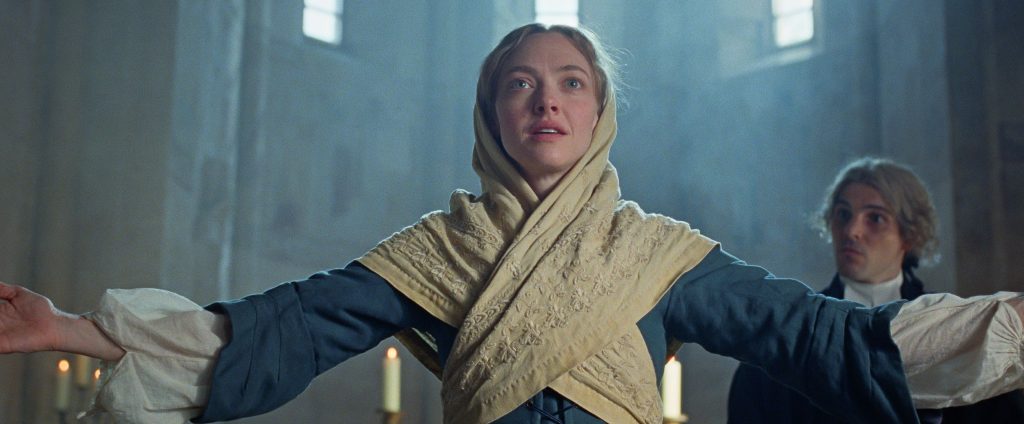
“Testament of Ann Lee is a gut-wrenching story of a woman’s faith that will have you spinning. Ann Lee, (Amanda Seyfried) born in Manchester UK in 1736 had a peculiar life. The opening sequence finds a group of pioneer women bending to the ground and throwing themselves towards heaven while chanting their way through a forest,” writes Anne Brodie at What She Said. “An incredible and outrageous story with strength and fury by director and co-writer Mona Fastvold. There are said to be only three Shakers left today.”
“Seyfried, who has already cemented her status as one of today’s most beguiling and unpredictable performers – any other actress would get whiplash going from playing tech-schemer Elizabeth Holmes in The Dropout to a betrayed opera virtuoso in Atom Egoyan’s Seven Veils to the sudsy theatrics of last [year’s] The Housemaid to this – is simply phenomenal,” notes Barry Hertz at The Globe and Mail. “In interviews, Seyfried said she approached the singing here as not something beautiful or melodic, exactly, but more animalistic, “like a woman on her knees.” And it is just that note of last-gasp desperation that makes her performance, which occupies almost every frame of the film, so entrancing.”
“The Shakers were certainly principled people, but they did know how to have fun in their own way. Nearly an hour of the film consists of recreations of their hymns and chants accompanied by dancing that morphs from stately to frenzied,” says Marc Glassman at Classical FM. “Daniel Blumberg, who composed the Oscar winning score for The Brutalist, has revived and arranged the authentic songs of the Shakers and written three new ones, which fit seamlessly into the soundtrack. The film truly comes to life when Amanda Seyfried, a fine singer, leads her group as ‘Mother Ann,’ in extraordinary songs and dances through the forests of early America.”
“The Testament of Ann Lee is a film about faith, the Christian faith with a difference. Though one might call hot a cult, Ann Lee preaches God as in Jesus, and so refutes a lot of her persecutors’ accusations,” writes Gilbert Seah at Afro Toronto. “The shakers were never ridiculed in the film, but more humanized.”
At That Shelf, Pat Mullen calls it “a miracle of a movie” and speaks with Amanda Seyfried and director Mona Fastvold, and asks Seyfried about how playing a musical director in Atom Egoyan’s Seven Veils informed her performance in this film: “Music comes in all forms. It’s all genres,” says Seyfried. “Especially an opera singer, that sound comes from so deep within someone’s body and it has to be connected to the soul. If it doesn’t, it sounds wrong. That’s exactly the same idea with the way Ann Lee uses her voice. It’s not because she wants to sound pretty and create a song and sing a song. It’s because that’s how she worships. It comes from a desperation and it comes from necessity.”
Files Under Miscellaneous
At the Toronto Star, Peter Howell tries watching 2001: A Space Odyssey on an iPhone and considers the role of screen size in the film biz: “If it’s harder than ever to suss the thinking of moviegoers, the industry itself often defies logic. The recent announcement that the Academy Awards is moving from TV broadcaster ABC to online service YouTube for the 2029 ceremony, a shift aimed at expanding the global audience, drew swift outrage from industry insiders who called it a downgrade for Hollywood’s premier showcase,” writes Howell. “The irony is hard to miss. Many of the same people who decry shrinking screens — including the likes of big-screen advocates Martin Scorsese and Steven Spielberg — have made production and distribution deals with streaming services. In truth, the Oscars have always been a small-screen event, made for living rooms, not multiplexes.”
At The Globe and Mail, Barry Hertz recaps memorable moments from the Golden Globes, including Teyana Taylor’s upset win: “In the biggest – and what turned out to be the only real – surprise of the night, One Battle After Another’s Teyana Taylor took home the Globe for Best Supporting Actress – Motion Picture over the presumed frontrunner Amy Madigan (Weapons). Seeming as shocked as anyone else, Taylor delivered an emotional and well-deserved acceptance speech that culminated with a shoutout to ‘my brown sisters and brown brothers … we belong in every home we walk into and our dreams deserve space!’”
On In the Seats with…, Dave Voigt has been a chatterbox with artisans on the campaign trail, including songwriter/singer Sara Bareilles (Come See Me in the Good Light): “Using the words of Andrea Gibson after they died, what Bareilles and Brandi Carlile do here is sum up what is a horrible emotional experience into a 3.5 minute experience that had this critic blubbering in tears.” Voigt also chats with Hedda composer Hildur Guðnadóttir, Sirāt sound designer Laia Casanovas, Hamnet costume designer Malgosia Turzanska and set designer Alice Felton, Avatar: Fire and Ash composer Simon Franglen, and Highest 2 Lowest singer/songwriter Aiyana-Lee.
TV Talk/Series Stuff
At What She Said, Anne Brodie investigates Netflix’s Agatha Christie adaptation Seven Dials: “Classic Christie! McKenna-Bruce puts in a terrific performance and how wonderful to see Bonham Carter in this juicy role.” Speaking of adaptations, Netflix’s Finding Her Edge offers a series version of the “young adult novel set in the world of competitive skating looks at family loyalties, the sometimes-confusing emotions girls experience as they grow up under pressure to perform, work ethic, family ties, and young love.”