
Reviews include The Mandalorian and Grogu, I Love Boosters, and Passenger.
TFCA Friday: Movie Reviews for March 27
March 27, 2026
Welcome to the TFCA weekly, a round-up of reviews and coverage by members of the Toronto Film Critics Association.
In Release this Week
53 Sundays (dir. Cesc Gay)
“The pleasure of 53 Domingos lies in the keen observations of the family dynamics,” notes Gilbert Seah at Afro Toronto. “How the family members argue, make mountains out of molehills and then get irritated and make more mountains out of molehills. The family could be called dysfunctional but this dysfunctionality can be seen in almost every family. There is sibling rivalry and friction of how the father comes into the picture. The issues examined in the film are uni resale – an aging parent and what to do with him – to put him in a home or have one (which one?) of the siblings look after him.”
After the Rain: Putin’s Stolen Children Come Home (dir. Sarah McCarthy)
“Despite the intent and content of the doc, none would have expected something more shocking or eye-opening to take away with water the film. There are too many scenes of the children just being children, and these scenes could have been taken out of any children’s camp,” says Gilbert Seah at Afro Toronto. “Still, the doc does bring audiences to the story of stolen children, an important issue and something that should never happen in a world.”
The AI Doc: Or How I Became an Apocaloptimist (dir. Daniel Roher, Charlie Tyrell)
“Midway between a feature-length doom scroll and an after-school special, the doc takes a serious approach to AI, despite its cutesy title. It roughly splits its interviews between pessimists (‘doomers’) and optimists (‘accelerationists’), and it leads with the doom,” notes Peter Howell at the Toronto Star. “Roher tries, not always successfully, to break up the talking heads with his own hand-drawn cartoons. Doodles swirl across the screen, poking fun at the gloom. It certainly needs tempering, because the first half of the film, which enlightens as to what AI is – it’s all about computers analyzing and expanding on patterns – makes you feel the theatre admission should come with a stiff drink.”
At POV Magazine, Pat Mullen chats with directors Daniel Roher and Charlie Tyrell about making a handcrafted film and where AI might find a place in documentary, if ever: “The guidelines and ethics of these conversations should revolve around the agency of the viewer to understand what they’re looking at and having the full context,” says Roher. “If you’re trying to pass something off as authentic and it’s not, that should just be understood as taboo and inappropriate, the same as we do now with plagiarism. But if there’s a big marker on screen that’s like, ‘This is AI generated,’ and it’s intended to be an aesthetic choice and it makes sense, I’m more open to that. But it’s a case that every filmmaker has to be critical and thoughtful about as they’re designing the approach.”
Alpha (dir. Julia Ducorneau)
“Ducorneau crafts a stunning visual tableau but for the first time it’s actually leaning much harder on its leading actors to give us a perspective of what is going on in this universe, even as we are jumping along in time and perspective throughout the narrative,” says Dave Voigt at In the Seats. “It’s messy but there’s a really interesting lyrical nature to the story that she’s trying to tell. Nothing is easy and it’s occasionally maddening but it’s always impactful.”
“Though the words AIDS or HIV are never mentioned in the film, it is clear what the disease is all about,” says Gilbert Seah at Toronto Franco. In that respect, it does not matter whether the name is mentioned or not. Since the name is not mentioned, director Ducournau could go further with her story about the disease, which she does not with the infected turning into stone. Alpha is an intense film, especially with fear spreading faster than the disease.”
Blue Heron (dir. Sophy Romvari)
***TFCA Awards Winner: Rogers Best Canadian Film***
***TFCA Awards Winner: Best First Feature***
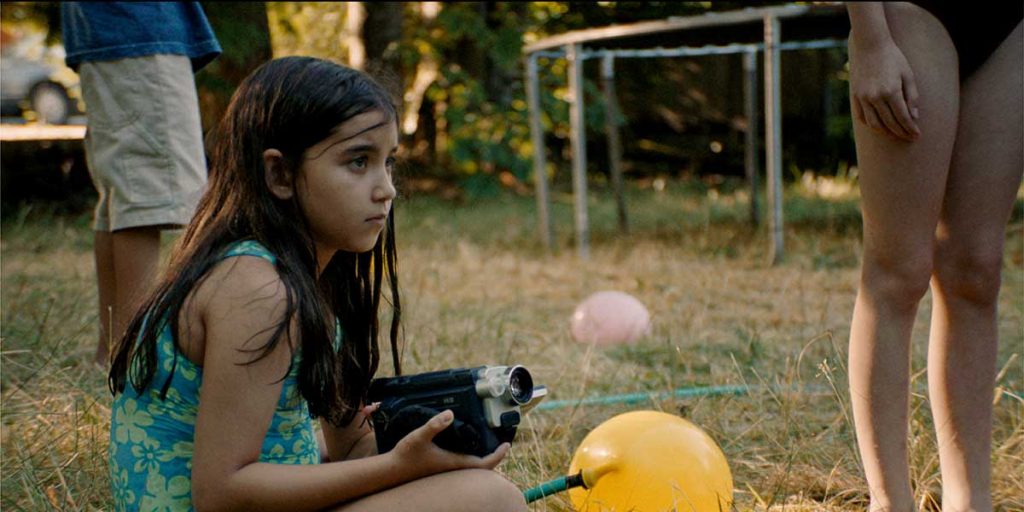
“Toronto filmmaker Sophy Romvari turns slippery memory into indelible cinema with a feature debut steeped in grief and grace. Drawn from her Hungarian Canadian family’s painful history, a topic she explored in the acclaimed shorts Still Processing and Remembrance of József Romvári, she again ponders family loss, this time through the story of a sibling’s mental illness,” writes Peter Howell at the Toronto Star. “It follows young Sasha (a stand-in for Romvari) as she and her three brothers move with their parents to Vancouver Island in the 1990s. The new beginning unravels when one brother’s psychological disorder disrupts the family and community, exposing the limits of tolerance and understanding. The film, winner of the Best Canadian Discovery Award at TIFF ’25, bridges eras as a collision of images and incidents, with childhood curiosity slamming into institutional failure. It’s a spellbinding debut, promising great things to come from Romvari.
“Blue Heron may be more overtly scripted and structured than Romvari’s shorts, but she doesn’t lose a beat while expanding her canvas with the poetry of life. The film isn’t so much an introduction to a fresh new voice so much as a confirmation of one,” writes Pat Mullen at That Shelf. “This is beautifully honest filmmaking that displays disarming vulnerability but also great sensitivity for the delicacy of its subject matter. The film draws from lived experiences and empathetically understands the shared sense of loss that bodies in the room will inevitably feel as they watch family unravel during that summer in the 1990s. If there’s a breakthrough talent [from] this year’s [Toronto International Film] Festival, this is it.”
BTS: The Return (dir. Edwin Earl Lewis)
“BTS: The Return is not just the making of. At best, the doc covers deeper issues while demonstrating the emotional portrait of a comeback—showing BTS at a vulnerable turning point as they try to redefine themselves after years of fame, pressure, and separation,” writes Gilbert Seah at Afro Toronto.
Holy Days (dir. Nat Boltt)
“1974 New Zealand: young Brian’s heart is broken, but he finds a quirky crew of nuns in a rundown convent facing shutdown. Together, they hit the road in a wild, hilarious race to save their home. ‘Holy Days’ is a feel-good joyride about faith, fierce family vibes, and finding hope where you least expect it. Buckle up!” exclaims Dave Voigt on In the Seats with…, who is joined by Nat Boltt to discuss telling the story of these tough old broads.
A Magnificent Life (dir Sylvain Chomet)
“What is impressive about director Chomet’s tactic is the use of a younger Marcel that takes the older version of himself through a reflective look at his entire life,” writes Gilbert Seah at Toronto Franco. “The framing device — a somewhat fading artist reconnecting with his younger self — gives the movie both emotional weight and a sense of “looking back,” making it a character study about aging, regret, memory loss, and creative doubt.”
“The most endearing section of the film is the pre-War studio era, when Pagnol rose to fame with the Marseilles trilogy, worked extensively with the beloved Fernandel and Raimu and made hit after hit,” says Marc Glassman at Classical FM. “With the arrival of the Nazis, matters became far worse causing Pagnol to close his studio. It was only after the end of World War Two that he was able to make his last great film Manon des Sources with his new wife and actor Jacqueline as the female lead. When Jacqueline and Marcel’s daughter died at the age of two, the last part of Pagnol’s life began—back in Paris as a writer.”
Pompei: Below the Clouds (dir. Gianfranco Rosi)
“It’s a living archive of a film that observes the ways in which past and present collide in this very specific site of memory,” writes Pat Mullen at POV Magazine, who gets some words from Gianfranco Rosi. “All my work is like a constellation of very different situations, and then the viewer has to discover the connections. I love to reveal the complexity of this world,” says Rosi.
Pretty Lethal (dir. Vicky Jewsom)
“Pretty Lethal is a meticulous cinematic experience as we slip into the point shoes of these ballerina as they kick all kinds of ass in order to survive,” says Dave Voigt on In the Seats with…. Voigt chats with film editor Richard Smither on “the art of editing and making sure that the character is always staying strong in the midst of the spectacle.”
The Red Line (dir. Sitisiri Mongkolsiri)
“The Red Line serves as a successful action driven morality tale that though running long at two hours and fifteen minutes moves fast enough with sufficient action set pieces )climatic car chase and shoot-outs included) that is entertaining as it is thought provoking,” adds Gilbert Seah at Afro Toronto.
They Will Kill You (dir. Kirill Sokolov)
“With a running time of and you and a half, They Will Kill You is an efficiently and effectively made action horror comedy that is at least original enough (it is not a sequel) besides the human sacrifice premise,” admits Gilbert Seah at Afro Toronto. “The title says what the film is all about, and horror aficionados should be pleased.”
Tough Old Broads (dir. Stacey Tenenbaum)
“These trailblazing women broke barriers in their time and continue to pursue their passions now. They’re living proof that you can follow your dreams and change the world,” says Dave Voigt on In the Seats with… who chats with Tenenbaum about capturing these women’s stories.
Two Prosecutors (dir. Sergei Loznitsa)
“Two Prosecutors has a Kafkaesque (from the writer Franz Kafka), feel of unsettling, absurd, and oppressive quality—like the worlds in his novels such as The Trial or The Metamorphosis,” writes Gilbert Seah at Afro Toronto. “This is where the greatest pleasure the film lies, in the creation and delivery of this mood and atmosphere. This is often created with static camera with almost no movement and long takes, minimal editing resulting in an effective and cold, controlled visual composition that almost makes the film look as if it is in black and white.”
“Idealism locks horns with autocracy during Stalin’s Soviet reign of terror, as a young lawyer (Aleksandr Kuznetsov) seeks justice for a wrongly imprisoned dissident,” says Peter Howell at the Toronto Star. “Sergei Loznitsa’s masterful adaptation of a novella by Georgy Demidov is impeccably photographed, staged and acted, and has a chilling resonance with modern times. The film’s meticulous attention to historical detail immerses viewers in an atmosphere of paranoia and fear, evoking the moral dilemmas faced by individuals under totalitarian rule. Loznitsa’s direction balances personal drama with broader political commentary, making this gut-wrenching tale easy to believe but hard to accept.”
File Under Miscellaneous
At Variety, Jennie Punter looks at the genesis of the Canadian series Glass House and speaks with creator, writer, and lead actor Martin Matte about bringing this Quebec story to streaming: “To me it was a story in Quebec and for Quebec people,” Matte tells Punter, “and if you told me it would be shown to people in another country I wouldn’t believe you…I wanted to write about the 1990s when my father was 53, and I was 25 and quit my father’s business to go into comedy…As I wrote, I could hear the way my father talked about things 30 years ago—when he had serious problems in the business, when my brother had a major accident.”
At the Toronto Star, Peter Howell picks five must-see films opening in April, including Chandler Levack’s Mile End Kicks: “The film opened both the Windsor International Film Festival and TIFF, indicating Levack’s wide appeal with cineastes. Mile End Kicks has also been nominated for seven Canadian Screen Awards, among them best original screenplay and best original song,” writes Howell. “Why I’m excited: Few Canadian directors capture 20-something angst with sharper humour and heart. Levack’s voice feels like a bridge between Matt Johnson and Sarah Polley, and I’m all in for that feedback loop.”