Movie reviews include La Bola Negra, Once Upon a Time in Harlem, and Wildwood.
TFCA Friday: Movie Reviews for May 15
May 15, 2026
Welcome to the TFCA weekly, a round-up of reviews and coverage by members of the Toronto Film Critics Association.
In Release this Week
The Bus: A French Football Mutiny
(dir. Jérôme Fritel and Christophe Astruc)
“The Bus: A French Football Mutiny is a fast-moving, 75-minute, real-life, exciting documentary that gets right to the chase with candid interviews with all those involved, including the coach and the football captain, all giving their points of view,” says Gilbert Seah at Toronto Franco. “It is clearly a case of ego, and the villain here is the coach who gets his comeuppance at the end. Recommended even for non-football fans.”
Cold War 1994 (dir. Longman Leung Lok-Man)
“It took the Oscars 98 years to acknowledge ‘Casting’ as a category, but this important profession is still not widely recognized in Asia,” writes Alice Shih at Original Cin. “Kudos to the casting team behind director Leung Lok-Man and producer Bill Kong. Every character in the Cold War Universe is meticulously cast, down to the background actors. The impressive ensemble consists of major award winners, including Chow Yun Fat and Aaron Kwok reprising their roles as the investigator duo, and the stellar chemistry played out by Daniel Wu, Tse Kwan-Ho and Terrance Lau back in the shady times of 1994.”
The Crash (dir. Gareth Johnson)
“The film suffers from being the typical Netflix doc where the incident is sensationalized, though one might argue that this is done for artistic entertainment,” notes Gilbert Seah at Afro Toronto. “But on the positive side, the film is intriguing, allowing the audience to be glued to the material as director Johnson stresses the important points of the story, which is the toxic relationship between Shirilla and Dom. The things young ones are capable of are seen with all their comfortable intrigue.”
Jack Ryan: Ghost War (dir. Andrew Bernstein)
“One of the film’s flaws is its technicality, especially involving the CIA, which many might not care about,” writes Gilbert Seah at Afro Toronto. “The film’s publicity insists that Jack Ryan gets more personal in his return to action. Ryan eventually uncovers that the real mastermind is not an outside terrorist leader but a Western intelligence figure using chaos to expand covert power and military influence. The ending leaves the franchise open to more films, and one would not be surprised that another Jack Ryan film is already in the making.”
Kartavya (dir. Pulkit)
“The film succeeds as less of a conventional action movie (do not expect a Bollywood-style film here) and more of a morally tense psychological crime drama. It focuses on a flawed hero grappling with systemic corruption, social hierarchies in small-town India, and the emotional burden borne by honest officers trapped within broken institutions,” writes Gilbert Seah at Afro Toronto.
Marty, Life Is Short (dir. Lawrence Kasdan)
“The documentary doesn’t over-analyze his work, but his peers, including Levy, O’Hara, John Mulaney (who cast Short in his short lived sitcom), and collaborator Steve Martin (Three Amigos, Only Murders In The Building) talk about the instincts and understanding of storytelling, timing, character,” says Karen Gordon at Original Cin. “No one declares him a comic genius, and yet, in clips of things he’s done – especially his outrageous celebrity interviewer character, Jiminy Glick – we see how funny, how fast, confident and in the moment he is…And as is typical of the Short we see in this film, it’s smart, it’s sad, it’s sweet and it’s wise. And based on what we’ve seen, it’s like the man himself.”
“While Kasdan doesn’t quite pace a documentary as well as he does his dramas, he still brings the heart that audiences expect from films like The Big Chill or The Accidental Tourist. Marty, Life Is Short draws upon an extensive range of archival materials to accentuate the emotional beats of the interview,” writes Pat Mullen at POV Magazine. “It’s touching to see so many talents who’ve come and gone in the life of this one performer—Gilda Radner, John Candy, Catherine O’Hara, Nancy Dorman, etc.—but the wealth of material on display shows comedy greats in their prime. Footage of a young Short and O’Hara riffing in an early SCTV sketch will give viewers all the feels, while range of off-the-wall comedy sketches from SCTV, Saturday Night Live, and Primetime Glick speak to Short’s unflappable energy that never sags.”
Silent Friend (dir. Ildikó Enyedi)
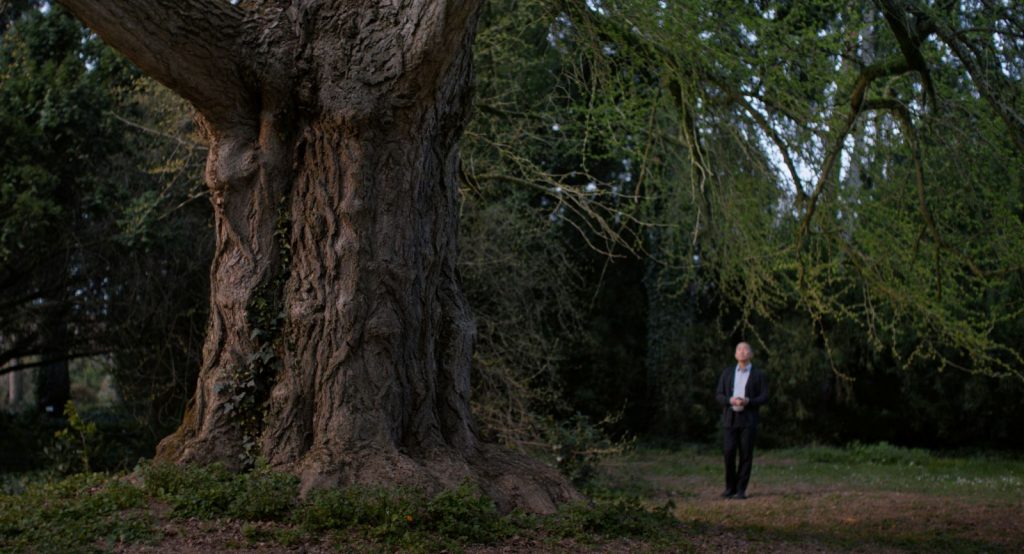
“The characters are well-defined as channeled through their distinctive voices, most evidently in the witty exchange in the 1908 section. Venice Film Festival Young Actress Award–winner Luna Wedler is exceptional as the pioneering student. The rest of the cast also excel, especially the tenacious but gentle professor played by Tony Leung Chiu-Wai, who Enyedi wrote this role specifically for. His eyes alone could convey the unspoken,” says Alice Shih at Original Cin. “The scientists all demonstrate their thirst for research breakthroughs; but the main protagonist of the film is our silent friend, the Ginkgo tree, from which point of view we witness and also shared the solitude of our three lonely protagonists. To study botanical consciousness is one way to unlock new means of communication, striving to open a dialogue with other seemingly non-expressive entities.”
“Silent Friend is a film that is filled with lovely moments but resists easy analysis. Enyedi offers us fragments of three stories but ultimately leaves them all without resolutions. What will happen to all of the characters, so winningly sketched out in the three tales? Will they find scientific solutions? Or romantic ones?” asks Marc Glassman at Classical FM. “Is it fair to “friend” a film? Ildiko Enyedi has made a work of poetics and great intentions. If you see Silent Friend, you’re bound to like it. Love it? Perhaps not.”
“A high concept art film, which is actually an anthology of three stories. It does not always work, and the inclusion of the century-old tree (the silent friend) often seems forced and pretentious,” admits Gilbert Seah at Afro Toronto.
“Silent Friend offers a surreal odyssey and an ambitious, richly layered work from one of cinema’s most fearlessly original talents. As with all experiments, Silent Friend features a fair degree of trial and error,” says Pat Mullen at That Shelf. “But when it succeeds with its formula, it unearths a film of great emotional intelligence. It moves the heart and gets one’s synapses firing. There’s a double entendre there somewhere.”
Strange Journey: The Story of Rocky Horror (dir. Linus O’Brien)
“As Strange Journey chronicles five decades of midnight madness with audience participation and slices of toast hurled in the air, it offers a fun and thoughtful reminder of the power of moviegoing as a collective experience,” says Pat Mullen at POV Magazine. “As alternative and independent films find ways to connect with viewers in the new landscape for theatrical releasing where community screenings and event shows become the norm for smaller films, it’s a welcome reminder that great films can find audiences, even if it means creating the right strategy for the audience to find a film. There’s a reason why so many people do ‘The Timewarp’ again and again.”
The Wizard of the Kremlin (dir. Olivier Assayas)
“Regardless of whatever Quentin Tarantino says, Paul Dano is quite strong here as the aloof artist turned TV producer and ultimately media manipulator to change the course of history,” observes Dave Voigt at In the Seats. “Jude Law also pulls off some fine work here as he manages the quite snarl of Putin in a way that kind of sneaks up on us. Having spent the bulk of the 1990’s and early 2000’s as a pretty leading man, he has rather quietly and successfully managed to morph himself into a fascinating character who is getting better with age. Alicia Vikander, Tom Sturridge and Jeffrey Wright all show up to give a little colour and variety in the story but don’t get to do much as Dano and Law (rightly) take up all the air in the room.”
“What Assayas and the two writers show is that Surkov’s story is not only essential to any understanding of Putin, but also how the new political world of sham and theatre and semi-fictional ‘realities’ has supplanted the older one-dimensional world leadership of the past,” notes Marc Glassman at Classical FM. “Surkov’s education provided excellent preparation for the new Russia: he went from studying military intelligence to a lengthy course in Moscow drama to a degree in economics. As the film shows, Surkov/Baranov worked in banking, the oil industry and as head of public relations for the leading former Soviet TV network before transitioning into politics—finally—by becoming the Deputy Chief of Staff for the President, who at that point, was still Boris Yeltsin.”
A Festival of Festival Coverage: Yes, We Cannes!
At the Toronto Star, Peter Howell reports from the Cannes Film Festival’s jury conference where Park Chan-wook spoke in favour of political art. “I don’t think politics and art should be divided. I think it’s a strange concept to think that they’re in conflict with each other,” the jury president said. “Just because a work of art has a political statement, it should not be considered an enemy of art … At the same time, just because a film is not making a political statement, that film should not be ignored.” He also reports on how audiences at the Croisette are making do without Hollywood blockbusters that will be opening in mere weeks: “If it seems strange that a glitzy event like the Cannes Film Festival would also celebrate the kind of films found in drive-ins, it shouldn’t be. [Thierry] Frémaux is quick to disavow any snobbery in the festival’s celebration of the seventh art,” says Howell.