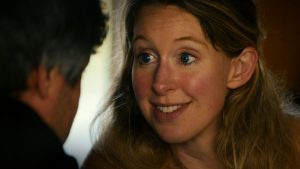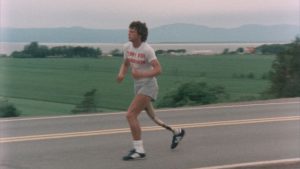
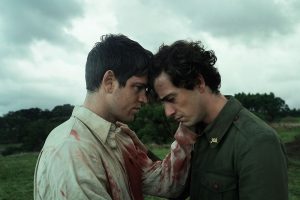
Movie reviews include La Bola Negra, Once Upon a Time in Harlem, and Wildwood.
TFCA Friday: Movie Reviews for May 8
May 8, 2026
Welcome to the TFCA weekly, a round-up of reviews and coverage by members of the Toronto Film Critics Association.
In Release this Week
Billie Eilish: Hit Me Hard and Soft (dir. James Cameron, Billie Eilish)
“Cameron’s team developed new cameras and lenses to bring advanced 3D technology to the screen, justifying the advertising claim that the film ‘reinvents the concert experience,’” writes Peter Howell at the Toronto Star. “Multiple cameras drift across, above and under the stage and also through the audience, providing deep-focus images that eliminate any visual separation between performer and crowd. The 3D glasses don’t cause any eye strain and the sound is also top-notch. You genuinely feel present, not as a tourist looking in, but as one of the faithful…Eilish‘s mostly teen and 20-something fans are clearly ecstatic, including the ones who danced in the aisle at the advance screening I attended. They sing along with every word and swoon over every high note and heartfelt gesture from the object of their affection.”
“The film introduces a lot of avenues with great potential that it doesn’t quite explore, but as a concert doc, it’s great entertainment,” writes Pat Mullen at POV Magazine. “When it focuses on the show, Hit Me Hard and Soft rocks hard enough to win over a die-hard Swiftie or Beyoncé fan who already got their turns. Eilish and Cameron unite their visions for a souped-up 3D extravaganza. He uses her creative energy on the stage as a guiding light for shooting the film version with three-dimensional depth. It looks great and captures the liveliness of Eilish’s performance style. She jumps up and down on the stage like a headbanger and her eye for giving the show a vertical access suits the big screen well. Add some flashy lighting and a bright cube that serves as on onstage platform/transitional device, and the film has enough moving parts for the 3D to be of service.”
Blue Film (dir. Elliot Tuttle; USA only)
On The Queer Gaze, Joe Lipsett calls the film “confronting, controversial, and exceptional.”
The Butcher’s Blade (dir. Liu Wenpu; May 12)
“It is the action sequences that make this film stand above the traditional run-of-the-mill martial arts films, aided by a solid plot involving a down-and-out constable whom audiences can root for as he tries to redeem himself in a corrupt world,” says Gilbert Seah at Afro Toronto.
The Last One for the Road (dir. Filippo Scotti)
“Our two lead miscreants played by Sergio Romano and Andrea Pennachi are a fun team and are reminiscent of a less desirable Norm & Cliff from Cheers. You wouldn’t necessarily gravitate to them at the beginning of any given evening, but when the beer goggles are thick and last call just got announced they have an ability to keep the party going and they drive the story with charm and ease that actually makes us laugh while acknowledging something of a quiet despair about them,” notes Dave Voigt at In the Seats. “While the aimlessness of these characters is hardly something to be aspired too, The Last One For The Road finds joy in those moments that we never really search for in our lives but allows us the space to appreciate times in our lives that we’ll never forget or be able to recreate….even if sometimes we didn’t always want to.”
“This film has garnered rave reviews, which is a surprise considering that the film meanders all over the place with apparently not much direction or narrative,” admits Gilbert Seah at Afro Toronto. “A few unconnected segments, like a gay kissing segment, make little sense either.”
Living the Land (dir. Hugo Meng)
“The film also explains the culture and work ethics of the Chinese folk. At best, the film examines and demonstrates the resilience of the human spirit of any person willing to go all out to achieve their goal in life,” says Gilbert Seah at Afro Toronto.
Marama (dir. Taratoa Stappard)
“Marama should not be dismissed as a mere horror movie,” advises Gilbert Seah at Afro Toronto. “The film works on several levels. One is the timely issue of forced colonisation, an issue that has rocked the world recently, especially in Canada, with the discovery of mass graves. In Marama, the main story concerns the Indigenous Maori people in New Zealand as the main character, Marama, who is Maori and who travels all the way by ship (the story is set in 1895), taking many, many days in order to reach Yorkshire, England.”
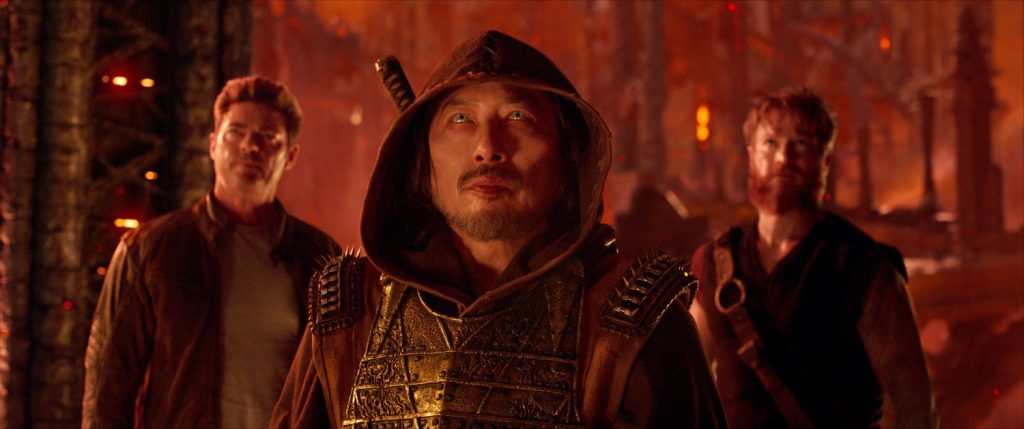
Mortal Kombat 2 (dir. Simon McQuoid)
“If it bothered you that the 2021 film didn’t even feature a Mortal Kombat tournament, rest assured, this film delivers,” says Victor Stiff at That Shelf. “It jumps right into the tournament from the opening sequence and provides scene after scene of bone-breaking, gore-spewing action. It features a number of thrilling fights, with stylish choreography and stomach-churning fatalities. While far from perfect, this sequel feels like the film fans were clamouring for back in 2021. Its story, settings, and action sequences wouldn’t look out of place running on your PS5.”
“There’s a definite samey-ness vibe to McQuoid’s direction in these fight scenes, which tend to rely on slow motion and the same kind of martial art moves,” adds Joe Lipsett at Queer Horror Movies. “Unlike the games – where characters have unique fighting styles – in the film, their only unique element are their powers, such as Sonya’s pink rings or Sindel’s (Ana Thu Nguyen) sonic scream. These are fun, but the film tends to rely too heavily on them, such as when Sonya fights the Queen: the whole fight simply involves Sindel screaming while Sonya tries to blast her.”
“Yes, it is a silly and contrived repetition of the first film, and an overextended expansion of the Mortal Kombat games’ already stupefyingly insane backstory,” says Jackson Weaver at CBC. “Add to that subplots involving a magical immortality-granting amulet, a race of anglerfish-looking orcs and a twisty revenge arc for nearly every character on screen, and you have a grab bag of more randomly assorted sci-fi and high-fantasy tropes than a Stranger Things-themed trivia night.”
My Dearest Assassin (dir. Taweewat Wantha)
“The fight sequences are ok for an action film, though not spectacularly impressive,” writes Gilbert Seah at Afro Toronto. “The film’s unique premise of the durum blood slowly loses its spark, and the film descends into the typical action film so common these days. Strictly for martial arts fans.”
Omaha (dir. Cole Webley)
“In his feature debut, director Cole Webley working from the script by Robert Machoian has crafted something devastatingly simple that actually has respects for its characters and the horrible nature of the situation they are and allows us to organically evolve with them. Nothing that happens is really anyone’s fault but they all have to suffer because of it,” says Dave Voigt at In the Seats. “The exposition is minimal; rather it all comes through the faces of our two leads that do a masterful job and taking us through a moment of quiet despair from two different perspectives. One who is knee deep in it and one who is slowly realizing the horrors of her situation.”
“From a story point of view, Omaha is a slight film but one that punches way above its weight,” writes Karen Gordon at Original Cin. “Much of that has to do with the performance of actor John Magaro (Past Lives, September 5), whose quiet presence gives the film more than just emotional ballast. His subtle performance also opens doors to issues like fatherhood and male grief…he emotion is what carries the film, and it is affecting, especially thanks to Magaro’s thoughtful work which draws incredible compassion to the themes of the film though it is arguably too thin in terms of background.”
Our Land / Nuestra Tierra (dir. Lucrecia Martel)
Calling it a “scathing analysis of the history of Argentine culture,” Marc Glassman at POV Magazine speaks with Martel about her relationship with documentary and narrative fiction: “Fiction trains us in the construction of verisimilitude. And that is a flashlight in the complex web of a country’s history,” says Martel. “History is an act of will of the generations that benefit from it. It establishes an order that legitimizes the access of some to the possessions of others. History is a very particular case of fiction, the most successful of fictions. A nation is founded on myth, never on facts. I think we call a documentary any attempt to establish an order that explains what has been left out of the origin myth. In fiction, actors die and rise again. In documentary film, death is definitive. Perhaps that’s what separates fiction from documentary.”
“Our Land, as evident in her many other works, demonstrates dense sound design with natural sounds of the Indigenous people, layered storytelling often showing the different points of view of the accused murderers and the victims, with intimate camera work often blending close-ups of faces showing emotional tension with distant shots,” notes Gilbert Seah at Afro Toronto. “The multiple themes of repression, privilege, colonialism, and social unease are impressively displayed in this remarkable documentary.”
Remarkably Bright Creatures (dir. Olivia Newman)
“The film is charming, with Sally Field doing her best to get the audience to really, really like her,” says Gilbert Seah at Afro Toronto. “Tova has lost her son, but no details are given in the early part of the film. She is at the point of decision and finally has decided to sell her house and move into a nursing home, where many of her friends are.”
At Zoomer, Brian D. Johnson chats with star Sally Field and learns about how she shared the screen with an octopus: “I’ve played with a lot of actors who weren’t quite there,” she laughs. “I’m hesitant to spoil the magic of what the piece is, to say how much of what you see of Marcellus is real and what is special effects. But all of acting comes from your ability to concentrate and hypnotize yourself – to think something is happening that isn’t happening.”
The Sheep Detectives (dir. Kyle Balda)
“From the first act straight through to the third, the film engages on a level far higher than it needs to. Which is what happens when you put real craft behind a premise that could have coasted on novelty. Director Kyle Balda (Despicable Me 3, Minions) works from a script by Craig Mazin (The Last of Us), adapted from Leonie Swann’s Three Bags Full. It’s an overqualified team for a flock of sheep—and that’s precisely why it works,” says Thom Ernst at Original Cin. “Somewhere between the whimsy and the absurdity, the film finds its footing. The cuteness never overwhelms the story, and the story holds. What emerges is a genuinely engaging mystery, one that plays fair while still indulging its premise. Call it Shears Out by way of Knives Out—lighter, warmer, and less interested in showing off.”
“The film also balances light humour with a real murder plot, with a perspective shift of humans being seen through the eyes of animals, making everyday behaviour seem strange or suspicious. I loved the film more than I had expected!” cheers Gilbert Seah at Afro Toronto.
“The cast of actors who get to use their bodies as well as their voices are quite good, too,” adds Marc Glassman at Classical FM. “Of course, they don’t have much to do but they acquit themselves well. Hugh Jackman is so amusing that it’s a shame we barely see him in the film. Emma Thompson is a delight as the lawyer, who works the inheritance case; again, not a stretch for her but it’s fun to just watch her dominate scenes. The only really interesting acting is by Nicholas Braun, who has been establishing a reputation as a slow burn comic actor since his breakthrough as the dumb aspirational cousin in the TV hit Succession. He’s very funny as Tim the cop who is mentored by the sheep into becoming a good detective.”
At That Shelf, Pat Mullen chats with actor Nicholas Braun about starring opposite sheep, defying casting, and going toe to toe with Emma Thompson: “I loved shooting my scenes with her. She’s an incredible actress, obviously a vet and came to set completely prepared, knew exactly what she wanted to do, was not phoning it in,” he says. “The two characters are such a fun match for each other, and they also have a nice arc together. But sitting across from her, she’s a very present actor. She’s giving you a lot. It’s the best experience when you’re acting to someone who has all their ideas.”
Sk+te’kmujue’katik (At the Place of Ghosts) (dir. Bretten Hannam)
“It’s hard to fathom how an 81-minute movie that takes considerable time to breathe can have so many ideas stuffed into it. It is definitely a storytelling accomplishment for the young L’nu filmmaker,” says Jim Slotek at Original Cin. “And American Indigenous actors Miranda and Goodluck are just similar enough, and just different enough, to be convincing as siblings, gay and straight. Their performances anchor the film and give the passing parade of visions a human sounding board that makes At the Place of Ghosts a believable and shared experience.” He also speaks with the actors about the new ground broken by this Indigenous production: “[O]nce you have people like in this film, Bretten in the community, the language keepers bringing in John R. Sylliboy (Dalhousie University’s vice-provost of Indigenous Relations) as the language consultant, it’s a different environment,” says Goodluck. “I’m interested in seeing Native and Indigenous folks behind the camera, cinematographers and ADs, producers, crew. You can have a bunch of Native actors, which is cool. But like you turn around and it’s sort of homogenous behind the camera.”
A Festival of Festival Coverage: Hot Docs Post-Mortem
At POV Magazine, Pat Mullen recaps Hot Docs 2026 where the festival showed strength in numbers even with a field of relatively “smaller” docs: “Add the stats to anecdotal observations of the turnout, and they yield an important point in Hot Docs’ strength in numbers. The festival had relatively few ‘name’ draws in terms of high-profile subjects, outside of opening night honouree Carole Pope and mid-fest headliner Kenny Loggins, and only a handful of directors with whom general audiences might be familiar,” writes Mullen. “Hot Docs 2026 selections seem ‘smaller,’ but they’re rewarding films that one likely won’t see elsewhere. This fact means that audiences were coming out to experience these stories and learn about the world. Put another way, people were motivated to attend simply due to their interest in docs and the titles that the programming team whipped up for their enjoyment.”
TV Talk/Streaming Stuff
At Original Cin, Karen Gordon celebrates the 100th birthday of nature documentary king David Attenborough. “His passion for the natural world never wavered. But as time went on, the human impact on the planet, and concerns about shrinking biodiversity, began to shift his work more towards environmentalism and using his work to advocate for change,” says Gordon.