
Reviews include Insidious: Out of the Further, Late Fame, and Spa Weekend.
TFCA Friday: Movie Reviews for Oct. 24
October 25, 2025
Welcome to the TFCA weekly, a round-up of reviews and coverage by members of the Toronto Film Critics Association.
In Release this Week
Anniversary (dir. Jan Komasa; Oct. 29)
“Despite the high aims of the movie tackling political issues, the way in which the approach is taken feels manipulative and cheesy,” writes Gilbert Seah at Afro Toronto. “The blending of the family drama and divisions enhances the cheesiness. The setup has echoes of ‘infiltration’ narratives—someone from the past re-enters a seemingly stable family with hidden motives.”
Blue Moon (dir. Richard Linklater)
“Scott, an actor who doesn’t seem to know how to do false notes, won a Silver Bear for Best Supporting Actor at the Berlin International Film Festival earlier this year for his brief turn here. That seems fair: He salvages the film,” notes Liam Lacey at Original Cin. “As Rodgers listens to Hart’s rush of speech, he responds with his gaze, in subtle shifts of resolve, discomfort, and sympathy for his friend’s humiliation. He has a faraway look of someone who can see the future, not just of the American musical, but his old friend’s setting sun.”
“Kaplow and Linklater know that the heart of the film lies in Hart’s two connections — one with a man he’s worked with for decades, the other with a woman who might just be able to inspire him to write something else,” writes Glenn Sumi at Go Ahead Sumi. “The filmmaker cleverly withholds Rodgers’ side of the story until late in the film when, during a moving sequence on a staircase, Richard confronts Larry about how his drinking affected their most recent collaboration. He grudgingly agrees to revisit an earlier musical, A Connecticut Yankee, which we’ve been told will be the last thing Hart worked on before his death in November 1943. You believe it when Scott says “it’s not personal, it’s business.” The problem is, with Hart, everything’s personal.”
“Robert Kaplow whose novel Me and Orson Welles, set during the great director’s 1930s theatrical production of Julius Caesar, was made into a successful film with Richard Linklater in 2008. Now he and Linklater have combined to create another fine film set in the glamourous old days of Broadway,” says Marc Glassman at Classica FM. “Ethan Hawke will surely get an Oscar nomination for his portrayal as Lorenz Hart. Blue Moon is a must see. It is the finest American film about the theatre since All About Eve.”
At Original Cin, Kim Hughes speaks with Richard Linklater, Ethan Hawke, Andrew Scott, and Bobby Cannavale on their collaboration: “We’re just friends,” says Linklater. “I read the script and sent it to Ethan without really even thinking he might play Hart. We started talking about it and 12, 13 years later we finally made the film (laughs). Also, we realized we hadn’t really worked together in about 10 years, but we felt like we had because we had been talking about this thing. Creative collaboration continues whether you’re working together or not. Those long-term artistic friendships are very satisfying and you’re looking for the right thing at the right time. In the meantime, you just appreciate people’s careers. It’s fun to see your friends firing on all cylinders.”
Bugonia (Dir. Yorgos Lanthimos)
“Yorgos Lanthimos’s Bugonia delivers a scathing indictment of modern society. The genius of the film comes from how this modern absurdist master hits batshit levels even as he grounds his film in a precise amalgam of themes and style that’s almost too simple. Yet, Lanthimos clearly captures a deeply haunting vision of humanity’s collision course to destruction,” notes Barbara Goslawski at Exclaim!. “Bugonia is a biting, satirical genre mash-up. Lanthimos offers a mind-expanding absurdist black comedy and mystery sci-fi thriller that’s a straightforward yet necessary warning on the inevitable climate disaster that awaits this planet.”
“Bugonia strikes a particular chord amidst the discourse online and in the mainstream media,” says Rachel Ho at Exclaim!. She also chats with stars Emma Stone and Jesse Plemons. “A character like this, early on, naturally, you have a more objective, aerial view of the character,” Plemons tells Ho. “You’re making those references, and then, slowly, it becomes more and more subjective, and you think less and less about what [he] represent. It’s more about trying to figure out the motivations [of the character].”
“Lanthimos knows the film is not to be taken too seriously, though he goes all serious during the first half,” says Gilbert Seah at Afro Toronto. “He goes all out with ridiculous alien costumes (big oversized furry baggy attire) with odd colours and sets. Even the locked closet being the transportation of the alien, turns out to be true in a twist of the plot. Now thing one can say about a Lanthimos film, it is never boring, though the film is a bit of a slow burn at the start.”
“As usual in Lanthimos’s films, Stone gives the best performance. Her Michelle is a control-freak of the highest order, who finds herself in a situation where control is just beyond her grasp. We see enough of her in her normal environment to know that her helplessness is tearing her up inside, even more than the shaving of her head or the electrical torture Teddy employs to try to get her to admit she’s an alien,” says Jim Slotek at Original Cin. “Plemons and Delbis do have their comic moments, particularly in their bungling execution of the initial kidnapping. And Delbis gives Donny a sweetness of character that softens Teddy’s psychosis and makes us a little more sympathetic to these two social outliers.”
“[T]wo of the most undeniably talented actors of their generation are once again pulled into Lanthimos’s ain’t-I-a-stinker orbit with Bugonia,” writes Barry Hertz at The Globe and Mail. “Plemons takes over the role of the crazed pseudo-hero, playing Teddy, a conspiracy nut who believes that Stone’s Michelle, the chief executive of a nefarious drug company, is an even more nefarious alien invader. Together with his slow-witted cousin Don (Aidan Delbis, whose every line reading grates), Teddy drags Michelle to his basement, shaves her head (to avoid the aliens from follically tracking her location), and demands that she call off the intergalactic invasion. What follows is nearly two hours of humiliation and contempt, for both the characters and Lanthimos’s audience.”
“While it’s a bleak affair, director Yorgos Lanthimos (Poor Things) handles it with a light touch no matter how darks things get. Bugonia boasts a major rebound for the director after last year’s misfire Kinds of Kindness,” says Pat Mullen at That Shelf. “He finds his groove again with the kind of absurdist, yet unsettlingly reflective, comedy that characterizes his best works. If Kinds of Kindness seems weird for the sake of being weird, then Bugonia asserts its authenticity by bringing audiences to the precipice of the lunatic fringe and gleefully knocking them over the edge.”
The Elixir (dir. Kimo Stamboel)
“The only positive point about this Indonesian horror movie is the zombie flick set in an Indonesian non-western setting,” says Gilbert Seah at Afro Toronto. “Despite the poor acting and silly storyline, the individual action set pieces are effectively staged. The film also shows that eternal youth and sex performance are very much desired in any setting.”
The Hand that Rocks the Cradle (Dir. Michelle Garva Cervera)
“Cervera and Bloomberg have crafted a contemporary, well-shot thriller that values the flawed complexity of its characters,” says Joe Lipsett at Bloody Disgusting.
Hedda (dir. Nia DaCosta; Oct. 29)
“What makes Hedda so great and unique is that the complex female character that we’re seeing is not only Black, she’s also queer, and she’s one of the most infuriating characters I’ve ever watched. Complimentary!” writes Kathleen Newman-Bremang at Refinery 29. She also chats with Thompson about her infuriating character. “Ibsen, in the head of Gabler, wrote the prototypical first, way-ahead-of-her-time complicated, messy woman. I think what felt really exciting is to turn that on its head and to reimagine it and to repurpose it and to reconstruct it in all the beautiful ways that Nia was able to,” says Thompson.
It Was Just an Accident (dir. Jafar Panahi)
“Panahi is a master, who makes films about darker subjects that are nevertheless light and enjoyable. Seeded with vibrantly drawn characters, It Was Just an Accident is a hybrid: part tragicomedy, part road movie, and part revenge thriller,” writes Karen Gordon at Original Cin. “Of course, at its core, It Was Just an Accident is a profound movie that asks big questions about morality, about justice. The people in the van have the power of life and death over someone who, if he is their torturer, has crossed every moral and human boundary for nothing.”
“Gradually, Panahi widens Vahid’s ticking-clock quest – every minute wasted is one more during which Eghbal could awaken and wreak havoc – adding a number of Peg Leg survivors reckoning with their own traumas,” notes Barry Hertz at The Globe and Mail. “Some are more fully sketched out than others, though a wedding photographer played by Mariam Afshari, who appears without the country’s mandatory hijab, is a welcome addition, quick-witted and dumbfounded at the same time.” Hertz also speaks with the Palme d’Or winner.
“The director, rightly famed for his own efforts to expose injustices of the Iranian regime, relies heavily on the paratextual elements surrounding his film—a trait in his filmography as facets of his films’ productions have become urban legends of their own,” writes Pat Mullen at That Shelf. “The moral quandary with It Was Just an Accident circles back to the question of forgiveness. Panahi is a talented filmmaker working in extraordinary conditions with undeniable fearlessness, but he holds a mirror up to a world that doesn’t feel real. Every person behaves like a total boob as they weigh the dual drives of guilt and vengeance. Is a bad film redeemed by what it represents?”
Last Stop: Rocafort Station (dir. Luis Prieto)
“Director Prieto makes full use of the mystery, menace, and history of the reputed haunted Rocafort Station to enhance a story of ghosts and murder,” notes Gilbert Seah at Afro Toronto. “One complaint audiences might have is that the film ends after all the mystery is explained, but not with a happy ending.”
Queens of the Dead (dir. Tina Romero)
“Is the film terrifying? It is, if you dread watching drag queen stuttering around like peacocks with their limp wrists and effeminate ways,” says Gilbert Seat at Afro Toronto. “But they are as camp as they are entertaining, if one likes this sort of thing. Queens of the Dead is a horror film not to be taken lightly, but with humour and lots of camp.”
Regretting You (dir. Josh Boone)
“Despite attempts at twists and turns in the story, it still comes across as manipulative, especially towards the privileged white female,” notes Gilbert Seah at Afro Toronto. “Why does everything good and all dreams come true for this spoiled teen? Also, what happened to baby Eli during the last half hour when all hell broke loose?”
Shelby Oaks (dir. Chris Stuckmann)
“Shelby Oaks is an occasional impressive first feature with some genuine scares that suffers from inconsistency (should supernatural forces exist or not?) and the lack of a strong narrative,” says Gilbert Seah at Afro Toronto.
“Those who can’t do, review? Not so for Chris Stuckmann, YouTube reviewer turned filmmaker,” observes Barry Hertz at The Globe and Mail. “Regrettably, that impressive switcheroo is the only real trick up Stuckmann’s sleeve, as the rest of Shelby Oaks proceeds to unfold in ways both expected and regretted. As Mia (Camille Sullivan), the older sister of the missing sleuth Riley (Sarah Durn), begins to mentally unravel over the mystery, Stuckmann’s film begins to feel overwhelmed by its many obvious influences (most of which the filmmaker has provided deep dives into over the years via his YouTube page). There is the abandoned-prison spookiness of Brad Anderson’s Session 9, the missing-person obsession of Joel Anderson’s Lake Mungo, the demonic possession hijinks of Ari Aster’s Hereditary, and too many Blair Witch nods to count.” He also chats with Stuckmann.
Springsteen: Deliver Me from Nowhere (Dir. Scott Cooper)
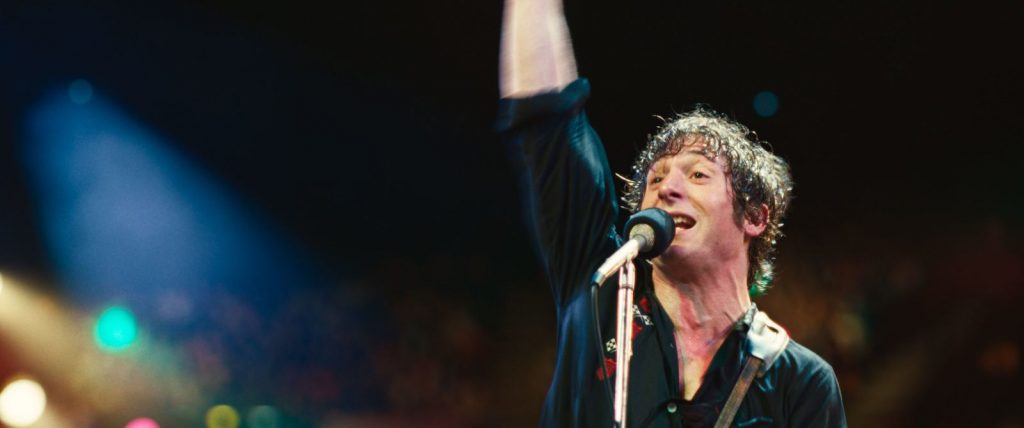
“Will anybody but Springsteen diehards appreciate Deliver Me From Nowhere? The film seems unlikely to attract the large audience earned last year by the music biopic A Complete Unknown, in which Timothée Chalamet received a deserved Oscar nomination for expertly channelling Bob Dylan in both look and sound,” says Peter Howell at the Toronto Star. Springsteen: Deliver Me From Nowhere honours its subject’s courage — he’s been honest about his mental health issues — more than it rewards his myth. A film of grit without glory, insight without ignition, it’s a tribute to Springsteen and Nebraska but far from transcendent as a viewing or listening experience.
“Cooper has put a lot into the film, with mixed results. There are pieces that feel underdeveloped and there isn’t a lot of context, notably in the relationship between Springsteen and Landau,” writes Karen Gordon at Original Cin. “The love and loyalty between the two is key, as any Springsteen fan can tell you, but as presented in the film, it’s a bit too elusive. The best, rawest and most immediate scenes are those with Faye. Sometimes things unsaid work best.”
“In Deliver Me From Nowhere, there’s so little urgency behind the writing that it feels intentional: when it comes to investigating the interior of Springsteen’s mind, we are alternatively given the narrative equivalent of a brick wall, or a brick to the head,” says Jackson Weaver at CBC. “Sometimes it is Springsteen speaking with boring ease, which we can only infer is an emotional front from all the times Landau literally tells us it is. Other times, his lyrics operate as a paint-by-numbers Freudian analysis. Though given the vagaries and intricacies of Springsteen’s troubled, artistically neurotic mind, these can be incredibly difficult to parse.”
“While no one professed to understand Springsteen’s motivations, Cooper makes it clear that Nebraska did get produced, released and even became a reasonably successful album hit,” says Marc Glassman at Classical FM. “More problematic is the decision to create a relationship between Springsteen and a beautiful New Jersey fan, a waitress named Faye Romano, played by Odessa Young. Though she’s good in an underwritten role, you wonder why Cooper decided to construct such a character. I suppose romance just felt necessary in the film. At least it allows Cooper to shoot scenes in diners and amusement parks—true Americana that the Boss clearly uses in his songs.”
“One thing to note is that this is not the typical biopic like the recent ones on Elvis Presley and Elton John. This is a dramatic portrayal of Bruce Springsteen as an artist fighting his personal demons, which include his depression, outbursts, and failed romances,” adds Gilbert Seah at Afro Toronto. “There is little seen of the Boss performing on stage, though there is emphasis on the songs he had written, in which one can appreciate his hard-to-recognize talent.”
“The arc of Bruce Springsteen’s career should be ripe, juicy material. The months-long stretch in which he hid himself away in a New Jersey lake house with nothing but the short stories of Flannery O’Connor, a copy of Terrence Malick’s Badlands, and a now-primitive four-track TEAC 144 Portastudio recorder for company? Not so much, it turns out, even when that scenario is placed upon the sturdy shoulders of Jeremy Allen White (The Bear), an intensely committed actor ready to lay down his life on a highway jammed with broken heroes for a last chance power drive,” writes Barry Hertz at The Globe and Mail. “Cooper, who is an old if not exactly steady hand at making movies about blue-collar rogues (Crazy Heart, Out of the Furnace), tries to beef up the drama wherever possible but only ends up thinning the material in the process.”
At Exclaim!. Rachel Ho speaks with director Scott Cooper: “People will come to this movie like they will Elvis Presley, and they will have preconceived notions,” Cooper acknowledges. “It’s really about stripping away all of that iconography and showing a man who is dealing with unresolved trauma, who is searching for re-connection with his father. A man who [feels] guilty that he’s no longer like the people he grew up with in Freehold, New Jersey. A man who has a very difficult time connecting with a partner in this chapter of his life.”
Stiller & Meara: Nothing Is Lost (dir. Ben Stiller)
“If you’re looking for Ben Stiller, the comedian, you won’t find him here. This is a quieter, reflective Ben. And the film ends up being more than just a biography. It’s not just his parents and their love story, their troubles, their career, but also of the legacy of their lives that continues to flow down through the generations,” says Karen Gordon at Original Cin. “Maybe the best way to tell you about that is to note that in the credits at the end of the film, there is a sequence that reads “A Film By:” and then every family member gets their moment on the screen.”
A Festival of Festival Coverage
At Original Cin, Jim Slotek previews Rendezvous with Madness and speaks with director Alan Zweig, whose film Love, Harold explores the effect of suicide on the living: “And I think there were four or five people in the film who were around that age who had experienced struggles, but had overcome, had some success and then were back down having lost everything – whether it was your girlfriend, meet a woman, you move in, she kicked you out, you’re back down. Do you want to go through that loop again?”
At POV Magazine, Pat Mullen picks documentary highlights at the Windsor International Film Festival.