Reviews include Onslaught, Mayday, and Hope.
TFCA Friday: Week of August 1
August 1, 2025
Welcome to the TFCA weekly, a round-up of reviews and coverage by members of the Toronto Film Critics Association.
In Release this Week
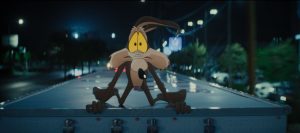
The Bad Guys 2 (dir. Pierre Perifel)
“[T]he movies do live and die based on the performance of Sam Rockwell as the lead antihero, Mr. Wolf,” says Barry Hertz at The Globe and Mail. “The Oscar-winning actor, prior to his long-awaited breakthrough role in the 2017 drama Three Billboards Outside Ebbing, Missouri, has long been one of the film and stage world’s most colourful (and underrated) performers. Thanks to his witchy mannerisms, his puppy-dog visage, and the wiry, idiosyncratic way he wraps his tongue around dialogue, Rockwell has spent decades perfecting a kind of debonair sense of danger. You’re never quite sure whether Rockwell wants to kiss you or kill you. And you’re pretty confident he hasn’t a clue, either.”
“As enjoyable as it is to see them try and untangle themselves from the latest mess they get into, the one knock on the franchise is it never resonates as deeply as it could,” writes Courtney Small at That Shelf. “Sure, there is messaging about never giving up in the times where change can feel hopeless, but those moments feel fleeting at best. Never letting the viewer sit with the difficulties that come with attempting to break free of the past, or even how we tend to inadvertently put others in boxes we refuse to let them out of, the film opts for quick gags that disrupt any hint of emotion.”
BTS ARMY: Forever We Are Young (dir. Patty Ahn, Grace Lee)
“A standard, but insightful look at the fanbase supporting world renowned Korean pop superstars, BTS ARMY: Forever We Are Young looks at the ways everyday admirers of artists can bolster and prop up their idols – and even each other – through various high and low points,” says Andrew Parker at The Gate. “Nothing in the film will necessarily come as a shock to anyone who has ever felt strongly about anything in pop culture, but as a testament to the BTS ARMY itself it offers a good deal of insight and warmth.”
Delegation (dir. Asaf Saban)
“The film is however, despite good intentions boring, tedious while not offering any new insight to the holocaust cause,” says Gilbert Seah at Afro Toronto. “Audiences around the world already sympathize the cause and need not watch shock boys goof around and flirting with the opposite sex and then sitting down to discuss their Jewish past. Audiences are forced to endure the teen’s romantic flings and then have to listen to them talk about how they felt about the holocaust.”
Ghosts of the Sea (dir. Virgina Tangvald)
“Sailing on the dark waters of the past, Ghosts of the Sea builds a poetic blueprint for how the male ego can tangle itself to the anchor of tragedy. Through archival footage of Thomas and Peter, and incorporating interviews with friends, navigation experts, family, and her own inner thoughts, Tangvald presents a vivid portrait of a family that has endured an unimaginable amount of grief,” says Courtney Small at POV Magazine. “An intriguing search for catharsis through the tall grass of tragedy, Ghosts of the Sea is a haunting work that lingers in the mind.”
Harley Flanagan: Wired for Chaos (dir. Rex Miller)
“Harley Flanagan has had a tough and intriguing life, creating lots of trouble as well as ink hits. A doc is often as interesting as its subject, and the saying is true here,” says Gilbert Seah at Afro Toronto. “The doc bears Flanagan’s life, warts and all, together with his philosophy of life, distorted, and whether one wants to accept it at all.”
An Honest Life (dir. Mikael Marcimain)
“An Honest Life is an interesting if undemanding made-for-Netflix thriller that weaves together themes of classism, anarchy, and ultimately a young character coming to terms with who he is, and how far off the path of an ordinary life he’s prepared to go,” notes Karen Gordon at Original Cin. “It doesn’t completely bite into some of the material that it touches on. But then, Marcimain isn’t focusing this film outward into the complications of the world.”
“Based on the novel by Joakim Zander with a screenplay by Linn Gottfridsson, the film, a coming-of-age fable, benefits from a Nordic touch in theme and look,” writes Gilbert Seah at Afro Toronto. “The film was shot in contrasting areas from the oldest University in Sweden to the cheap dance bars in Lund, while interrogating themes of rebellion, social class, betrayal, and ideological seduction.”
My Oxford Year (dir. Ian Morris)
“The film, shot in Oxford, with the academic buildings that make the city deliver a more respectable romance, with a light comedic rather than dramatic touch, though one can complain [about it being] a bit slow in development,” notes Gilbert Seah at Afro Toronto. “Those familiar with Oxford, closer to London than Cambridge) will recognize local university landmarks like Magdalen College, Christ Church, the Bodleian Library, Sheldonian Theatre, and Windsor Castle.”
The Naked Gun (dir. Akiva Schaffer)
“The brilliance of The Naked Gun is its ability to take everything that was good with the spoof genre and the franchise without being corny, sanitized or cruel,” says Rachel Ho at Exclaim!. “Schaffer understands the weight of the assignment he accepted and thrives under that pressure. He and the entire ensemble unapologetically and unabashedly make the film as silly as it possible, to a degree that would make Leslie Nielsen proud.”
“Director Akiva Schaffer and his writing team keep it simple by taking the spoof cadence and candor of the original films and applying it to the 21st century,” adds Dave Voigt at In the Seats. “It takes skills to make something that is just the right level of goofy but still keeping us engaged with the character and the story arcs so it’s more than just a cavalcade of silliness it’s always earned from minute one. Even when they repeat jokes they actually land harder than they did the first time. They studied at the altar of David and Jerry Zucker and the worked paid off because this film actually honored the spirit of the originals and still allowed it all to feel fresh.”
“There were a few moments where audience laughter drowned out the next joke, so I guess I may have to see it again, but I won’t begrudge one second of the experience,” says Chris Knight at Original Cin. “Oh, and Cane’s electronic gizmo? It’s a device called the Primordial Law of Toughness, or PLOT. Very clever. This Cinephile Routinely Investigating The Inane and Comedic is impressed. The Naked Gun is giddy as charged.”
“A parody of hard boiled cop thrillers that follows a bumbling, idiotic officer that implausibly solves crimes while doing untold amounts of damage in the process, The Naked Gun films have been masterclasses in how to effectively deliver jokes, gags, and pratfalls like they were being fired from a gatling gun,” writes Andrew Parker at The Gate. “Now handed over to director Akiva Schaffer (of The Lonely Island comedy team) and producer Seth MacFarlane, this new take on The Naked Gun takes the same approach. If it ain’t broke, don’t fit it, and if it is broke, then just go ahead and break the mold even more. It’s a lot funnier that way.” He also chats with producer Erica Huggins where we talk about how hard it can be to get a theatrical release for a comedy these days: “I think the marketing team did a brilliant job from the very beginning of time on this to get people talking about it,” she says. “They did a great job of showing people what kind of comedy this was, because parody is something a lot of people didn’t grow up with in this world.”
It’s one of those self-contained gag movies of the type that pulled in respectable-ish money in the ’80s, reached their height in the 2000s’ Scary Movie days, but were pretty much completely D.O.A. by 2010’s abysmally insipid The 41 Year Old Virgin Who Knocked Up Sarah Marshall and Felt Superbad About It,” says Jackson Weaver at CBC. “But The Naked Gun’s humour is not exactly the same. Born out of the 1980s series Police Squad, the franchise operated in that typically American (though still vaguely British) comedic space of the high-brow low-brow. The sort of humour that requires a ‘sensible chuckle’ to indicate you actually got it; a kind of intentionally dumb comedy that, at times, demands a bit of intellectual rigour.”
“This outing retains the series’ unabashed mix of comedy styles, sight gags (milk from the fridge), and its habit of underplaying and overplaying in the same moment,” adds Anne Brodie at What She Said. “It’s not as much laugh out loud, as its quick, surprising, one line or gimmick followed immediately by another, layer upon layer. You can’t make noise laughing or you’ll miss the next thing, and the next. You’ll find yourself grinning at the screen, frozen, waiting, and leaving satisfied.”
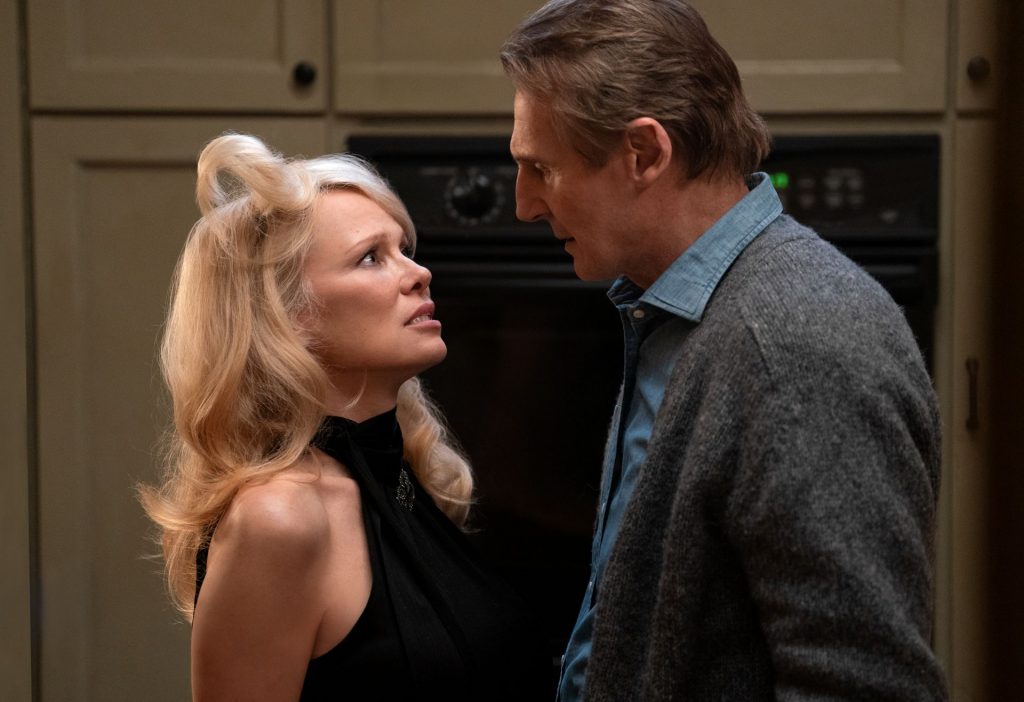
“Actually, there is something to see in The Naked Gun 2025. It’s the affectionate interplay between Liam Neeson, as the equally dense and deadpan Lt. Frank Drebin Jr., and Pamela Anderson as Beth Davenport, femme fatale and comic foil,” notes Peter Howell at the Toronto Star. “These two get along like a flaming clown car, seeming to wink to the camera (and each other) even when they don’t. Comedy comes naturally to Neeson, who has taken mostly dramatic roles since Love Actually in 2003. The same goes for Anderson, the former Baywatch star who loves to cameo in funny films.”
“While one-liners, sight gags, and they-really-went-there laughs make this return a winner, the real coup of The Naked Gun is its casting. Neeson doesn’t immediately come to mind as a comedic actor. Nor does Pamela Anderson. But the laughs are heightened here by the inspired casting against type,” says Pat Mullen at That Shelf. “Anderson, like Neeson, has terrific comedic timing and she’s very funny by playing it straight. She’s also a great sport about the sexualisation of her character, while the script smartly lets Beth in on the jokes without making Anderson the butt of them. After The Last Showgirl, Anderson’s turn continues her well-earned second act as Beth gamely plays the dumb blonde. Her stealth mode underscores the genius of the film: It takes a lot of smarts to be this stupid.”
Rude to Love (dir. Yukihiro Morigaki)
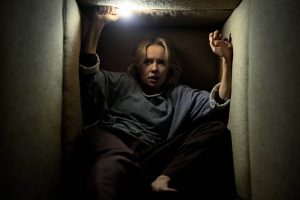
“Based on the novel by same title by Shuichi Yoshida, and screenplay written and directed by Yukihiro Morigaki, we follow her as she crawls under their house to cuddle with a onesie for the baby she miscarried,” writes Anne Brodie at What She Said. “On top of the rest of it, her beloved cat disappears and soon her spirit. She’s disappearing, becoming a nonentity. Eguchi is mostly silent, perpetually haunted, fearful even as she fulfills her husband’s idea of who she is. She’s nothing. The emotional burden is authentic and achingly real in Eguchi’s powerful, mostly silent performance.”
Together (dir. Michael Shanks)
“You know the horror movie cliché where someone gets dragged off screen at incredible speed by an unknown supernatural force? Turns out it’s just as scary when it happens slowly. Makers of frightening films, take note,” writes Chris Knight at Original Cin. “The result is an appealing two-hander, with an occasional third in Damon Herriman as a colleague of Millie’s whose attention to her makes Tim nervous. Director Shanks slathers on the weirdness like a mad confectioner, until you can’t tell where the cake ends and the icing begins. He sprinkles in just enough phrases — you complete each other, my better half, etc. — to raise our hackles without us rolling our eyes.”
“Shanks’ views on the way relationships change people over time are writ large, in bold, underlined, italicized, and repeated throughout the film like the same notes being played over and over again on an instrument, but as a complete piece, Together is undeniable in its effectiveness,” argues Andrew Parker at The Gate.
“Central to this pleasure-pain dynamic are Franco’s and Brie’s raw and committed performances, which surely resulted in some off-set couple’s therapy,” notes Barry Hertz at The Globe and Mail. “While Franco, the younger brother of current Hollywood pariah James, has always been an ace comic player (21 Jump Street, Neighbors 2, The Disaster Artist), he has never been afforded as juicy a platform as the one that Shanks provides here. And Brie, consistently a wonderful presence in projects both great (Mad Men, Community, The Post) and not-so-much (Happiest Season, Freelance), grounds Millie in something achingly real, even when she’s wielding a chainsaw.”
“Ultimately what kind of bothered me about all this is how quickly the protagonists were resolved that they weren’t going to stop being bonded together by this nefarious force because they ultimately decided that they both loved each other too much to think about the alternative…~Barf~,” upchucks Dave Voigt at In the Seats. “Don’t get me wrong, I believe in true love as much as the next guy but staring down an eternity with my spouse as the Spice Girls’ ‘2 Becomes 1’ plays on the record player is not how I want to go.”
File Under Miscellaneous
At The Canadian Encyclopedia, Pat Mullen profiles the genesis of the Indigenous Screen Office and profiles its founding director Jesse Wente.
At the Toronto Star, Peter Howell picks five films that could end summer movie season on a high note, like Darren Aronofsky’s Caught Stealing: “Aronofsky’s eclectic arthouse filmography is something to behold, encompassing everything from Bible sagas (Noah) to psychological horror (Mother!). He’s taking a decidedly multiplex turn with Caught Stealing, which makes it all the more fascinating. Butler has been a heavy hitter since his Oscar-nominated performance in 2022’s Elvis, but the bench strength of Caught Stealing is buzzy in its own right,” says Howell. “Aronofsky’s films and Butler’s acting are always worth watching.”
TV Talk/Series Stuff
On In the Seats with…, Dave Voigt chats with Twisted Metal’s Stephanie Beatriz “about coming back for more, the fun in the chaos of it all, getting a little break from the dudefest that was Season 1.”
At The Globe and Mail, Barry Hertz chats with Chief of War star Jason Momoa about shooting a series in the indigenous Olelo Hawai’i language: “Brother, that was the deal-breaker for us,” says Momoa. “We wouldn’t have been able to go home if we did this in English. Like, we can’t. But having said that, it needs to evolve, too. Some characters would learn English, like Ka’iana, as any chief of war would. You have to know the enemy’s language.”
At CBC, Jackson Weaver praises the use of language and Momoa’s lead performance in Chief of War: “Then, there’s an impressive level of commitment to character and gravitas to the acting — even if the performances occasionally dip into the dour. This is particularly true of Momoa, who reminds viewers he has more talents to flex than just the muscles stretching his Aquaman costume or the comedic chops visible through the disappointing seams of A Minecraft Movie.”
At What She Said, Anne Brodie catches up with Netflix’s Ed Sullivan doc: “Not only is this an important docu, it’s also highly entertaining as we stroll down memory lane, one great song and performance at a time,” she says. Meanwhile, Goddess of Slide tells the story of musician Ellen McIlwaine with “performances must be seen to be truly appreciated, they defy description.” And Leanne offers “pure, unadulterated sitcom southern cornpone.”