
Reviews include Onslaught, Mayday, and Hope.
TFCA Friday: Week of July 18
July 18, 2025
Welcome to the TFCA weekly, a round-up of reviews and coverage by members of the Toronto Film Critics Association.
In Release this Week
Almost Family (dir. Felipe Joffily)
“Some of the jokes, and the film is in Brazilian Portuguese, might be over the head for local North American audiences, but the film is still entertaining, though the story often falls into clichéd territory,” says Gilbert Seah at Afro Toronto. “A father/daughter relationship is also thrown into the story for good measure. An ok watch for the undemanding viewer.”
Bury Me When I’m Dead (dir. Seabold Krebs)
“The film has an interesting enough plot, but it is difficult to root for the protagonist who has cheated on his wife and someone who has broken his dying wife’s wishes for his own personal gain,” writes Gilbert Seah at Afro Toronto. “It is natural that he will be haunted by his own guilt. There is no real surprise or twist in the plot in an otherwise slow-burning movie.”
Cloud (dir. Kiyoshi Kurosawa)
“At first, it is difficult to pinpoint what changes and when. Is the turning point when Yoshii hires a suspiciously enthusiastic assistant named Sano (Daiken Okudaira)?” asks Barry Hertz at The Globe and Mail. “Or perhaps when Yoshii has an unfriendly run-in with a local police officer after a seemingly random act of vandalism on his rural property? Kurosawa dials the dread up slowly and steadily, until Yoshii finds himself the target of the world’s most disgruntled customers.”
“One wonders the message director Kurosawa is trying to deliver,” admits Gilbert Seah at Afro Toronto. “His film has an uneasy change of pace from drama to action shootout towards the end of the film.”
“The violence is carefully orchestrated. There are plot turns, double crosses and, appropriately for the online world, threats of live streaming torture and echoes of video battle games,” says Liam Lacey at Original Cin. “But there’s at least a half-hour too much of it. Following the film’s chillingly restrained first half, it feels like a big splat of excess.”
“Kiyoshi Kurosawa is a master at genre movies: he’s made a fortune creating horror films and thrillers that are beloved in Japan,” says Marc Glassman at Classical FM. “With Cloud, he gets to have fun in a style that resembles that of Quentin Tarantino. A quarter of the film consists of Yoshii trying to escape from his would-be killers in scary but comical ways. Then, in the lengthy closing scenes, after Yoshii is caught and bloodily freed by his erstwhile assistant Sano, the duo takes on, in a series of violent encounters, all his assailants.”
“Part slow burning techno thriller and part action extravaganza, Kurosawa’s riff on the traditional Nikkatsu styled noir (distributed domestically by the same purveyor of those B-movie classics) sets a proper stage before exploding to life,” notes Andrew Parker at The Gate. “Cloud is a film that winds itself up so much that when the snap finally arrives, the final results are more satisfying as a result. Throw in the fact that Kurosawa also offers up intelligent commentary on the current state of retail finance, and Cloud emerges as one of the prolific and varied director’s most uniquely entertaining efforts.”
Don’t Let’s Go to the Dogs Tonight (dir. Embeth Davidtz)
“Don’t Let’s Go to the Dogs Tonight is a sad reminder of the evils of colonialism and how racists are created,” notes Anne Brodie at What She Said. “Racism is plain and out in the open and Bobo may become one of them. Every person, white and Black, is armed. Headstrong, thoughtless mother picks a fight with a Black family just having lunch on their vast farm but she’s about to get hers. Her absent husband’s selling the farm, driving her into a drunken frenzy; she feels protected there, with her precious horses she values over her own child.”
“Don’t Let’s Go to the Dogs Tonight attempts to be noble and equitable in its approach, but is held back through its narrowed down point of view and perspective,” writes Andrew Parker at The Gate. “An adaptation of Alexandra Fuller’s memoirs, Don’t Let’s Go to the Dogs Tonight gets bogged down in precociousness thanks to its chosen method of story delivery, making for a muddled, problematic whole that retains an uneasily frightened white perspective on African race relations at the end of the 1970s.”
“Bobo is nothing if not observant, and the film follows suit, its camera roving the landscape to take in the sometimes raucous behaviour of the whites, and the downtrodden lives of the oppressed majority. We sense the girl’s innocence bleeding awkwardly into understanding. At one point she asks her mother pointblank: ‘Are we racists?’” writes Chris Knight at Original Cin. “The film is a potent portrait of the heavy bootprint that colonialism left on the African continent, but the childlike point of view makes it an eminently watchable story, with moments of levity and even humour.”
“Don’t Let’s Go to the Dogs Tonight wouldn’t be the success it is without Lexi Venter, who gives a charismatic portrayal as Bobo,” says Marc Glassman at Classical FM. “She and Davidtz dominate the film, with stunning performances perfectly in keeping with that devastating point in time. Today, with racism and imperialism on the rise, this film feels awfully pertinent. Since Davidtz is unafraid to quote Herbert, let’s remember another injunction, this time by Santayana, while praising her brave film: ‘Those who cannot remember the past are condemned to repeat it.’ This is a film worth viewing.”
Eddington (dir. Ari Aster)
“Aster has clearly thought deeply about what he sees happening, and there is little doubt in my mind that the movie is going to annoy a percentage of viewers, especially if they don’t stand back and look at the bigger picture he’s showing us,” writes Karen Gordon at Original Cin. “Aster isn’t judging his characters or shoving answers at us. He presents the town of Eddington as a microcosm of society at a specific time and place and it’s up to us to decide what we’re going to take away.”
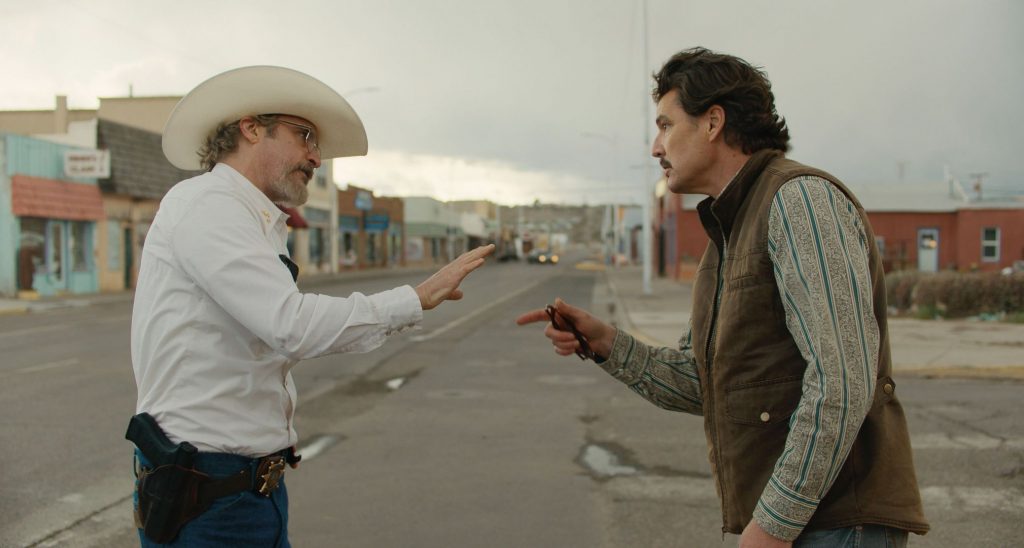
“Eddington is successfully bi-partisan but not in a way that is trying to lecture or take sides but in a way that lingers and reminds us that we’re all still dealing with this crap in more ways than one,” says Dave Voigt at In the Seats. “That comes through brilliantly in the performance from frequent Aster collaborator and fellow eccentric Joaquin Phoenix. He shows his chops here as a modern day John Wayne trying to do the right thing for his community. But unlike Wayne (or Jimmy Stewart) or any other prototypical small town sheriff in a western, he’s a neurotic self-involved insecure mess and in May of 2020 that was the general psyche of the entire population of the planet. If Spencer Tracy as John J. Macreedy in Bad Day at Black Rock needed a Xanax prescription, that would be Phoenix here.” Voigt also chats with costume designer Anna Terrazas about crafting the slightly worn and sundrenched world of Eddington.
“There’s not much reflection in Aster’s more didactic moments, where the writer-director rants about privilege, social media, and how people are always telling others how to live their lives via his characters,” adds Andrew Parker at The Gate. “All of these are easy targets taken out with a strange blend of rage in terms of how loudly everyone shouts and kid gloves so the viewer can “do their own research,” as a lot of the characters like to say in the film. There’s a disconnect in Eddington that feels melodramatic and snarky at the same time, and for the life of me, I can’t figure out what the intent or purpose is of any of this.”
“There’s no cause too remote for Eddington. Accusations fly about ‘Antifa’ false-flag operations, encroaching wokeness, sexual deviancy and other alleged threats – and then conspiracy king Peak decides to pay the town a visit,” says Peter Howell at the Toronto Star. “He’s assembled a brilliant cast and created strong characters but hasn’t given them much of a back story or much of anything to say, and there’s no reason to care about any of them. Aster slices into both the hysterical right and the smug left, which is all to the good, but his satiric sword has a dull blade.”
“That Aster sees the United States as an incurably toxic land – a place that was infected long before 2020, and forever immune to any kind of existential inoculation – should not be surprising to anyone who has witnessed his earlier cinematic nightmares,” writes Barry Hertz at The Globe and Mail. “But in many ways, Eddington represents an impressive leap in ambition and execution for the filmmaker, who is now within spitting distance of becoming the king of American alienation.” Hertz also speaks with director Ari Aster and members of the cast to learn about making a pandemic period piece: “I went down several rabbit holes here. But I just wanted to create as broad a picture of the country as I could, while still being intimate and telling a focused story,” Aster tells Hertz. “I was trying to cover as much of what I was seeing happening without being reductive or being polemical.”
I Know What You Did Last Summer (dir. Jennifer Kaytin Robinson)
“What little tension the reboot manages is drowned in over-explained backstory and clunky twists. Still, a few moments rise to the surface. Gabbriette’s Tyler brings a welcome energy as a true-crime podcaster with a murky connection to one of the main characters, and Cline as Danica (a role far removed from her debut in the faith-based drama Redemption) gets some deserved, (some not) laughs,” says Tom Ernst at Original Cin. “There are a few kills worth a horror fan’s smirk, but mostly, IKWYDLS is an underwhelming collection of tropes and throwbacks.”
“For every tiny thing that director Jennifer Kaytin Robinson’s sequel to the original 1997 slasher does right, it executes a million other things gigantically wrong,” sighs Barry Hertz at The Globe and Mail. “Cline is unbearable as a whiny prom queen, while a floundering Sui Wonders seems like a totally different performer than the one who gives as good as she gets on Seth Rogen’s Apple TV+ series The Studio. The only young actor to emerge from the film intact – in terms of his reputation, if perhaps not his vital organs – is Withers, who channels a young Channing Tatum in his knowing obliviousness.”
“At a certain point in I Know What You Did Last Summer I came to a sobering conclusion,” admits Andrew Parker at The Gate. “No matter who was revealed as the killer at the end, I wasn’t going to care because I felt zero investment or excitement in what was happening. No big twist, reveal, surprise, or final battle was going to save this thing. It would’ve taken a miracle of storytelling to turn me around on this thing. And sure enough, the villain shows their face, and I couldn’t care less outside of remarking just how illogical and pulled out of thin air it all seemed.”
Smurfs (dir. Chris Miller)
“The aggressively mediocre, unimaginative, and low effort rebooting of Smurfs is the ultimate in nap-time cinema for the youngest possible crowd,” notes Andrew Parker at The Gate. “Offering absolutely nothing to any demographic over the age of five, Smurfs is the kind of disposable movie that even the target audience will be tired of after seeing it and loving it once.”
“[L]ike the 2017 movie, this version is a semi-musical, even if most of the tracks here are from Rihanna – perhaps the contractual result of convincing the pop star to voice Smurfette,” says Barry Hertz at The Globe and Mail. “But if you are the type of child or suspiciously fully grown adult who is somehow wooed by the prospect of seeing a cartoon Rihanna strut her stuff, then good news, because this new movie is little more than a feature-length advertisement for the singer’s recording catalogue.”
Wall to Wall (dir. Kim Tae-joon and Sharon S. Park)
“Wall to Wall is a fast-paced well well-made film that suffers from too many mixed messages, which makes one wonder where everything is leading to or what the real message is,” writes Gilbert Seah at Afro Toronto. “Still entertaining enough as a cautionary tale of a typical young ambitious man trying too desperately to survive in a changing society.”
A Festival of Festival Coverage
At The Globe and Mail, Barry Hertz reports on the first in TIFF’s press-release-per-day line-up rollout: “The curious case of where the highly anticipated third chapter in Rian Johnson’s hit whodunnit series, Knives Out, will premiere has been cracked,” writes Hertz. “On Wednesday, organizers from the Toronto International Film Festival revealed that Wake Up Dead Man: A Knives Out Mystery will make its world premiere in the city this September.”
At Variety, Jennie Punter reports on the kickoff of Montreal’s Fantasia Festival and what it means for genre cinema right now. “Genre film does best when the world is in crisis,” Fantasia artistic director Mitch Davis told Variety. “The Vietnam War, for example, made American cinema angry and anxious and ask provocative questions. This is often done in a framework of genre, where artists are free to dig into uncomfortable ideas that would be considered subversive in mainstream contexts…So much of what we read now is baked in existential dread and a world that’s changing for the worse – the loss of agency, the loss of self.” Punter also looks at the Canadian slate, which boasts a healthy Quebecois crop, including Death Does Not Exist: “The subject matter [of Death Does Not Exist] might be difficult, but it is made with total honesty, and we put everything we had on screen,” director Félix Dufour-Laperrière tells Punter. “We want people to feel the magic of handmade images that never existed before we made them, even within what is at the end a tragic and fantastic tale.”
At POV Magazine, Pat Mullen reports on the death of Hot Docs co-founder Debbie Nightingale at age 71. “Hot Docs co-founder Debbie Nightingale has passed away at age 71. She died on Thursday, July 10, following a recurrence of cancer. A veteran member of the Canadian documentary scene and representatives from Hot Docs confirmed her passing,” writes Mullen. “Nightingale co-founded Hot Docs documentary festival with Paul Jay in 1993. Jay hired her to work on spec as she served as Hot Docs’ first festival manager. She is credited with getting the event off the ground by raising key funds, getting the word out locally and internationally, and encouraging submissions.”
TV Talk/Series Stuff
At What She Said, Anne Brodie gets in the saddle with Eric Bana for Untamed: “Untamed is an exceptional series that stinks of authenticity and delicious dread,” notes Brodie.” Meanwhile, Leanne serves “pure, unadulterated sitcom southern cornpone” and Pretty Blind “inspires admiration and understanding.”