

The critics were busy at this year’s Toronto International Film Festival! From our annual pre-festival party, this year held at Hotel Le Germain Toronto Mercer and generously sponsored by Redbreast Whiskey, to scurrying from screening to screening, our members can attest that TIFF was in full swing. This year again held an abundance of riches, […]
The Horror of Desire
July 8, 2026
How films like Obsession, Leviticus, and Backrooms tackle wishful thinking
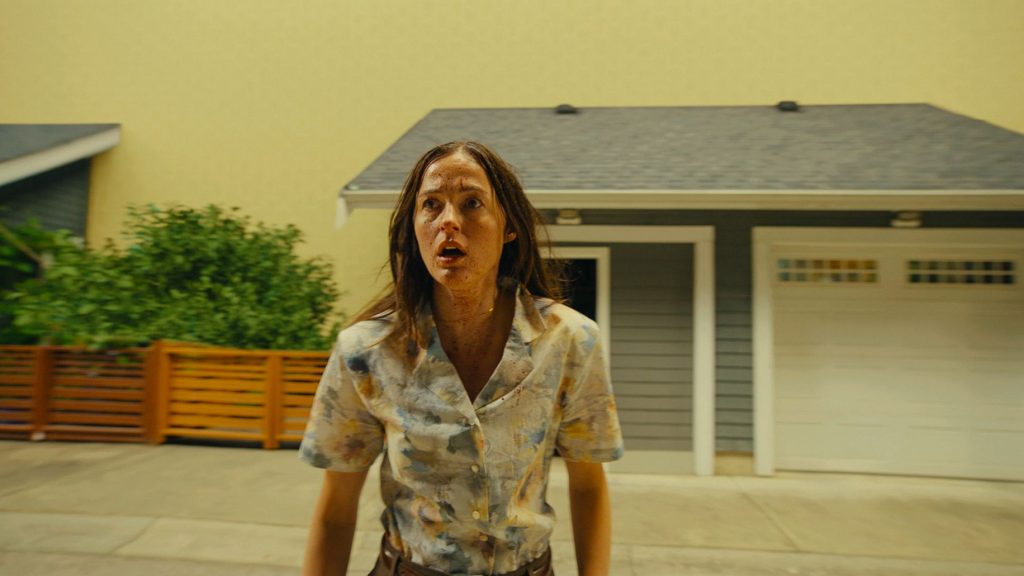
It used to be that horror was a place to face your fears and the various, imaginative manifestations of them. Every jump scare a reminder of how awfully human you are, a highly addictive feeling. Over the years, both within myself and observing those seated around me, I’ve noticed that the effects horror promises respond to a kind of primal drive to be convincingly shocked—psychologically scarred, “shook” even—meaning that these films are tasked with a double expectation: not only to stage and execute spectacles of fright within the context of a cohesive, if not coherent, narrative, but also for the figurative values to resound independent of that spectacle. It is no longer enough to stoke the impulse to cover our eyes and ears, it seems. Fans of the genre expect a film that can be ravenously unpacked and makes interpreters of us all.
In a recent wave of popular horror films that includes Curtis Barker’s Obsession, Adrian Chiarella’s Leviticus, and Kane Parson’s Backrooms, I was surprised to find what they all had in common—and perhaps this is the root of their widespread appeal—is that they are seemingly less interested in creating successive instances of fear as much as utilizing genre conventions in order to face the horrors of desire: for another life, for a body deemed too similar to one’s own, or for an ideal lover bending to one’s will. In their own ways, these filmmakers similarly tap into a sense of dissatisfaction latent in their characters to imagine new realms whose unfamiliarity allows for the certainty of their desires to be worked through despite the futility of such a task.
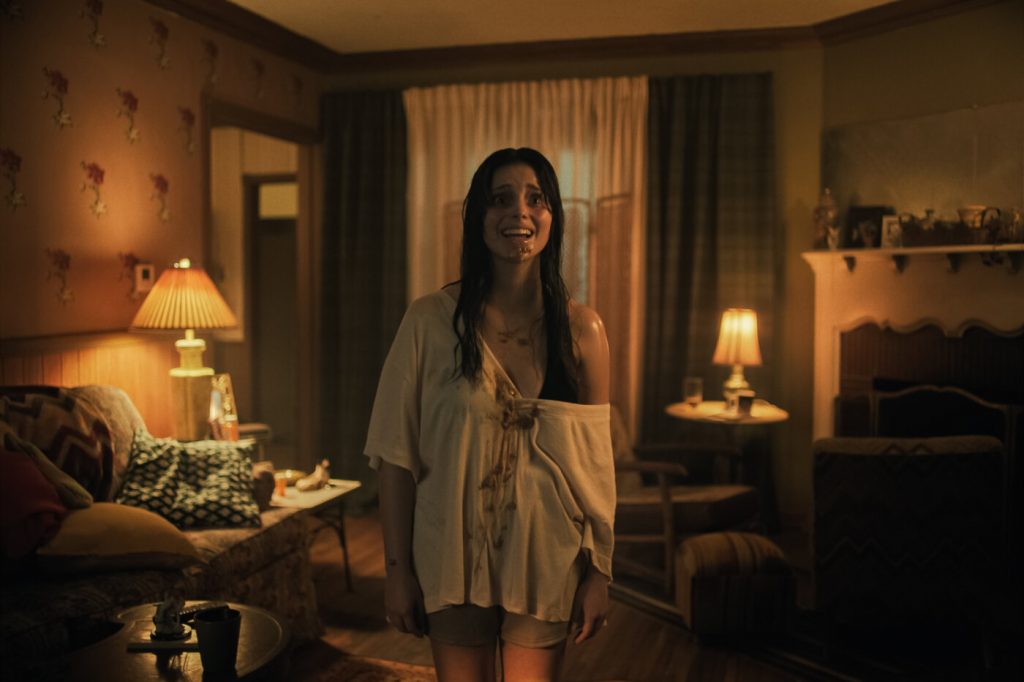
Obsession presents this concept most straight-forwardly. Early on, the protagonist Bear (Michael Johnston) happens upon a Crystal Shop where, without being asked, he seeks to replace the crystal his object of desire, Nikki (Inde Navarrette), drops down the drain at work. Looking around, he almost gravitates towards a display and picks up the box for a novelty item called a “One Wish Willow” that instructs prospective users to spark the middle, break it in half, and make it count. “Everybody wants a wish,” the cashier tells him. A few scenes later, after Bear fails to confess his feelings to Nikki or to find the right time to give her the gift, Bear uses the gift himself to break the unbearable tension: “I wish Nikki Freeman loved me more than anyone in the fucking world,” he commands. As a voice on TV at the start of the film, which eulogizes Bear’s dead cat, makes explicit, the strain of love he seeks is “unwavering and enduring.”
What proceeds is the incarnation of his wish, which violently, viscerally, and grotesquely sees the exaggeration of Nikki’s blinding obsession—although “possession” feels like a more accurate descriptor—accompanied by self-harm and self-sacrifice. Whether it’s among a group of friends, at a restaurant or in private, what causes Bear unease is Nikki’s inability to contain her explosive emotions, to not only create scenes but push them to the furthest extent before he must give in to appease her, causing him to question the basis of his initial desire. She becomes too much for him despite being designed exactly by him, his situation a case study for the fallacy of wishful thinking that, in the rules of the world of the film, no amount of reversals or attempts at escape can undo but death. All the while terrifying flashes of Nikki’s suppressed consciousness break through the veil. She is a woman trapped in a body seized by the spell of another’s desire.
That brand of human wickedness—of being at the behest of those closest to us—also crops up in the insular domain of Leviticus. Here, in middle of bum-fuck nowhere Australia, burgeoning adolescent bodies are policed by their parents and placed under the jurisdiction of religious and state powers. What I admired about Chiarella’s script is that it skips the tropes that lead to Naim (Joe Bird) and Ryan’s (Stacy Clausen) union. We don’t need to see their distance at school to understand why they might experience the desire to become intimate. Although later on, when Naim catches Ryan making out with the priest’s son and snitches on them, that acceleration lessens the impact of its narrative pivot and we have to assume rather than experience those stakes to be earned. In the only full sex scene in the film, a hand job in the back of a bus, in which Naim receives a release that provides him hand-tingling bliss, the exchange appears to give pleasure to the both of them, assuaging the guilt and fear they receive in everything outside of their bond. In Leviticus, then, love makes you go the distance, outside of your body and towards the rest of the world. It’s the antidote to the apparitions in the distance.
What is spine-tinglingly frightening, as a result of Bird’s sensitive performance, is when Naim’s mother (Mia Wasikowska) delivers him to the preacher, whose fiery spell will sentence him to same fate as Ryan—who is haunted by a phantom identical to Naim—or the priest’s son whose severed head is found dead in a ditch. That fear that he cannot escape undergoing what he already knows will do more harm than good made me wince. Later, in the woods, after Ryan goes missing, the aghast look on Naim’s face when his mother reveals that she knew the spell was irreversible, is heart-breaking. It is unspoken but evident in her repeated dismissals of his pleas, that his mother would rather risk him driving himself to death than chance his happiness with an openly queer life, of entering a relation that would bring him a satisfaction that she, in her failed attempt to adhere to hetero-normative convention following a divorce, couldn’t secure.
One by one, cruelly too, the members of the community turn on the lovers so they have nowhere to turn to but each other and make their way to the city, where they can chance never being alone, susceptible to a fear borne to invalidate their desires. As the final images suggest, that they may not have escaped the spells matters less, for nothing, as the film’s title alludes, can vanquish the flames of paranoia and madness once they’ve been ignited. Paranoia is an apt word to read Backrooms through, since its most prominent character, Clark (Chiwetel Ejiofor), recovers from a divorce that has left him living a hopeless existence. He appears reluctant to make any changes—in both action and in thought—that might free him, sighing his days away.
“Do you ever feel like you’re living behind glass, watching life happen, but never really stepping into it,” Dr. Mary Kline (Renate Reinsve) asks in a commercial aired on late night TV: “Maybe it’s time to open the window within…It’s never too late to forge a new path.” Clark’s stubbornness primes him for a breaking point, a limit in which something must give, which appears as a glowing line of light that beckons his attention, to, like Bear and the Willow, almost seduce him: a door to a parallel space behind his corny furniture store; a portal to another life. What is initially a journey of curiosity soon becomes an obsession for Clark, a place to return, memorize, later sketch out. The realm allows him to live with the subconscious refractions of his world. In the same way that Bear realizes life is preferable without the manifestation of his wish, and that Naim and Ryan prefer to be together than apart, so, too, does Clark find his place. “For the first time in a long time I feel like I’m right where I’m supposed to be,” he tells Dr. Kline.
By the end, it is Dr. Kline who most complexly engages with the realm of the backrooms, whose material properties uncannily manifest the advice she promotes to her patients, a sense which she herself contends with as unexplained flashbacks of a sheltered childhood without an overprotective and paranoid mother barge in. Dr. Kline’s main motivation, when she arrives at the realm’s entrance, is to locate Clark, but as soon as she decides to enter Parsons’ attention to her acclimatization prioritizes an existential rather than the moral dimension Clark represents.
Starting from the second act when Clark enlists his employee (Lukita Maxwell) and her boyfriend (Finn Bennett) to come down with him, the film cheats from its rules: the virtual reality, single-take immersion cuts to different sections of the realm without showing us how it got there. The biggest jump in the film occurs when Clark strangles Mary and she wakes up in a kitchen, where the film, which had practiced its restraint, suddenly decides to supply some intent. Clark subjects her to the role-play activity she practiced with him and there is nothing she can do but to submit. It is ironic watching her methods used against her, her belated realization of the risk of breaking the loop, which reminds me of Obsession when Nikki, blood-soaked and freed from a spell, tremblingly wails as she, like Niam in Leviticus, undergoes the chilling horror of realizing what has been done to her without her consent, of having been under the control of another, to have unwittingly become a survivor, a distorted still life.
In these films, fear lies not in what you wish for, but the snare of the wish itself.