An interview with Fight Kid director Michael Del Monte on using his documentary roots to capture a warm yet gritty slice of realism.
TFCA Friday: Movie Reviews for Dec. 12
December 12, 2025
Welcome to the TFCA weekly, a round-up of reviews and coverage by members of the Toronto Film Critics Association.
In case you missed it, we crowned the winners of this year’s TFCA Awards and revealed the nominees for Rogers Best Canadian Film and Best Canadian Documentary.
Applications are also open for the Telefilm Canada Emerging Critic Award!
In Release this Week
Cutting through Rocks (dir. Mohammadreza Eyni, Sara Khaki)
“Cutting Through Rocks is one of those profound vérité documentaries that are only possible through the patience and perseverance of the filmmakers,” observes Barbara Goslawski at POV Magazine. “There’s an alchemy at work that transforms this individual focus into a frightening expression of reality. It couldn’t be more powerful in its portrait of individual resilience and in its indictment of authoritarian regimes.”
“Cutting Through Rocks takes a direct cinema approach to its story, spending almost all of its time on the ground with Shahverdi as she goes about her campaigning, teaching, and community outreach,” says Andrew Parker at The Gate. “The film would benefit from more context and explanation when it comes to the ins, outs, and structure of Iranian politics, both municipal and federal, but that would break the choices made and stuck to by the filmmakers.”
Dust Bunny (dir. Bryan Fuller)
“Dust Bunny is funny, frightening and fantastical, macabre fare carried nicely by Mikkelsen and comparative newcomer Sloan, who is a delight. Their characters are played as equals — both deadpan, both world-weary — and it’s a treat to watch Sloan go toe-to-toe with Mikkelsen,” writes Liz Braun at Original Cin. “Like any decent fairy tale, Dust Bunny is full of Freudian family weirdness, magical events and impossible sights and creatures. But do not bring the kids.”
“Fuller’s feature debut may be whimsical and weird, but it’s also a reminder of just how fun genre cinema can be,” observes Rachel West at That Shelf. “Dust Bunny is the kind of film that crawls out from under the bed and straight into cult classic territory, a gateway for the next generation of horror fans.”
“While I could see some audiences feeling like Dust Bunny plays the story a little too lightly, it actually settles into a good little sweet spot as it gives us just enough of the darkness to balance out the whimsy and the light of the whole situation,” says Dave Voigt at In the Seats. “It’s a slice of fantasy that we haven’t seen since the 80s and the animated films of Don Bluth like The Secret of Nimh. Sure it’s pretty well suitable for the entire family but it’s got a real insidious edge to it that can keep the bigger kids engaged throughout.”
“A visual phantasmagoria of styles, tones, colours, sounds, and focused absurdism, Dust Bunny is both familiar and unique,” writes Andrew Parker at The Gate. “To unpack the number of global influences that have gone into writer-director Fuller’s kinetic, darkly comedic fairy tale would take forever. It’s a niche film and a crowd pleaser at the same time; a studious exercise in genre homage that seeks to give audiences a chaotic mash-up the likes of which they’ll never see again.”
“Dust Bunny, though uneven at times, has a fairy tale, nightmarish feel with emotional undercurrents, and its balancing act between horror and wonder is impressive,” notes Gilbert Seah at Afro Toronto.
Ella McCay (dir. James L. Brooks)
At S Magazine, Marriska Fernandes speaks with the cast of Ella MaCay, including scream queen Jamie Lee Curtis, who reflects on the power of letting it all out: “I’m not that person. I get mad. I’m not that screamer. I might drop an expletive and get very coarse. I can get a little angry, but I’m pretty quiet, to be honest. I know it’s hard to believe but it’s true,” Curtis tells Fernandes.
“The ironic thing about Ella McCay, James L. Brooks’ surprisingly slight politically themed comedy, is that it’s an aggressively feel-good movie that may leave you feeling bad,” notes Jim Slotek at Original Cin. Slotek also speaks with James L. Brooks and stars Jamie Lee Curtis and Albert Brooks about finding positive spin for a film set during the 2008 recession: “I wrote it trying to be accurate to the characters. It ended up being enormously positive. I can’t say the same is true of me as a person. But there’s some wonderful actors in the movie…and it finally is a team sport. So somewhere in the process, I think from a genuine place, it ended up being a real positive film.”
The Fakenapping (dir. Amine Lakhnech)
“It does not help one bit if the protagonist, Sattam, has no redeeming qualities that the audience can identify with,” says Gilbert Seah at Afro Toronto. “For one, Sattam has that annoying childish grin, making him look like an Arabic Mr. Bean. At least this part works, as the film is being billed as a comedy. He has borrowed money but pretends he has lots of it to his mother and daughter.”
La Grazia (dir. Paolo Sorrentino)
“La Grazia is another Sorrentino film that follows an aging, once virile male figurehead trying to stave off irrelevance and obsolescence in a modern world that has little space for him,” notes Andrew Parker at The Gate. “That’s nothing new, but La Grazia is decidedly less horny and leering than a lot of Sorrentino’s other takes on this subject. Like every other Sorrentino film, La Grazia is also an exercise in style and form, but not at the expense of the narrative this time out. Most of the story here plays out in the same halls of power, devoid of life and vibrancy except for what Sorrentino is able to bring to the settings. Visual subtlety has never been Sorrentino’s strong suit, but a lot of his showy flourishes here have a more poetic and elegant bent instead of being in-your-face provocations and proddings. It’s still a Sorrentino film, but a kinder, gentler one that’s able to be a bit more granular in its look at life on the backside of middle age.”
Influencers (dir. Kurtis David Harder)
“Influencers is a satisfying, sophisticated young adult sexy horror thriller set in a social media setting with shades of Patricia [Highsmith] and Hitchcock,” says Gilbert Seah at Afro Toronto.
Not without Hope (dir. Joe Carnahan)
“While working on an obvious budget of having his actors in a wave pool, Carnahan isn’t afraid to make sure that the elements of the situation come into play,” writes Dave Voigt at In the Seats. “Sure it drags its feet at times but it’s a film about the endurance of the human spirit and Carnahan manages to (mostly) avoid any hammy tropes and allows his actors to express the desperation of the moment. It could have been very over the top with lines between characters making sure that they tell the other ones mother that they love her (that does sneak in a little bit) or about a believing in a God that put them in this situation while adrift at sea (that does sneak in a little as well) but the attempts at displaying human frailty come through.”
Peter Hujar’s Day (dir. Ira Sachs)
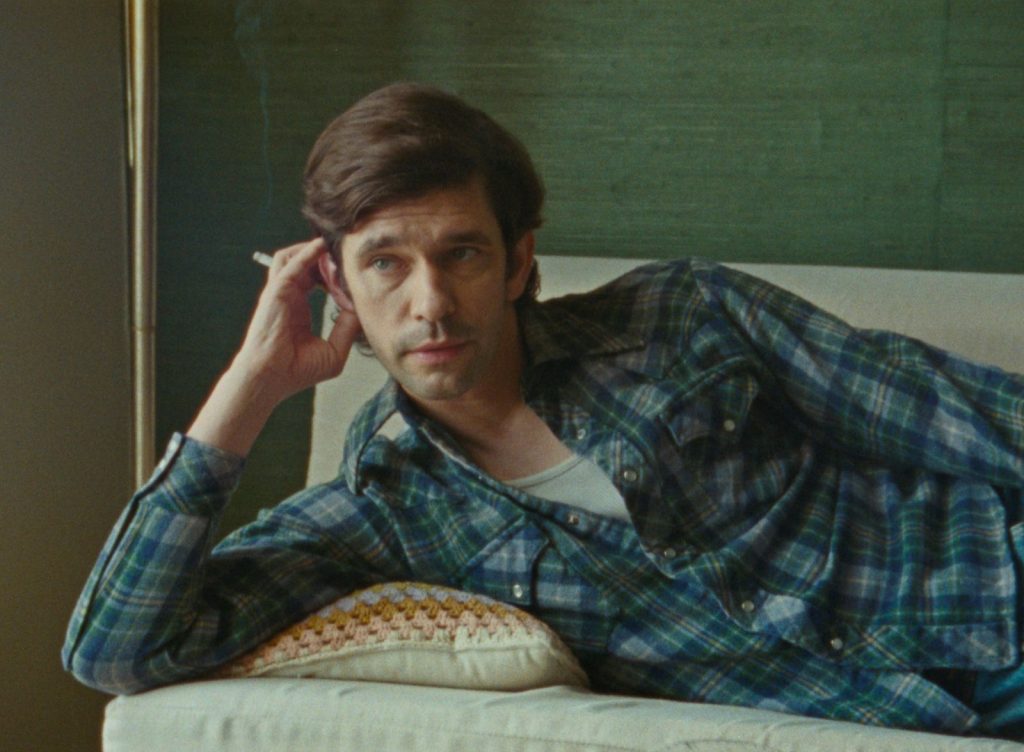
“Fans of certain actors will sometimes say that they could watch their favourite performers read a phone book and they’d be happy. There are more than a few moments in Sachs’s film that take that joke literally,” notes Barry Hertz at The Globe and Mail. “But in the hands of Whishaw and Hall, two actors who have natural chemistry and possess an easy charm all their own, this is a movie that is more red-hot than Yellow Pages.”
“It captures a feeling that’s hard to define; almost like you’re in a room with two mutual friends who know each other, but you had no clue they were acquainted,” says Andrew Parker at The Gate. “And then you let them chat about everything that’s on their mind while you remain a silent observer. And through all of that, somehow you’re never bored or lost. You hang on every word they’re saying and go along with it, even if one of them controls more of the conversation than the other. It’s oversharing by design, and there’s almost nothing else like Peter Hujar’s Day out there; a mixture of history, biography, art world trivia, and stream of consciousness that arises from the simplest of questions: what did you do yesterday?”
“The film is obviously not for everybody,” admits Gilbert Seah at Afro Toronto. “It is a two-handler with all talk – and talk that might not appeal to or interest everybody, even though the talk might intrigue those interested in photography or writers. The film is all about, as intended about a day in the life of the photographer, which can be described as getting up, preparing for an interview and then going back to bed. Peter talks about his musings, and Linda, who has not much to say in the film, basically reads and makes sight comments.”
“Peter Hujar’s Day is a wonderful time capsule into an era that is now gone. During his ‘day,’ Hujar photographs the beat poet Allen Ginsberg for the Times and has a difficult time doing it,” says Marc Glassman at Classical FM. “Ginsberg is in a foul mood and part of Hujar’s job as a portrait photographer is to make him happier so that he can give himself more willingly to the camera eye. The photo chosen for the Times is a classic: a sombre soulful Ginsberg is relaxed, almost stalwart as he looks at Hujar’s camera; behind him, is the littered city street in Alphabet City near to where the poet resided.”
“Whishaw and Hall—both Brits—create wonderful portraits of the New Yorkers,” says Pat Mullen at POV Magazine. “Peter Hujar’s Day offers a delicate two-hander as Whishaw holds court by interpreting Hujar’s words with a laissez-faire cadence, never quite convinced that his own story seems interesting enough for people to read. However, Whishaw injects a tone of playfulness here and there to suggest the slightest hint of dramatic embellishment. Hall, meanwhile, creates a captivated receiver, and their dynamic shares the art of active listening and reacting—two acts deftly engaged in Sachs’ experiment in portraiture. The naturalism of the performances finds poetry in the mundane.”
Resurrection (dir. Bi Gan)
“Using the experience with super-long takes he gathered in his second feature Long Day’s Journey Into Night (2018), Bi masterly executed a seamless take close to 40 minutes long in this chapter exploring ‘touch,’” says Alice Shih at Original Cin. “Cinematographer Dong Jingsong smoothly flows his camera to touch everything along its path with our Deliriant, now street smart, who is falling in love with a beautiful vampire played by Li Gengxi, who said her name is Tai Zhaomei, a Taiwanese singer-songwriter.”
“Resurrection can be more accurately described as an experience than a conventional story: a ‘dream made film,’ where one feels rather than one can understand,” writes Gilbert Seah at Afro Toronto. “At its best, it is a bold and ambitious film, successful or not, which is debatable. All flaws aside, Bi Gan is still a gifted filmmaker and a talent to be reckoned with.”
“But the deeper that Resurrection goes, the more that Gan’s vision delicately, meticulously, and, of course, slowly envelopes you, no matter your level of comprehension,” says Barry Hertz at The Globe and Mail. “A particular highlight: The second-last chapter, which like the final third of Long Day’s Journey evokes the end of the world (in this case, New Year’s Eve, 1999) and is also filmed in one remarkably fluid single-take shot that must be seen to be believed, if not fully understood.”
“Bi Gan’s films are usually praised for their poetic and dreamlike style—and this is no exception. He is a master at evoking cinema’s past glories,” says Marc Glassman at Classical FM. “The ‘suitcase’ story beautifully conjures up the virtuoso style of Orson Welles—not an easy thing to do–right down to a homage to the classic mirror shootout sequence in Lady From Shanghai. Bi Gan clearly loves to give meaningful tributes to great old films. The opening 20 minutes of Resurrection offer an astonishingly accomplished tribute to silent cinema: not a word of dialogue is spoken as the Twenties’ grand era of classics is beautifully reproduced by the director. And let’s not forget his ability to create long takes in this film but even more exceptionally in Long Day’s Journey into Night.”
Silent Night, Deadly Night (dir. Mike P. Nelson)
“Okay, there is one intriguing twist that writer-director Nelson tries to spin on the property,” writes Barry Hertz at The Globe and Mail. “Taking the bones of the original grisly flick – in which a young man named Billy becomes a serial killer in a Santa costume after witnessing the Christmas Eve murder of his parents – this iteration of Silent Night, Deadly Night mashes together the worlds of horror and Hallmark, with our psycho hero (Rohan Campbell) staging his latest murder spree in a small town that is just the kind of perfect setting for a seasonal TV movie.”
“The supernatural element added in the remake serves to add another level of incredibility to the story, making slasher films more credible in the first place,” says Gilbert Seah at Afro Toronto. “With the gore, blood and multiple killings, horror fans can easily dismiss the implausibility as long as their desire to see blood is satisfied.”
At The Gate, Andrew Parker has a video interview with director Mike P. Nelson, who made a gore soaked horror movie, but admits that The Holiday is one of the best Christmas movies of all time.
Catch Up Corner
At What She Said, Anne Brodie catches up with The Tale of Silyan: “This true story – documentary – is also part fairy tale but we can drop our definitions for this exquisite film experience. The stork knows Aleksandar’s farm but traverses it in a pondering manner because the once bountiful fields are now ruined. Over time Aleksandar begins to hope and think that the bird is indeed his son and healing begins. Is the documentary a projection of the filmmakers or is what they’ve captured miraculous? Bold, gorgeous – sweeping weather patterns play a big role – and full of hope and love.”
At That Shelf, Pat Mullen reports from the Wake Up Dead Man press conference at the Toronto International Film Festival where Rian Johnson and the cast dished on whodunits, Knives Out: All Stars, and giving a bit more substance to the story: ““These movies, the first one, was very much about family. The second one, we wanted to do a big, broad vacation blow-out mystery, like a comedy. And this one, I wanted to tuck it back in a little,” explains Johnson. “I grew up very religious. I didn’t grow up Catholic. I grew up Protestant, what we’d call Evangelical. It wasn’t just that I was brought to church with my family. I was, personally, very religious. And through my early 20s, I really framed my life and the world around me through my relationship with Christ. It was something that was really, really a part of me.”
At CBC, Jackson Weaver catches up with Hamnet: “While that play has long been described as being about a man brought down by his indecision, Hamnet helps bolster the counternarrative. Instead of an overly cerebral coward too weak to act without thinking, Zhao’s potentially historically untrue backstory gives Hamlet a different grounding,” writes Weaver. “Struck by the profound emotional horror Zhao is able to conjure, who wouldn’t morosely wonder ‘To be or not to be?’ And, as Hamlet fatefully quips, who wouldn’t decide that the sad, intractable way forward is simply to ‘Let be’?”
At Sharp, Marriska Fernandes chats with Golden Globe nominee Wagner Moura about The Secret Agent and representing Brazil: “What I can bring to this is the way we do films in Brazil, which is anchored in the tradition of political Brazilian films, and also the way we move with the camera. We don’t have much money to shoot it in Brazil — usually all the films are very independent.”
File Under Miscellaneous
At The Globe and Mail, Barry Hertz picks his top 10 films of 2025 with TFCA winner One Battle After Another topping the list: “Thoughtful yet incendiary, romantic yet skeptical, patently absurd yet at the same time brandishing a mirror that so clearly and unforgivingly reflects our own cracked reality, Paul Thomas Anderson’s epic arrives with the kind of casual, confident brilliance that feels deceptively effortless. By its end, One Battle After Another reveals itself as Hollywood’s most contradictory creation in ages: a crowd-pleasing political manifesto, a riotous action-comedy of ideas, a movie constructed for the eye as much as the heart and mind. Revolutionary, one might say.”
At Afro Toronto, Gilbert Seah shares his top 10 films of 2025 and agrees with Barry: “The film that is on everyone’s Top 10 list. Great action comedy in which the protagonist is not an action fighter but someone hiding and running away for half the movie. Director PT Anderson’s best and most successful box-office hit.”
At What She Said, Anne Brodie shares highlights from BritBox’s Jane Austen 250th anniversary celebration: “But it all begins with the documentary feature Jane Austen: The Rise of a Genius which sheds light on what drove her to become a writer, her inherent skill and how she drew from her family and friends and searched her own soul. Thanks to her keen interpretations became one of the greatest and most influential female writers of all time. Austen spoke for women who couldn’t or wouldn’t in the repressive Georgian society with her remarkable understanding of female psychology.”
At Sharp and S Magazine, Marriska Fernandes picks some frontrunners from this week’s Golden Globe nominations, including Canuck Seth Rogen: “Seth Rogen’s Golden Globe nomination for Best Performance by an Actor in a Television Series, Musical or Comedy for his role in The Studio is part of a much larger, history-making achievement for the show. Rogen stars as the newly appointed head of Continental Studios, a movie studio in Hollywood. The series is a sharp, meta-comedy that follows Rogen’s character and his team of executives as they desperately juggle corporate demands and talent ambitions all while trying to keep movies relevant in the modern era. The show itself achieved an extraordinary feat, becoming the most Emmy-winning freshman comedy in history, garnering 23 Primetime Emmy Award nominations and breaking the record for the most wins for a comedy series in a single season. There’s no doubt that it will strike gold at the Golden Globes.”