Reviews include Project Hail Mary, The Things You Kill, Ready or Not 2: Here I Come.
TFCA Friday: Movie Reviews for February 27
February 27, 2026

Stay tuned! On Monday, March 2, we reveal the winners of the Rogers Awards for Best Canadian Documentary and Best Canadian Film at the TFCA Awards Gala hosted by Tamara Podemski. Check out the nominees here. Ballots are in the mail!
In Release this Week
Accused (dir. Anubhuti Kashyap)
“The film plays as a psychological mystery thriller with two issues of whether Geetika is actually guilty of the sexual predator accusation, and also whether her relationship with Meera will survive. The film also explores how public judgment can form and the emotional toll that serious allegations can take on someone’s life,” says Gilbert Seah at Afro Toronto. “Accused is an entertaining enough thriller, directed efficiently and moving at a fast enough pace.”
Dreams (dir. Michel Franco)
“This is pared-down storytelling that leaves you to draw your own conclusions, but nobody’s dreams are coming true here,” says Liz Braun at Original Cin. “Filmmaker Franco seems to assume his viewers will be paying attention, so Dreams is a typically understated affair, just slightly chilly in its detachment and stripped down in action and in dialogue. Money talks, though.”
Everest Dark (dir. Jereme Watt; Mar. 2)
“There is, admittedly, a sense of déjà vu,” admits Pat Mullen at POV Magazine. “Key footage from the 2014 avalanche appears in other films, notably Sherpa, while Everest Dark has the unenviable challenge of following Lucy Walker’s recent triumph Mountain Queen: The Summits of Lhakpa Sherpa, which is quite possibly the best mountain movie ever made. The stories obviously differ, but few films find the extraordinary screen presence of a character like Lhakpa. Her ability to tell a story proves as thrilling as her skills on the mountain. Mingma, by contrast, humbly shares his perspectives in modest and deferential accounts. He’s a man of few words. He just wants to get the job done and restore the balance. It’s a noble quest, but not the most dramatically exciting or emotionally satisfying one. It plays like a rescue film without life-or-death stakes.”
In Cold Light (dir. Maxime Giroux)
“None of it makes any sense, alas, and you’ll stop caring about what happens or who it happens to, fairly early on. There seems to be a lot of pseudo-Freudian yammer in the middle of this crime drama, or perhaps there’s a lot of drug-trade-related violence in the middle of a psychological family study; either way, it’s mystifying as hell,” admits Liz Braun at Original Cin. “It looks good though, courtesy of cinematographer Sara Mishara.”
“The film also has a mystery element,” says Gilbert Seah at Afro Toronto. “The mystery element is how Ava will outmaneuver the forces closing in, though it is difficult to root for a druggie and former drug queen. Still, the film could do more of the thriller element.”
Jimpa (dir. Sophie Hyde)
“Perhaps because so many elements in Jimpa are personal, Sophie Hyde has created an overabundance of plot lines. There’s Jimpa’s quest to find a new job in Helsinki despite his apparent promise to mentor Frances in Amsterdam,” says Marc Glassman at Classical FM. “There’s Frances’ search for love in a city famous for it. There’s Hannah’s attempts to land a cast for her proposed film. There’s Jimpa’s coffee klatch of gay friends who talk endlessly to Frances and Hannah—and themselves—about their salty opinions on politics and sex. There’s Richard, Jimpa’s assistant, who is gay but seems to have a thing for Hannah. There’s Isa, who decides to teach Frances about sex. There are flashbacks to the AIDS crisis, and to Jimpa being a bisexual parent in Adelaide, and to Hannah’s reaction to his leaving for Europe—and, quite frankly, to too many past personal events.”
The President’s Cake (dir. Hasan Hadi)
“We’re treated to a colourful slice of life, strange sounds, music, and language as we fear for Lamia’s safety,” notes Anne Brodie at What She Said. “She’s brave and walks and walks and bargains, as war planes fly overhead. When she doesn’t return her uncle sets out to find her, even as she escapes concerning situations. Lamia’s accepts things as they are; childhood is exciting, fun, always changing, a brave and self-reliant girl forced to grow up too soon. It’s uncomfortable to watch a nine-year-old wander the city alone for an unspecified period of time, to see her harassed by her teacher and struggle to fulfill her mission without complaint. There’s a twist that brings her grandmother to the city to find her. And I wont spoil it. Don’t look away for a second.”
“I was a little surprised to find out that all the actors are first-timers and non-professionals; they deliver heartfelt and believable performances, not least young Lamia, who seldom cracks a smile (why would she?) during her epic quest,” says Christ Knight at Original Cin. “But despite all the background peril (fighter jets flying overhead) and notwithstanding one super-creepy food purveyor, everything seems to run just a little too smoothly. Presumably this is a conscious choice on the part of the filmmaker. But when your viewers can easily see where the rough edges have been sanded down to a fine sheen, perhaps it’s a sign to put down the sandpaper, or at least choose a coarser grade.”
“Disaster strikes when Lamia is ‘honoured’ with bringing the cake for her school class’s mandatory celebration of Saddam Hussein’s birthday,” adds Gilbert Seah at Afro Toronto. “In other circumstances, this might be an innocuous responsibility, but Bibi and Lamia can’t afford the ingredients — and the last family that didn’t comply was dragged through the streets. Director Hadi takes his audience around the poorer streets of Iraq, showing how people eke out a living, and it is not a pretty sight.”
“Hasan Hadi has made a film full of incident and character. Through Lamia’s hunt for the cake’s ingredients, we’re introduced to a panoply of individuals ranging from the best—Jasim—to predators and con-artists,” says Marc Glassman at Classical FM. “Her relationship with Saeed deepens into friendship and while there’s anger between the two, a bond is developed that is affecting.”
“As Lamia’s journey becomes more perilous by the minute, and Bibi becomes increasingly concerned about her granddaughter’s whereabouts and safety, Hadi rebuilds an entire cinematic era from scratch,” notes Barry Hertz at The Globe and Mail. There are certain sequences, including one in which Lamia weaves between large-scale protests, that feel Hollywood-sized in their size and scope. And all the while, the director coaxes a remarkably affecting performance from his young, untested lead actress. You believe in Lamia’s drive to bake this ridiculous cake because you believe in Nayyef’s conviction and commitment to her character.”
Scream 7 (dir. Kevin Williamson)
“Scream 7 arrives not as a reinvention but as an act of remembrance, nostalgia soaked with blood. Kevin Williamson, who wrote several of the original films and now directs in the series for the first time, seems keen to exhume rather than reimagine. It’s a stab-happy stroll down memory lane, but it’s not without a few grim pleasures as familiar faces return to the screen,” says Peter Howell at the Toronto Star. “The staging is clumsy and the acting is mechanical, as though the series’ reflexes have finally dulled, and there are plot holes you could drive a hearse through.”
“While Williamson and his co-screenwriter Guy Busick are both experienced writers, this script is leaning on the formula and it’s forced attempts to evolve it just a little too much with an underdeveloped story and simply not enough reasons to actually care about anything that is actually going on,” says Dave Voigt at In the Seats. “It telegraphs the action and drives us into a myriad of predictable moments as it tries (in vain) to swerve us and keep us going in this franchise that while always violent has always had a solid spirit of ‘whodunit’ and ‘mystery’ about it. It trades that in for gore that feels more akin in a Friday the 13th movie then here in this franchise. Combined with a myriad of cheap cameos under the plot point and guise of the ‘evils of Deep Fakes and Artificial Intelligence’ so much of this film just felt fake, which ultimately misses the point with the reveal of the killers landing like lead balloon.”
“[I]nstead of a Last Action Hero for gore, we get Tron: Ares: a functional, if uninspired, fan-service return that feels drained of all the tonal originality of the first movie. Which is all the more dire for a franchise like Scream; removing the one thing that makes it unique only emphasizes how the film — and especially its big bad — are essentially toothless,” writes Jackson Weaver at CBC. “In fact, it was more or less designed that way. On paper, the universe of Scream is set up to mock the relentless sameness of the horror landscape: youthful protagonists voyeuristically slaughtered for the unforgivable sin of youth has been done and redone so often it becomes painfully — and boringly — obvious who’s going to be picked off next.”
“Scream 7 respects the franchise. Director Williamson understands slasher movies, and it shows in his direction of Scream 7,” says Gilbert Seah at Afro Toronto. “There is sufficient explanation of the story details with reprisals of roles by Cox and Campbell. The scares and shocks are both entertaining and unexpected. Scream 7is a worthwhile sequel.”
Smother (dir. Achmed Abdel-Salam)
“The psychological horror film succeeds for several reasons, primarily because director Achmed Abdel-Salam moves his film at a rapid enough pace, throwing in more surprising bits of detail into the plot as his film progresses,” writes Gilbert Seah at Afro Toronto. “The line between real and imaginary is always in question as one wonders whether Michi is suffering from a psychological horror or if the monster in the house is real.”
This Is Not a Test (dir. Adam MacDonald)
“The necessary zombie violence occurs with the bashing of the zombies, particularly their heads, often shown to be a bloody mess,” notes Gilbert Seah at Afro Toronto. “There is no mention in the original of the virus causing humans to transform into zombies. The script never even tries, and what is going on with the rest of the world?”
“Adapted from the book by Courtney Summers, This Is Not a Test avoids the trappings of your standard teen zombie horror flick to give us something a little more psychologically severe and grounded as these young people coming of age are confronted with decisions they never even considered in their lives until now,” says Dave Voigt at In the Seats with… He also chats with director Adam MacDonald.
File Under Miscellaneous
At The Globe and Mail, Barry Hertz profiles Sung Kang from the Fast and the Furii franchise, who was in town for the Canadian International AutoShow: “Hollywood has never been what I thought it was going to be. Don’t get me wrong, it’s changed my life, being part of that franchise. But I just felt like I had so much more in me as an actor, as a storyteller,” Kang tells Hertz. “I would wake up hopeless so many days. You start to question like, what is your purpose on this Earth while you’re here? Is it just to be leaning up against a car and eating snacks? That’s cool for five minutes, but then you’re like, there’s so much more of me to offer.”
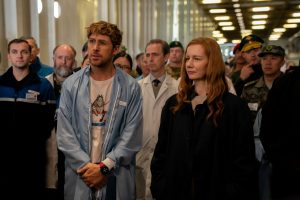
At the Toronto Star, Peter Howell picks five films to see in March, including Ryan Gosling’s Project Hail Mary: “f blockbuster chemistry counts as rocket fuel, it’s time to light this bird up. The trailer was viewed more than 400 million times in its first week, so moviegoers want in on the ride,” writes Howell. “Few directors juggle chaos and heart like Lord and Miller. If they can land this mix of science and soul, Gosling might have a Martian-level hit.”
Also at The Globe and Mail, Barry Hertz dives into the situation for Canadian film with a recent report from Telefilm Canada: “But in Canada, the underlying problem is that audiences have little idea of what a Canadian film even looks like. And if they manage to miraculously find that out, then it is another struggle altogether to discover when those films are being released and where. That’s where marketing comes in,” writes Hertz.
Also at the Toronto Star, Peter Howell reports on the AGO exhibit of Paul McCartney photography: “McCartney pointed his newly acquired 35-mm Pentax SLR camera (a replica of which is on display) toward not just the screaming fans and phalanxes of police and journalists pursuing the band, but also his friends, lovers, business associates and other fellow travellers. Anticipating the selfie craze of decades to come, McCartney even took pics of himself in a mirror, as seen in a 1963 self-portrait.”
TV Talk/Series Stuff
At What She Said, Anne Brodie looks back at SCTV, which returns following the passing of Catherine O’Hara: “Its original sketches were the stuff of comedy dreams, satire, politics, cultural change – the seventies! – all flavoured with the maple syrup of Canada’s deep comedy reserves and our distinctive point of view.” She also binges the Kaley Cuoco series Vanished: “This cat and mouse puzzler is engaging and intense and despite frequent time jumping, is worth an evening.”
On In the Seats with…, Dave Voigt chats with the cinematographers of How to Get to Heaven from Belfast, Nathalie Pitters and editor Nigel Williams.