Movie reviews include You Can See Everything, Fjord, and Musk.
TFCA Friday: Movie Reviews for January 23
January 23, 2026
Welcome to the TFCA weekly, a round-up of reviews and coverage by members of the Toronto Film Critics Association.
In Release this Week!
The Big Fake (dir. Stefano Lodovichi)
“As the story unfolds, it soon becomes clear that this is not a mystery crime thriller but more of a character study with some messages put forward, as the narrative is more character-driven,” says Gilbert Seah at Afro Toronto. “Directed by Stefano Lodovichi, the film has a luscious beauty, being meticulously choreographed and staged, like the ride of a bicycle by the two lovers, for example, in the middle of the night as sights in Rome are seen in the background. High production values follow throughout the film, making it an impressively photographed work, complementing the fact that its lead character is an artist.”
Cosmic Princess Kaguya (dir. Shingo Yamashita)
“The film runs over 2 hours, that is pretty lengthy for an animated feature,” observes Gilbert Seah at Afro Toronto. “But Cosmic Princess Kaguya is an easy undemanding watch, and quite a pleasant one, as one sees a young female manoeuvre through her puberty, with the child of a moon princess. The film does not reach any potential it might aiming at, with a lagging middle.”
H Is for Hawk (dir. Philippa Lowthorpe)
“Foy’s success in conjuring Helen’s emotional detachment keeps the viewer at bay even as we sympathize with her sadness and marvel at her ability to manage a creature whose bloodlust for rabbit and grouse contrasts with Helen’s desire to shrink inside herself,” says Kim Hughes at Original Cin. “But it’s hard to feel invested in the film’s central character: Helen, not the hawk, whose feral eyes and ferocious flights are magnificent to behold.”
Honey Bunch (dir. Madeleine Sims-Fewer and Dusty Mancinelli)
“Without saying much about it, the denouement is of the ‘twist’ type that is supposed to tie everything together – a narrative full-stop that is often associated with M. Night Shyamalan, but was rampant in the ‘70s (everything from ‘Soylent Green is people!’ to ‘the Stepford wives are all robots!’),” says Jim Slotek at Original Cin. “For that reason, Honey Bunch might have been better served by its inclusion at the Toronto International Film Festival if it were placed in the Midnight Madness programme, where audiences are more inclined to accept wonky turns and lapses in logic (think The Substance).”
“A genre-bending sci-fi thriller with a 1970s look and setting, this film is as unconventional as anything can be in a tale that explores love in a remote rehabilitation facility,” writes Gilbert Seah at Afro Toronto.
“[I]t takes unnecessarily long for writers-directors Madeleine Sims-Fewer and Dusty Mancinelli to reveal the true nature of Diana’s injury and Homer’s intentions to ‘cure’ it – by which point the mystery of Honey Bunch has been stretched past intrigue into something more frustrating,” notes Barry Hertz at The Globe and Mail. “The filmmakers have taken great pains to cloak and slather their story with the stylistic trappings of a 1970s psychological thriller – the influences of Dario Argento and Ken Russell linger in every nook and cranny of the film’s pseudo-hospital – but the surreal absurdity of it all doesn’t quite add up. The grand and purposefully chaotic final act is simply too unwieldy, the ending crying out for a more carefully constructed jaw-dropper.” Hertz also chats with the filmmakers.
Kidnapped: Elizabeth Smart (dir. Benedict Sanderson)
“The doc plays like a murder whodunit rather than a kidnapping mystery. Director Sanderson places a few red herrings,” says Gilbert Seah at Afro Toronto. “The suspects were first, Elizabeth’s parents, then Richard Ricci a previous violent felon who has worked as a contractor on the family house. Ricci died while in prison, leading the police to lose their prime suspect, and whatever secrets he kept with him. The mystery suspense pacing is excellent right up to the very end where the doc starts lagging with the doc trying to offer some messages about life.”
Mercy (dir. Timur Bekmambetov)
“The sci-fi malfunction Mercy is an early candidate for the worst film of 2026, proof that artificial intelligence isn’t the only thing running amok,” says Peter Howell in a zero-star review at the Toronto Star. “Lazily written, chaotically directed and played out with all the zest of a convenience-store security video, it lacks not only vision and purpose but the faintest hint of entertainment. This is what happens when a filmmaker mistakes a noisy trend for the pulse of human drama.”
“Mercy is a sufficiently satisfying thriller that pushes its credibility promise at the end to detrimental results, creating a silly twist for the sake of just creating one,” notes Gilbert Seah at Afro Toronto. “The incorporation of AI into the promise is a timely and important one. As expected, the moral dilemma of an AI with a human court justice system comes into the equation. The debate is not carried out that intelligently and ends up with some really corny dialogue. An example is Raven trying to convince the AI robot on what a hunch is. For the undemanding action-seeking audience, Mercy should or might satisfy. Others looking for something more should best turn away.”
“At heart, Mercy is a mystery, though not the cozy, audience-participation kind. This is an action mystery, where clues are thrown rather than considered. Revelations arrive quickly; some land, others don’t. The mystery itself is largely solvable within the first half hour, assuming you’re paying attention and not distracted by the film’s insistence on showing you absolutely everything, all the time,” writes Thom Ernst at Original Cin. “But that turns out not to be the point. Mercy isn’t really about what happened. It’s about watching the machinery of justice, technology, and human instinct grind through a process already in motion.”
A Private Life (dir. Rebecca Zlotowski)
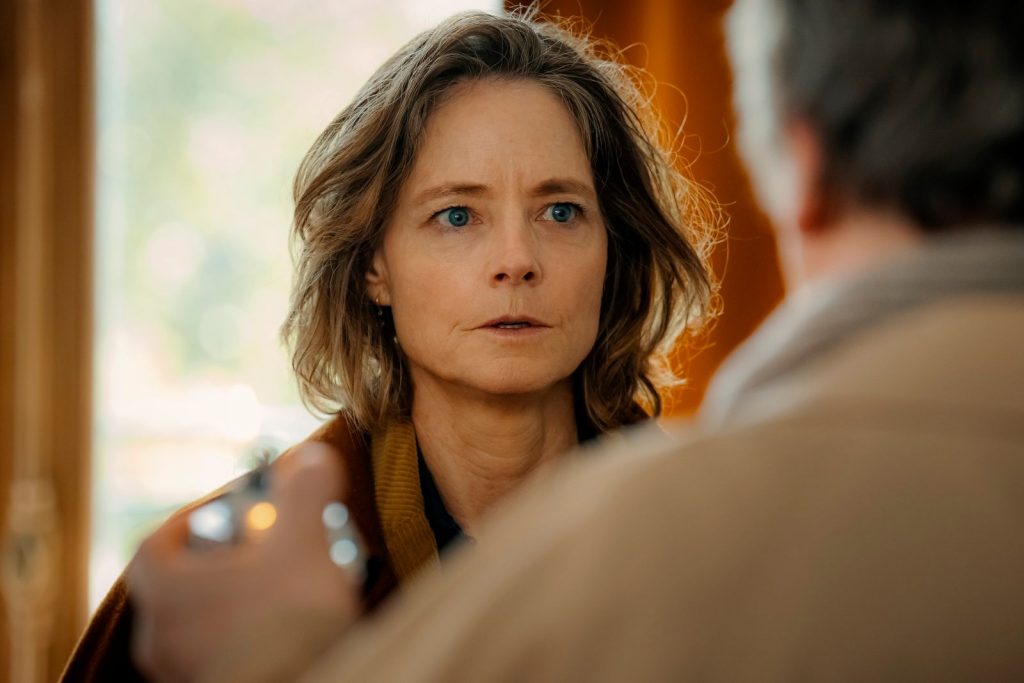
“In the midst of my notes scrawled during a screening at the Toronto International Film Festival last fall are the words “only murders in l’arrondissement.” And this darkly funny thriller does indeed feel like a French version of the popular TV series,” notes Chris Knight at Original Cin. “And it’s very French. Everyone smokes, even the non-smokers. Much red wine accompanies every meal. Lilian has an ex-husband (Daniel Auteuil) whom she convinces to help her; he agrees, and they also sleep together, though he has a girlfriend on the side. (‘She’s married, so it’s OK,’ he says.)”
“The script contains a lot of crazed characters, Jodie’s psychiatrist being one of them, with her conspiracy theories of murder and her past life,” writes Gilbert Seah at Afro Toronto. “It all turns out well at the end with a happy ending, though a bit too far-fetched for the film’s own good.”
“Foster is, as always, exceptionally compelling to watch as she tries to puzzle out Lilian’s motivations. And the actress is surrounded by France’s finest men of a certain age,” notes Barry Hertz at The Globe and Mail. “Auteuil, Amalric and Vincent Lacoste do their due diligence as performers, even when Zlotowski’s screenplay asks them to abandon all pretenses of rationality.”
At Original Cin, Kim Hughes gets some words from Jodie Foster, including how she finds acting in French: “I went to a French school, have studied for years, but I have a totally different personality in French than in English. My voice is higher, I’m less confident and so more hesitant. In some ways it was easier for me to fall into a brand-new character because I don’t sound like — or feel like — the grounded person I am in English. And it was such an honour to work with these French actors because I am such a fan of French cinema. Especially Daniel Auteuil because I have been watching him for years. This was a gift Rebecca brought to me.”
At POV Magazine, Pat Mullen gets some words from Jodie Foster about sharing the screen with scene-stealer Frederick Wiseman, who plays her character’s mercurial mentor: “I think what Fred brought to the film, textually, is that we see Lillian as somebody who left her country, abandoned her country, to become somebody new. That new person is a fantasy of what a French person would be, which is what Americans want to do,” Foster observes. “They want to come to France, and they want to live a fantasy like Jean Paul Belmondo [from Godard’s Breathless]. They want to inhabit this idea of what they have in France, live in this beautiful apartment overlooking the Parc Monceau and having little espresso cups and all that stuff.”
Sound of Falling (dir. Mascha Schilinski)
“In just her second feature, Schilinski creates a true art-house epic, haunting and lyrical. What might have come off as an eyebrow-raising trick of construction – shtick, almost – is elevated by the director’s sincere commitment to the conceit, a feat of editing as much as it is shooting,” says Barry Hertz at The Globe and Mail. “Every moment delicately, profoundly bleeds into the next – the audience isn’t so much challenged by the structure as it is enthralled. Like the most meticulously maintained farmhouse, every element and corner of the film is handled with great care by its caretaker, down to the sound design, which manages to find poetry in the sound of a buzzing fly.”
The Well (dir. Hubert Davis)
“I had high hopes for this latest end-times tale — it’s a genre I tend to enjoy, ironic as that may seem. And there is much to appreciate here, not least the performances, all of them strong, and no less than McCarthy, whose rare turn as a villain is wonderfully against type,” says Chris Knight at Original Cin. “But everything else hits just shy of the mark. The environmental disaster and its societal effects are never more than sketched in, hinted at more in the production design — lots of rusting industrial ruins and rebounding wilderness — than the writing. The underlying motivations of the main characters remain similarly vague.”
File Under Miscellaneous
At The Globe and Mail, Barry Hertz digs into the Oscar nominations, including why F1 made Jafar Panahi eat dust: “Even though many in the industry sneered when Joseph Kosinski’s race-car thriller F1 was mentioned as a Best Picture contender, observers simply didn’t count on what I’m calling the Top Gun: Maverick factor. Of course the Academy Awards would want to single out a movie that not only trumpeted the strengths of the big-screen experience but also actually found favour with audiences around the world. And so now the Brad Pitt-led vehicle (in more ways than one, wink wink) will waltz into the Oscars with four nominations, including Best Picture. I am under no illusions that the film will win, but sometimes getting close enough to the finish line is enough.” He also chats with the animators behind the NFB Oscar nominee The Girl Who Cried Pearls.
A Festival of Festival Coverage: The Sundance Kids
At the Toronto Star, Peter Howell speaks with previews some of the Canadian films at Sundance and speaks with programmer Heidi Zwicker: “Toronto’s Daniel Roher, Oscar winner for the Sundance-launched doc Navalny, returns to the fest with a film casting a wary personal eye on artificial intelligence: The AI Doc: Or How I Became an Apocaloptimist, which he co-directed with Charlie Tyrell. It features Roher himself as a worried father-to-be ‘exploring the existential dangers and stunning promise of this technology that humanity has created.’”
At POV Magazine, Pat Mullen previews some documentary highlights, including Nuisance Bear: “Nuisance Bear expands the award winning and Oscar-shortlisted film that brought audiences to Churchill, Manitoba where polar bears hunt for garbage and tourists flock to snap photos of the beasts in their very unnatural habitat. The hit short documentary gets a grand canvas, and we can’t wait to see what directors Gabriela Osio Vanden and Jack Weisman do with more wiggle room and a bigger screen to observe the climate crisis through polar bears’ forced migration paths amidst the arctic melt. The short doc boasts very promising cinematic vision with a memorable tracking shot and a fearless ability to get up close to the bears while creating empathy for them, so a little time and hopefully a lot more funding will take the story even further.”
TV Talk/Streaming Stuff
At What She Said, Anne Brodie binges Steal with Sophie Turner: “Zara’s at home frantically working on her laptop revealing to us what really went down. And Det. Rhys sees her escaping her home through a window. Buckle up folks, this riveting six-parter delivers shock after shock. The use of hand held cameras, and a jarring score ramp up the anxiety.” She also looks at the chilling documentary 33 Photos from the Ghetto: “A cache of 33 photos was recently discovered under a floorboard in a family home and now Grzywaczewski’s efforts have new meaning. His images of what transpired there, are horrifying. His courage in recording what he saw in these monumental photographs, are all proof and evidence for future generations to judge and mourn. One survivor couldn’t look at them; she’d tried all her life to forget those days. The doc is a slap in the face of anyone who thinks we know the Holocaust. There are other stories we don’t and will never know about this most brutal, bestial event in recent human history.”