Reviews include Run Terry Run, The Social Reckoning, and Your Mother Your Mother Your Mother.
TFCA Friday: Movie Reviews for July 17
July 17, 2026
Welcome to the TFCA weekly, a round-up of reviews and coverage by members of the Toronto Film Critics Association.
In Release this Week
Barrio Triste (dir. Stillz)
“The film looks like cinema verite with a loose narrative and handheld camera techniques, making the film look like found footage,” says Gilbert Seah at Afro Toronto. “This kind of film can be annoying to many, but it encapsulates a certain realism.”
Desire (dir. Teresa Simon)
“Desire is another take, a female take on Fatal Attraction with a female director, female protagonist, and many female characters in the story. But the film, which takes a while to establish its thrilling momentum, is predictable to a fault. The film has a different feel in its first half compared to the second, which is more thrilling,” writes Gilbert Seah at Afro Toronto.
The Odyssey (dir. Christopher Nolan)
“This is a story steeped in a time of magic and myth. Like the sirens luring men to their doom, it’s here where Nolan’s more modern tone and approach clashes with the otherworldly challenges Odysseus encounters,” writes Eli Glasner at CBC. “There are moments when The Odyssey becomes almost a different kind of film, such as the confrontation with a cyclops in a cave, where Odysseus’s men scramble as the massive creature lazily munches soldiers. Nolan has talked about the influence of special effects pioneer Ray Harryhausen, and working with actor and clown Bill Irwin, and you can see him finding human solutions for these larger-than-life moments.”
“The result is a film that’s visually stunning and which transports us to the ancient world in a visceral and exciting way,” notes Karen Gordon at Original Cin. “Driven by powerful performances, particularly from Matt Damon, we see a thinking man in The Odyssey, who is really us, in an adventure bigger than we could imagine. It is both relevant and urgent. It’s bracing, powerful stuff by a master storyteller.”
“With spectacular visuals from stem to stern, a strong cast, riveting action scenes and a symphonic narrative that wends its way toward an exhilarating finale. And it amounts to a magisterial feat of cinema, a world-building epic that far outweighs Oppenheimer. Nolan may have built a vessel bent on reviving a classic era of sword-and-sandal epics like Ben-Hur (1959) and Spartacus (1960). But he takes the genre to a whole new level, with a profound relevance to the world we live in,” says Brian D. Johnson at Zoomer. “There’s a slew of Oscar-calibre performances. Damon deftly underplays his role as a wily combatant reluctant to reveal himself. Anne Hathaway swings between ferocious resentment and enduring devotion in her role as Penelope, our hero’s long-suffering wife. Pattinson gives evil a razor’s edge as the cunning Antonius. And Morton is blithely terrifying as Circe, the witch who turns Odysseus’s men into pigs with her bare hands in a scene worthy of David Cronenberg.”
“Mimicking the oral tradition from which this tale emerged, the film’s narrative keeps passing hands. Early on, Odysseus’s faithful servant, the blind Eumaeus (a dignified John Leguizamo), who looks after the King’s loyal dog, Argos (who won’t die until he sees his master, a nice bit of foreshadowing), delivers some much-needed initial exposition,” says Glenn Sumi at Go Ahead Sumi. “Not surprisingly, Nolan handles the big set pieces masterfully. If you’ve ever wondered how that Trojan Horse trick was pulled off, he shows you, claustrophobia and all. Odysseus’ trip to the gates of Hades is nightmarish, the blind Tiresias (James Remar, unrecognizable) hovering over the ground to deliver his prophecies. Ludwig Göransson’s score, here and elsewhere, adds layers of propulsive drama.”
“It’s a shame that much of the film sheds the lyricism that has sustained Homer’s text for millennia in favor of flat, contemporary dialogue. While Nolan’s efforts to render the material accessible remain admirable, The Odyssey struggles to strike a delicate balance between poignancy and authenticity, too often sacrificing emotional, thematic heft at the bloodied altar of mass appeal. The result is an experience that frequently feels less like an ancient myth brought to life than an assortment of American and English performers enthusiastically cosplaying as legendary Greek figures,” argues Prabhjot Bains at Range. “While Damon’s nuanced turn—which deftly navigates stoic heroism and aching guilt—transforms a closing act monologue into a timely indictment of our current, continued penchant for war mongering and exploitative gain, Much of The Odyssey labours to find anything touching or earnest enough to justify its grand pretensions. A quality exacerbated by some tepid, distractingly exaggerated turns from Tom Holland and Robert Pattinson.”
“Nolan has worked with the brilliant cinematographer Hoyte van Hoytema to visualize Odysseus’s decades long voyage of discovery, which places him in the midst of battles on land and sea, battling creatures as terrifying as the Cyclops and haunting as the Sirens while encountering seductive figures like the goddesses Circe and Calypso,” adds Marc Glassman at Classical FM. “As the stories unfold, van Hoytema lenses them with panache, whether they’re on the blustery greyish blue sea tossed waters near the Greek islands, the dank, murky shores where the dead come alive again briefly to talk to Odysseus or the stark hillside lands of the warrior’s home in Ithaca. Nolan and van Hoytema have exploited the visual properties of 70mm IMAX to its fullest, immersing the viewer in the exotic but often challenging landscape where Odysseus is forced to fight his many battles.”
“Much is said in Christopher Nolan’s The Odyssey about ‘Zeus’s Law,’ the ancient Greek code of conduct requiring strangers to be treated with respect and hospitality. Violations of the decree by humans and monsters fuel much of the drama in this transfixing adaptation of Homer’s epic poem, a spectacle of magic, devotion, crushing pain and extreme brawn set 3,000 years ago. It’s the blockbuster of the summer,” says Peter Howell at the Toronto Star. “Yet ‘Nolan’s Law,’ to coin a phrase, is a more powerful edict. Witnessed in action but not discussed onscreen, it’s the writer-director’s self-imposed dogma of making films with male protagonists, a curious career-long fascination that reaches a peak with The Odyssey, his 13th feature. The film feels like the purest expression of that fixation.”
“An epic tale told on an epic scale with an epic runtime to boot,” says Joe Lipsett at Queer Horror Movies. “One strange byproduct, however, is that some story beats hit harder than others. Odysseus’ infamous encounter with the Cyclops feels a little quick and the attack by the giants, reimagined here as enormous warriors in armour, is exciting but also feels inconsequential. Instead, the film is at its best when it slows down and allows its talented cast to tease out emotion, such as the trip to Hades where Odysseus must confront the men he’s sacrificed along the way, including Sinon (Elliot Page in a minor, but crucial role) or his tense – and political – conversation with Circe after she’s turned his men into pigs.”
“Nolan’s use of minimal CGI is noticeable in the film,” notes Gilbert Seah at Afro Toronto. “His film looks epic and real. The majority of the sea voyage was filmed on a full-size sailing vessel in the Mediterranean, Scotland, and Iceland rather than against green screens. The Odyssey marks the world’s best filmmaker at his prime, telling one of the oldest and most mesmerizing stories of all time. The film, costing $250 million to make, should end up with a solid profit.”
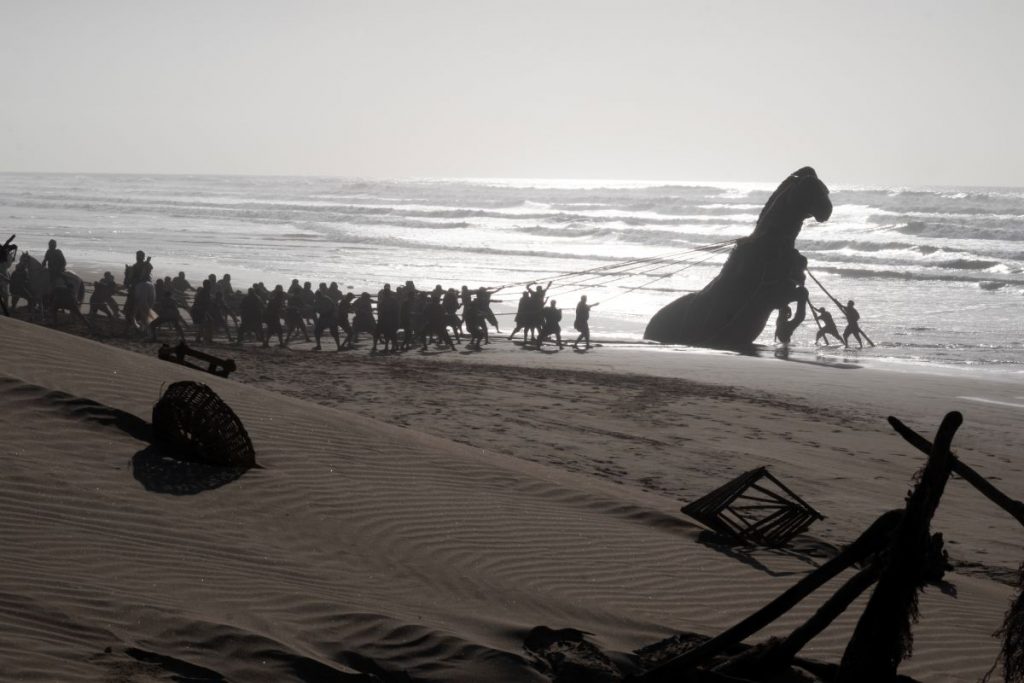
“The music, settings and costumes are just lovely. And it’s shot in 70mm IMAX film suitable for an odyssey like this one. The acting, though — and it’s a huge, all-star cast — is just OK, with few performances standing out (Anne Hathaway was excellent),” says Daniel Garber at Cultural Mining. “I was not impressed by Matt Damon; he pales in comparison to Ralph Feinnes in the same role, in the same story just two years ago, in The Return. And for a movie that cost a quarter of a billion dollars to make, there’s no excuse for the uneven special effects. The Trojan Horse is magnificent — nothing like the rickety wooden statue on wheels I’ve always imagined. The cyclops, though, is just awful, the dog-headed monsters in Scylla and Charybdis are messy and hard to make out; and what I’m guessing are supposed to be the giant Laestrygonian cannibals are just a series of identical, shiny suits of armour. Probably cost a fortune, but still very cheap-looking.”
“The picture features all the major stops in Odysseus’ journey, from the man-eating Cyclops to the deceitful witch, Circe (Samantha Morton),” adds Sarah Gopaul at Imagery at the Movies. “However, Nolan alters the story to make Odysseus the steadfast hero, always ready for a fight. Consequently, he also shifts the focus of these confrontations to the action. Where negotiation and wit once prevailed, Odysseus now uses threats and brute force. The result is a glossy spectacle of swordfights and monster encounters that is sure to keep audience’s attention.”
Remake (dir. Ross McElwee)
“The film touches upon so many of the responsibilities and tensions entailed in documentary filmmaking, particularly the complexity of representing the lives of others—a point that becomes increasingly difficult as key figures from McElwee’s life and work have passed away,” writes Pat Mullen at POV Magazine, along with a few words from McElwee. “I thought moments like that represented a fashion, in my head, of filmmaking and that my feelings for the people I was filming, in fact, should be part of the film. So they’re in there,” says McElwee. “Looking back now, I can say maybe that was a mistake. Maybe I sulk, but it represents an accurate version of where the filmmaker was; the world that he was filming in the early ’80s. But with Remake, I think the way in which people appear is maybe more gentle than in previous films, less ironic, and maybe that is a good thing.”
“Sherman’s March is not a very good film,” argues Gibert Seah at Afro Toronto. “But it is a decent and sincere film, a point that polarized the film, with audiences able to connect with the subjects. The question is why the need to remake a mediocre documentary? Remake follows the same way Sherman’s March does.”
Rose of Nevada (dir. Mark Jenkin)
“The film takes time to settle, requiring a bit of patience, but Jenkin’s film has both a marvellous and mysterious look and feel about it,” praises Gilbert Seah at Afro Toronto. “This time, the story blends folklore, grief, and science fiction into an atmospheric story rather than a conventional thriller. Aided by George MacKay’s moody performance, the film also makes an emotional turn that is more important than the time travel. Rose of Nevada is the best film I have seen this year.”
Steal Away (dir. Clement Virgo)
“Illness and madness are difficult to depict at the best of times, and with the political situation unraveling in the country they’re inhabiting, the histrionics in Fanny and Florence’s mansion gets worse. Steal Away moves in its last third from a gothic styled melodrama into a more straight-forward narrative involving a chase against the police,” notes Marc Glassman at Classical FM. “Virgo is able to handle the tonal shift quite well, but the film understandably loses much of its emotional thrust. Although the final sequence in Steal Away is quite moving and beautifully shot, the film seems to have gotten away—somewhat—from Virgo.”
“A filmmaker of Virgo’s calibre doesn’t create a mood like this without a sinister payoff. It seems many babies are conceived among the refugees with their eventual whereabouts unknown. There are copious loose threads in this narrative, and having filled the viewer’s head with burning questions (Are they anchor babies? Is Florence a collaborator?), the last act is a bit of a disappointment,” says Jim Slotek at Original Cin. “It’s not that it isn’t an emotional and even action-heavy resolution to the mysteries of Florence’s home. I’ll just say it seems heavy-handed and unlikely and leave it at that. That said, Steal Away is a simmering watch, a race-based mystery in a foreboding place that is hard to turn away from.”
“As there are already so many films based on black slave history, this fairy tale approach makes the film more intriguing, with director Virgo carefully reconstructing real historical events through archival research,” writes Gilbert Seah at Afro Toronto. “Symbolism, dream logic, suspense, and horror to explore race, gender, and power. The film is also a coming-of-age story of Fanny, with the film focusing first on Cécile and then Fanny coming into the picture.”
“Steal Away is a fascinating and complex film, including elements of science fiction, historical drama and fairytails,” adds Daniel Garber at Cultural Mining. “That said, I found the story hard to mentally unravel for most of the film. But it all comes together before the shocking ending. The film is the work of longtime Toronto collaborators director Clement Virgo (The Book of Negroes, Brother) producer Damon D’Oliveira and writer (and Virgo’s partner) Tamara Berger (Maya & Samar) and is maybe the most lavish of their substantial roster.”
TV Talk/Series Stuff
At Original Cin, Liam Lacey binges Ride or Die: “In the spy terminology of the film, Judith and Debbie are both WOACAs, an amusingly bureaucratic acronym for ‘women of a certain age’, which is key to the film’s concept and demographic target. Like Jane Fonda and Lily Tomlin in the series, Grace and Frankie (playing character a generation older), they’re adult professionals who serve as models of women’s importance when they are past the ingenue stage.”
Meanwhile, Steve Norton at ScreenFish looks for art in Young Farts, Trailer Parts: “These are two young men who have earned their stripes and have made mistakes along the way,” says Norton. “But there’s such a genuineness about them that you can’t help but feel like you’re meeting the real guys. These aren’t performative stars who throw glasses of wine and complain about the manager. They’re just two guys who have worked hard to build something that matters. They love beer, smoking, their family and, most importantly, each other. In the unreal world of reality television, they feel entirely authentic. And we love them for it.”