Movie reviews include You Can See Everything, Fjord, and Musk.
TFCA Friday: Movie Reviews for Oct. 23
October 23, 2026
Welcome to the TFCA weekly, a round-up of reviews and coverage by members of the Toronto Film Critics Association.
In case you missed it: We are launching the TFCA Critics’ Picks screening series. Our first film is The Righteous, presented by member Dave Voigt at Imagine Cinemas Carlton on Monday, November 2.
In Release this Week
Ali G: Who Iz I? (dir. Sacha Baron Cohen)
“More than 20 years old, Sacha Baron Cohen’s character is so popular that it spawned a full-length movie Ali G Indahouse that I saw in the U.K. but never made it to the theatres in North America, is now updated with most of the humour tired and unfunny,” says Gilbert Seah at Afro Toronto. “In the film, he makes statements about the players who are in it and those who are not. Still, it all seems trite and mostly unfunny, even if all that is stated is true.”
Jim Queen (dir. Marco Nguyen and Nicolas Athané)
“More silly than pointedly satiric, Jim Queen turns into a gag-filled quest of the Parisian gay subcultures, introduced by a drag queen godmother figure named Glamydia (Harald Marlot). There is, for example, a ‘bear bar’, which is not for burly, hairy gay men, but men who actually dress like bears and enter a cage to compete in karaoke contests. The term ‘gaydar’ is a literal super-power that causes its’ possessors to glow like a radioactive comic book hero,” says Liam Lacey at Original Cin. “You could almost think of it as a coming-of-age Disney film, but with prostate orgasms.
“Jim Queen will cater more to a gay audience than a straight one, who are unlikely not to get the humour, which is deliberately raunchy and crude (slings in the spa, sex toys and anal penetration) nor what is going on. But so far the film’s critical response has been largely positive. Jim Queen is well made, hilarious, and satirizes its target spot on,” observes Gilbert Seah at Afro Toronto.
“Much in the fashion of last year’s whackadoodle odyssey Lesbian Space Princess, Jim Queen seems destined for cult status. It’s fun, sassy, and so unabashedly fine with playing to its core audience. It creates a safe space for everyone to share a laugh. It knows that the haters won’t bother and doesn’t aim to pander to their tastes,” says Pat Mullen at That Shelf. “The film manages to conjure laughs without yucking anybody’s yum, too. Lucien’s role in Jim’s quest offers a lesson in embracing the power bottom within and, in turn, teaches Jim not to be wary of the rail-thin behinds that are equally deserving of an out-of-this-world pounding.”
Klara and the Sun (dir. Taika Waititi)
“There are more complicated things that have shaped the characters, that are unspoken, but that affect the way the characters interact as Klara enters the picture. For a long time, Chrissy remains hostile towards Klara. There is unresolved grief in the family. And there are a few more elements, a surprise turn or two that should add emotional complexity to the characters and how they move forward,” says Karen Gordon at Original Cin. “But, although there are some interesting moments, things in the film don’t ever seem to add up to anything that we can get a grip on. We see a bit more as it progresses. We learn about the things that Chrissy and Josie are carrying, and of course we get a steady dose of Klara’s unshakeable optimism and loyalty. The tone ranges from whimsical to comedic to dramatic and back around again.”
“The idea of a robot sacrificing itself for its masters is a formidable task that director Waititi milks, but indeed, he could have done with more insight and subtlety, and with less sentimentality,” admits Gilbert Seah at Afro Toronto.
La Bola Negra (dir. Javier Ambrossi and Javier Calvo)
“Directors Javier Calvo and Javier Ambrossi’s ambitious period piece concerns three sexually repressed gay males and they sort out their lives,” says Gilbert Seah at Afro Toronto. “A beautifully shot atmospheric period piece, though a bit long.”
“A contemporary strand follows a gay historian and author (Carlos González), whose inheritance from a fascist grandfather opens an unsettling door into the past. Penélope Cruz steals her brief scenes as a brassy cabaret performer. At times the film can be unruly and overripe, but Calvo and Ambrossi bring a rich, theatrical sweep to their reclamation of a queer Spanish history long forced into silence,” notes Peter Howell at the Toronto Star. “For all its flamboyant excess, La Bola Negra is a heartfelt, unapologetically theatrical act of historical reclamation. It finds connection and hard-won joy in lives Spain tried to erase. It’s the rare festival crowd-pleaser with both emotional and political weight.”
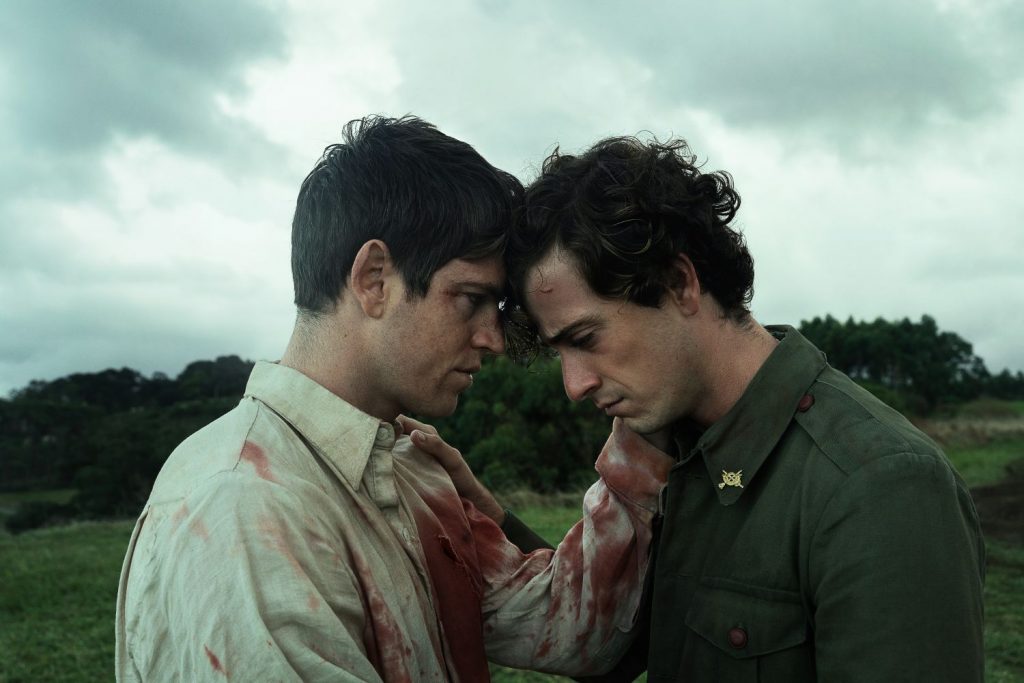
“La Bola Negra furthers García Lorca’s work by affording a new generation of artists a platform for queer stories. Many players in the film’s excellent ensemble are debut performers, which further demonstrates the filmmakers’ confidence with the material and their vision to realise it. The film proves the apex of gay cinema by literally assembling an army of hot men who are as strong in spirit as they are in physique,” writes Pat Mullen at That Shelf. “For one, Guitarricadelafuente gives a star-making performance as Sebastián. His soulful, expressive eyes inject the film with heartache, longing, and the power of desire. Meanwhile Gonzalez provides levity and an accessible entry point with a cantankerous character who couldn’t be more different from the actor who sashays around the film’s press tour.”
Once Upon a Time in Harlem (dir. William Greaves, Liani Greaves)
“Other films that celebrate similar gatherings, like Jean Bach’s A Great Day in Harlem, prove to be joyfully nostalgic and sympathetic to those being recalled. With Greaves, however, there’s more at play—a genuine design not to simply laud those from an early era, but to capture the sense of argument, debate, and discussion that fostered the movement in the first place,” writes Jason Gorber at POV Magazine. “We are witness to the recollections from the participants in this dramatic era of change, and equally was can see how these movements were birthed in the first place. Thus Greaves captured in almost magical fashion this multifaceted portrait as relevant and resonant today, if not more so, than when the footage was captured those many years ago.”
“The result is one of the year’s best documentaries, an extraordinary cinematic time capsule of Black cultural and political history, and a bridge between the cultural awakening of the 1920s and the Black Power movement of the early 1970s,” adds Liam Lacey at Original Cin. “The guests, now, in their sixties through their nineties, speak of how the Harlem cultural moment came in the shadow of a plague of lynchings and white-on-black mob violence across the South following the First World War. A couple of the older guests, Eubie Blake and actor Leigh Miller, founder of the Negro Actors Guild, actually had parents who were born in slavery.”
“As implied, the doc is quite a dense and layered examination of Black issues that might be over-the-top for most non-coloured audiences,” says Gilbert Seah at Afro Toronto. “But still, it is informative, if one can be patient and try to learn and understand what transpires. The problem is that most audiences are unfamiliar with most of the dignitaries on screen in the doc during a Duke Ellington dinner cocktail party, nor familiar with celebrations like the Medicine Show or the Minstrel Show.”
Paralysed by Hope (dir. Judd Apatow and Neil Berkeley)
“At best, the film balances Maria Bamford’s moderately funny performances with a frank, compassionate portrait of her mental-health struggles,” notes Gilbert Seah at Afro Toronto. “It is directed by two filmmakers who clearly admire her work, rather than approaching her merely as a celebrity subject.”
Possible Love (dir. Lee Chang Dong)
“South Korea’s Lee Chang-dong (Burning), an auteur of buried truths and slowly unfolding secrets, returns after eight years with a coldly funny, increasingly caustic drama of class anxiety and unlikely friendship. Mi-ok (Jeon Do-yeon) and Ho-seok (Sul Kyung-gu), a blue-collar couple reeling from Ho-seok’s factory layoff, become close to the affluent Ye-ji (Cho Yeo-jeong, Parasite) and Sang-woo (Zo In-sung, Hope),” writes Peter Howell at the Toronto Star. “Ye-ji, a documentarian making a film about workers facing layoffs and automation, insists that she is sincere: ‘I’m trying to love these people.’ But cynical businessman Sang-woo congratulates her on her ‘great Method acting,’ while Mi-ok cautions her against wearing expensive clothes around people struggling to make their mortgage payments. As Ho-seok’s depression deepens, Mi-ok finds herself drawn to Sang-woo. Loosely inspired by Thou Shalt Not Covet, an episode of Krzysztof Kiezlowski’s Dekalog, Lee’s exacting, increasingly uncomfortable film won three prizes at Venice, including the Silver Lion Grand Jury Prize.”
“There’s a lot of pain in Lee’s film, especially in Sul’s portrayal of Ho-seok, a man without the tools to express his helpless anger and shame,” observes Liam Lacey at Original Cin. “But there’s humour and joy as well in Jeon Do-yeon’s performance, which conveys both innocence and a warm intelligence that illuminates this exceptional film.”
“Possible Long is a long slow-burn, but if shortened and made more efficient, the film would succeed even more, and with more push and impact,” says Gilbert Seah at Afro Toronto. “Still, director Lee takes the alternative route of a slower, longer film, and one has to respect him for that. Still, Possible Love is an intriguing film from start to finish.”
Surviving Hurricane Otis (dir. Jorge Michel Grau)
“Though clichéd as a survival and disaster epic, the film explores family loyalty, courage, resilience, and the will to survive when confronted with an overwhelming natural disaster, using a real-life catastrophe to tell what is basically a tried-and-true drama,” writes Gilbert Seah at Afro Toronto. “
A Talent for Murder (dir. Anton Corbijn)
“What follows is a battle of wits in which the balance of power shifts, suspicions mount, and the purpose of Edward’s visit becomes increasingly difficult to pin down. Highsmith, apparently amused by the challenge, proposes a bargain: if Edward can devise the perfect murder plot, she’ll sign the contract,” says Thom Ernst in Original Cin. “Corbijn wisely gives her room to dominate the proceedings. Mirren doesn’t so much imitate Highsmith as inhabit the less agreeable qualities associated with her reputation. She’s abrasive, suspicious, impatient, and capable of delivering an insult with the casual indifference of someone asking for another cup of tea. There’s something enormously entertaining about a character who makes no effort to be liked, particularly when played by an actor who knows exactly how to make that unpleasantness irresistible.”
“Mirren puts audiences into Highsmith’s juicy, rich psychology,” says Pat Mullen at That Shelf. He also chats with Mirren and learns about the joy of playing the baddie playing Highsmith alongside her work in MobLand: “The first thing when you’re playing a baddie is never to see them as the baddie,” says Mirren. “Obviously, they’re completely different characters. The gothic nature of Maeve Harrigan in MobLand, the extremity of the writing, I always compare it to Jacobean Tragedy. It has that Jacobean edge to it where everything is heightened and much more extreme than anything in real life. Patricia Highsmith’s very different. For Patricia Highsmith, I had to really try to get into the absolute reality of who she was.”
Wicker (dir. Alex Huston Fischer, Eleanor Wilson)
“Even with all its weirdness and endless memes, Wicker is a surprisingly tender romance that uses its strange premise to explore the expectations placed on women and the ways those expectations shape relationships,” says Rachel West at That Shelf. “Beneath the raunchy humour and the fairy-tale setting is a story about finding love and happiness outside the roles society assigns us. What begins as an absurd fantasy about a woman ordering a husband made of wood becomes something far more heartfelt, proving that the most meaningful connections are not necessarily the ones that conform to convention.”
“Wicker plays like an adult romance fantasy with black humour, a kind of adult Grimm-like fairy tale,” adds Gilbert Seah at Afro Toronto. “Yes, and there are adult (sex) scenes thrown in for good measure. Olivia Colman is marvellous as she always is and makes the movie. The film also touches on several issues such as social conformity as the village punishes anyone who refuses to live by its rules.”
“Olivia Colman delights as an odiferous fisherwoman, shunned by her rude and cruel fellow villagers, who conscripts the magical local basketmaker (Peter Dinklage) to craft her a husband out of wicker, a hunky creation empathetically played by Alexander Skarsgård. Elizabeth Debicki adds brio as the jealous and meddling tailor’s wife, who is out to disable this fable,” writes the Toronto Star’s Peter Howell at Night Vision. “The trouble is that this made-to-order mate makes the village’s flesh-and-blood husbands look bad. He fixes up the fisherwoman’s home, handles the housework and, judging by the sounds echoing across the village at night, leaves little to complain about in the marital bed. She catches the fish; he proves quite the catch.”
Wildwood (dir. Travis Knight)
“The most distinctive thing about Wildwood is that it uses elaborate, handcrafted stop-motion animation rather than conventional computer-generated animation,” notes Gilbert Seah at Afro Toronto. “The film spells ‘wonder’ from start to finish, a fundamental element that is a must in animated features. It is a strong fairy tale settings with a princess, a Kingdom, magical creatures and an evil witch-like villain to boot. Everything spells success in Wildwood.”
“Wildwood offers a breathtaking cinematic achievement, but the sheer scale of its production really needs to be seen to fully grasp the artistic and technical accomplishments that build the world of the mythical forest creatures who reside in the woods surrounding Portland,” notes Pat Mullen at That Shelf. “During a recent set visit to Laika Studios, That Shelf got to witness the behind the scenes magic that brings young Prue (Peyton Elizabeth Lee) from the stage idea to becoming the moving and breathing heroine who explores the woods while searching for her brother, Mac, after he’s abducted by a murder of crows one sunny afternoon. Put another way, it’s pretty amazing to see how the sausage of Wildwood gets made. There’s a whole universe of tiny wheels in motion behind the fantasy that unfolds on screen. When production yields roughly 1.8 seconds of footage a week, that’s a lot of shared love and labour.”
File Under Miscellaneous
At Exclaim!, Victor Stiff chats with Street Fighter star Callina Liang about kicking ass and bringing onscreen representation a step forward. “Man, it honestly gets me emotional every single time,” Liang says. “As a little girl growing up, there were not many women or people that looked like me in big-budget action films, especially as the leads. This movie shows the next generation of girls that they can grow up to be strong, if not stronger, and you can show strength and be feminine at the same time, and go after what you want and take your place in the world.”
At POV Magazine, Pat Mullen looks at the success of You Can See Everything and assesses whether it could make Oscar history for a documentary: “Critical consensus hardly poses an Oscar bellwether, but it indicates what You Can See Everything represents at this point in the fall cycle: that original masterwork that gets people excited about movies. I haven’t seen so many people discuss a film with such enthusiasm since Parasite,” says Mullen. “The first hurdle for You Can See Everything may be the Academy’s documentary branch itself. The members tend to be traditionalists. Scan the processes behind previous nominees and winners, and you’re most likely to see a field of vérité-driven driven docs and interview-heavy films, plus some archival, filling the nominee bracket year after year.”
A Festival of Festival Coverage
At That Shelf, Rachel West previews the Windsor Film Festival and picks some highlights to see.
At POV Magazine, Pat Mullen previews Toronto’s three-fest weekend and instantly regrets the number of pitches for additional events it invited.
TV Talk/Series Stuff
At Bloody Disgusting, Joe Lipsett dives into Yaga: “Yaga is compulsively watchable and, with such short episodes, highly bingeable. Loaded with enough bizarre cult-like imagery and captivating performances, there’s plenty to recommend,” writes Lipsett. “If there is one significant drawback, it would be that Rapp and Carson’s temperaments tend to shift too quickly to be believable. This becomes more apparent in the back half of the series, and tends to feel like a narrative construct to induce needless character friction.”