Movie reviews include La Bola Negra, Once Upon a Time in Harlem, and Wildwood.
TFCA Friday: Week of August 15
August 15, 2025
Welcome to the TFCA weekly, a round-up of reviews and coverage by members of the Toronto Film Critics Association.
In Release this Week
Americana (dir. Tony Tost)
“A highly unpredictable, irreverent, and intricately constructed small town crime saga, Americana packs a lot of value into an unassuming package,” says Andrew Parker at The Gate. “It’s more of a good time than a great movie, but in these lazy, waning days of summer when original, quality entertainment tends to be in shorter supply, Americana is a welcome change of pace.”
Boys Go to Jupiter (dir. Julian Glander)
“It’s indie animation with a Gen-Z slacker feel that borrows from anyone from Kevin Smith and even Richard Linklater and we had the pleas of sitting down with writer/director Julian Glander about doing animation on a shoestring budget, the rounded edges of this universe and so very much more,” says Dave Voigt on In the Seats with…
“Boys Go to Jupiter, the debut feature film from American 3-D animator, video game designer, and illustrator Julian Glander, is both jaded and fresh, a Gen-Z version of Richard Linklater’s early slacker comedies with a sprinkling of Studio Ghibli’s childlike fantasy. Whipped together in 90 days with the free, open-source animation software Blender, the film has the lo-fi plastic look of a vintage video game and a script that balances casual plotting with sharp dialogue,” says Liam Lacey at Original Cin. “The setting is suburban Florida, between Christmas and New Year’s Eve. It’s portrayed as a limbo of faded pastel colours, empty pools, and parking lots, with billboards offering evangelical warnings about get-rich schemes.”
East of Wall (dir. Kate Beecroft)
“Beecroft finds much beauty in what Tabatha calls ‘the new West’ — horses and kids running wild and free, and astonishing shots of the badlands, which Porshia says in voiceover are what the bottom of the ocean would look like if it all dried up,” says Chris Knight at Original Cin. “But the story tends to meander. A late-night gathering of women discussing the (often) terrible men in their lives plays like a writer’s clumsy attempt at creating a #MeToo moment. And the ultimate conclusion of Waters’ designs on the ranch feels tacked-on. Still, there is much to enjoy here. East of Wall is Beecroft’s first feature, and I eagerly await her second — just please don’t let it be a Marvel movie. She captures so many little moments perfectly and just needs to trust herself to let the big moments take care of themselves.”
“Filled with sharp, sweeping views of endless skylines and natural wonders, and edited in a snappy fashion that befits many of the film’s younger characters and their cinematic influences, East of Wall keeps it real, but not in the gritty faux-documentary one might expect from a movie that blends non-actors (including all other teens on the ranch) with professionals amid a tightly constructed story,” notes Andrew Parker at The Gate.
“Despite the realistic atmosphere and performances, one can hardly call the film enjoyable for the reason that it is never much fun to watch a family in struggle,” says Gilbert Seah at Afro Toronto. “The story occasionally falls into clichéd territory, as one can expect Tabatha to be fighting with the ranch’s buyer over her loss of control of the ranch. The film’s cop-out happy ending that includes Tabatha having her way with the ranch and the dolled-up reconciliation between mother and daughter are also a bit hard to take.”
Fixed (dir. Genndy Tartakovsky)
“Dog owners should relate more than others to this movie, which highlights the eccentricity of the animal,” writes Gilbert Seah at Afro Toronto. “Fixed is an adult animated comedy about dogs and particularly about a mutt named Bull about to get fixed. Being fixed means, for Bull, getting mutilated and his balls cut off, which means that there are plenty of high jinks involved with dirty jokes abound. The jokes are a hit and miss with fortunately, more hits than misses. But the humour gets nasty in this R-rated comedy.”
Folktales (dir. Heidi Ewing, Rachel Grady)
“Dynamic doc duo Heidi Ewing and Rachel Grady (Jesus Camp, 12th & Delaware) strike a lighter note with Folktales, which resembles their earlier 2005 work The Boys of Baraka in that it follows a group of young people going to school,” says Peter Howell at the Toronto Star. “With its focus on sled dogs and their magical effect on their human companions at a Norwegian wilderness school, Folktales might have been better titled Dogwarts. It’s beautiful to watch humanity’s best friends alleviate modern coming-of-age anxieties in troubled teens. The chilly Arctic climes make for an especially illuminating backdrop.”
“Folktales is a visually transporting work of documentary cinema that makes the viewer consider taking such a journey of self-discovery themselves. It looks like a lot of hard work, but also romantic and satisfying,” writes Andrew Parker at The Gate.
“As Ewing and Grady observe the school Folktales weaves an evocative motif with the tale of Odin,” says Pat Mullen at POV Magazine. “Red thread wraps a tree in the woods, gradually encompassing the trunk and branches as the norns guide the students’ futures over the course of the year. It’s an evocative image and shock of colour amid the wintry woodland. The image proves strikingly specific with the Nordic setting. However, it lends a universal resonance to the coming-of-age story, just as good folk tales do. These young people might trust the norns to thread their fates, but learning to control their own destinies proves an empowering life lesson.”
The Glassworker (dir. Usman Riaz)
“There’s also the occasional intrusion by djinns, those supernatural beings of Islamic mythology, seen in the film only indirectly as sparkles of pink and blue reflected light which, at turning points in Vincent’s life, flash about like the fairy Tinkerbell,” writes Liam Lacey at Original Cin. “The dialogue, on the other hand, definitely does not sparkle: ‘Without art and music, what do we have in this world full of conflict and war?’ Alliz asks. In a moment of rage, Vincent declares, ‘I’ll show them. I’ll show them all!’ But his father Tomas admonishes him. ‘Don’t let your hatred consume you. We need to be better than that!’ If it earns a D for tone-deaf dialogue, The Glassworker earns an A for ambition and bonus points for the useful reminder that war destroys things and art isn’t shatterproof.”
“Evoking memories of Studio Ghibli and Cartoon Saloon this is a personal and inspirational story on so many levels we had the pleasure of sitting down with co-writer/director Usman Riaz about not only the origins of the story but the origins of him mounting his own animation studio which is a first for Pakistan and a reminder in the power of simply not quitting as this film is easily over 10 years in the making,” says Dave Voigt on In the Seats with…
Highest 2 Lowest (dir. Spike Lee)
“But Highest 2 Lowest doesn’t really seem to have a cohesive message. The most forgiving take for why that is would be that Lee simply never bothered to gather his disparate themes into one. The less charitable take would be that the interpretation of class and worth Lee does eventually land on is as shallow as it is head-scratching,” says Jackson Weaver at CBC. “What you can’t say, though, is that there’s no message at all; both this update and the original are so completely concerned with the concept (or figment) of upward mobility that they allude to it right in their titles. And both start from that higher position: as in Kurosawa’s version, our protagonist is an upwardly mobile and aptly-named businessman.”
“It seems Lee learned from his experience making Oldboy, and rather than distinguishing his film by piecemealing the story into a formless, superficial rendering, Lee takes the time to find the points of difference between Japan in the 1960s and Black America in the 2020s,” says Rachel Ho at Exclaim!. “Where Mifune’s Gondo rebuffed the idea of his company selling cheap, low-quality shoes, Washington’s David fears how an acquisition will wipe away his company’s history of supporting Black music and musicians. In High and Low, the police readily and effectively help Gondo, while Highest 2 Lowest highlights the ineptitude of the police, to the point that David needs to take matters into his own hands.”
“There’s emotion roiling under David’s skin, but strangely that doesn’t add up to a lot of emotional connection with the other characters. I waited a long time before I felt that what was happening on camera made me feel that people were connecting in a real way. Those moments of connection are there, but fleeting,” notes Karen Gordon at Original Cin. “Highest 2 Lowest has a range of tones, sometimes intense, sometimes not intense enough. The film’s second half is livelier. It becomes a thriller, taking us through the streets and subways of New York, and Lee has a lot of fun with it. There’s a train full of boisterous Yankees fans on their way to a game against the Boston Red Sox.”
“One of Lee’s greatest and most curiously unremarked upon talents is his ability to be a masterful entertainer when called upon,” observes Andrew Parker at The Gate. “Lee’s ability to pull off the numerous twists and pivots in Highest 2 Lowest is flawless, and there’s enough energy on display to power a good portion of the city he lovingly calls home.”
“During a sequence set during the Bronx’s annual Puerto Rican Day parade, Lee stages a wild, delightfully frenetic chase scene,” says Barry Hertz at The Globe and Mail. “The sequence is shot with such verve and love for the Big Apple – with several NYC celebrities making cameos as themselves, including one of Lee’s long-time collaborators, whose relationship with the director stretches back even further than Washington’s – that it forces audiences to reconsider the preceding hour.” Hertz chats with Spike Lee and Denzel Washington about their return to the Big Apple: “I’m a New Yorker, and you have to shoot a film where a film takes place, so this was the first one where that’s happened in a while. But I was happy to sleep in my own bed,” says Lee. “There was no way we’d do it anywhere else. New York’s a character. It was never discussed, even in somewhere like Toronto.”
It’s Never Over, Jeff Buckley (dir. Amy Berg)
“It’s Never Over expectantly shifts tone when Buckley makes the move to Memphis,” says Rachel Ho at Exclaim!. “The mood grows sombre and the pace slows. Berg treats Buckley’s tragic death at only 30 years of age with a gentle grace rather than as aggressive tabloid fodder. She overlays news footage reporting on the drowning, clips from his memorial service and words from the three women with his cover of Leonard Cohen’s ‘Hallelujah.’ His version of the song has only grown in popularity, with its intimacy poetically matching the sense of loss those closest to Buckley and his fans experienced.”
“Berg makes Buckley’s struggles with imposter syndrome, manic depression, and his perpetual fear of losing creative control into effortlessly relatable and humane topics of discussion, even for those who’ve never heard a note of Grace or his posthumously released material,” writes Andrew Parker at The Gate.
At POV Magazine, Rachel Ho speaks with Amy Berg about telling Jeff Buckley’s story through the women in his life. “I felt the pains of a man who was so talented and had a father [singer-songwriter Tim Buckley] he met one time that he was compared to over and over again throughout his career. I just could not imagine how difficult that must have been for him,” says Berg. “Also, I am a single mom, and I understood that there was a complicated relationship with his mother. I really wanted to tell an intimate family story.”
Night Always Comes (dir. Benjamin Caron)
“The film moves along briskly, but the trouble with the film is its predictability,” says Gilbert Seah at Afro Toronto. “One can see whether the film is heading in the first 30 minutes, as the fact that everything is going wrong for Lynnette is forcing his lady into crime. Crime can be committed by good people as well, and the film intends to show this fact.”
“Night Always Comes is the rare example of a misguided thriller that feels thin and stifling at the same time. There’s plenty of atmosphere and in-your-face subtext, but also curiously little in the way of character or logical reasoning,” says Andrew Parker at The Gate.
No Tears in Hell (dir. Michael Caissie)
“Featuring a great performance by Luke Baines, this true crime adaptation is an extremely rough watch. A little drawn out, but perhaps that’s also just because the subject matter is so gruelling,” says Joe Lipsett on Murder Made Fiction.
Nobody 2 (dir. Timo Tjahjanto)
“Nobody 2 seems to channel something more akin to Deadpool than the Keanu Reeves franchise, which suits these characters and the situations Hutch finds himself in much more than the first film,” says Rachel West at That Shelf. “People getting hurt can be funny, especially when the camera cuts back to a chagrined Odenkirk who really just wants to enjoy his summer break. More than the punches, it’s Odenkirk’s visage that makes the story successful. The first film played it a bit more straight, but now that the sequel leans into the humour, it provides a refreshing and genuinely entertaining ride. It is not just violent: It is violently funny.”
“Nearly every beat is an act of gleeful retribution: an insult answered with a head-butt; a shove countered by a jaw-snapping uppercut. It’s violence as choreography, choreography as crowd-pleasing spectacle. The rhythm is relentless, each fight scene stitched together with just enough plot to let the audience catch its breath before diving back into another orgy of face-pummeling justice,” says Thom Ernst at Original Cin. “And make no mistake — this is a summer movie. The kind that plants (and occasionally face-plants) audiences into the warm fantasy of life in full bloom: lounging in vacation spots, wearing loud Hawaiian shirts, draping beach wraps over sun-warmed shoulders, exuding youthful spirit no matter the date on your birth certificate.”
“The insane third act plays out like an ultraviolent Home Alone, if Kevin McCallister had a bit of help from Back to the Future’s Doc Brown and the Wu-Tang Clan. All of this is what most people would expect going into Nobody 2,” notes Peter Howell at the Toronto Star. “But it’s hard not to regret that Odenkirk, who brought so much depth and character to his sleazy lawyer Saul Goodman in Breaking Bad and Better Call Saul, is content to keep developing Hutch as a psychotic score-settler rather than seek the troubled man within the killing machine.”
“A disturbing feature about the film is the acceptable use of violence that is allowed for Hutch to keep his family on vacation,” says Gilbert Seah at Afro Toronto. “Hutch gets to lose a finger, though this segment is treated in all good fun. Lots of bloody, violent gore are also present with weapons like daggers and machetes, chopping off limbs and thrusting into various assorted bodies of the villains. Nobody 2 still comes across as good clean (or good unclean) fun, all taken with large pinches of salt.”
Russians at War (dir. Anastasia Trofimova)
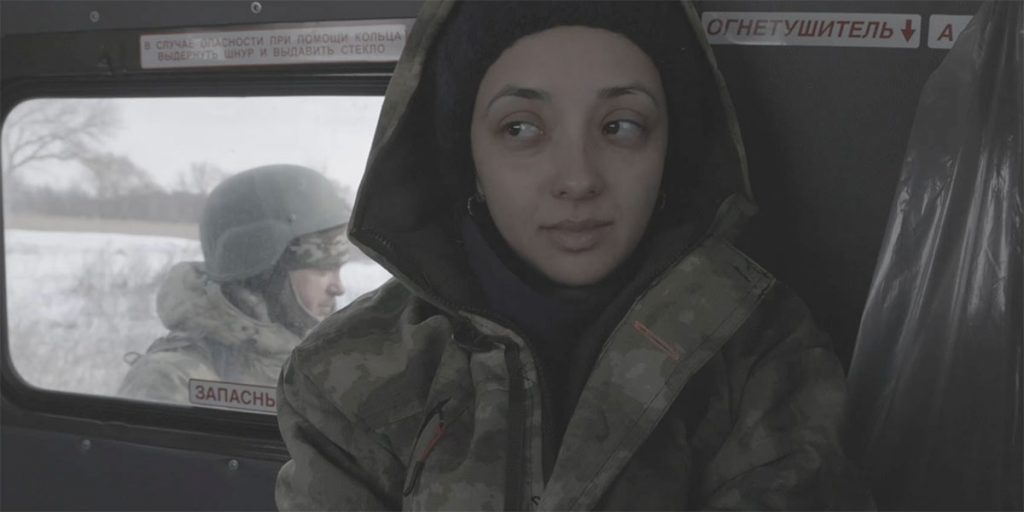
“It’s a stark and stunning piece of cinema that reiterates the simple truth that no one ever really wins at war,” notes Dave Voigt at In the Seats with…, along with an interview with director/producer Anastasia Trofimova and producer Cornelia Principe.
“The horrors of war aren’t shied away from, but so much else about this film backs away from deeper questions that are left on the table. It’s potent, but also empty; more of a conversation starter and lightning rod than a balanced depiction of the war in Ukraine,” argues Andrew Parker at The Gate.
“With Lewis Milestone’s 1930 adaptation of All Quiet on the Western Front clearly a guiding light, Trofimova has created an explicitly anti-war, anti-Moscow film that should ensure she’ll never set foot inside the country of her birth so long as Putin is in power. Is it so radical to suggest that not every single Russian of fighting age is a monster, but a human being merely hoping to escape the machinations of their state?” asks Barry Hertz at The Globe and Mail. “This is not to say that the film is above reproach. Legitimate criticism can be levelled at Trofimova’s disinterest in including any Ukrainian perspectives in the film, people whose country and lives have been devastated by the whims of the power-mad Putin. Yet documentary cinema does not need to abide by the rules of a news-magazine style report where all sides are equally represented.”
“If documentaries have the power to provoke and inspire conversation, Russians at War serves as a battleground for freedom of speech and journalistic integrity,” writes Pat Mullen at POV Magazine. “Go into Russians at War with a willingness to wade through the fog and see the bigger picture. By doing so, you’ll find a remarkably courageous feat of documentary filmmaking. The access that Trofimova gets while hunkering down with soldiers is indeed impressive—doubly so that it was captured without authorization or press credentials…Beyond the feat of access, what makes the film so compelling is the raw insight into the minds of Russians on the front lines. The film burrows deep into the psychology of war, and that’s what makes it so unsettling and effective.”
Sweet Angel Baby (dir. Melanie Oates)
“No men were hurt in the making of this female outcast,” says Liz Braun at Original Cin. “In all that narrow-minded, ‘small town’ business, writer-director Oates has found a lens to underline the impossible road to authenticity that women travel. Like every woman who has had to hide her light under a bushel, downplay her intellect, tamp down her sexuality or otherwise keep a dimmer switch on her abilities, Eliza now must decide how much of herself she will reveal and how much censure she can tolerate.”
“If you’ve ever lived in a small town, you know where this one is going, but kudos to writer/director Melanie Oates for really bringing some nuance and genuine humanity to this story,” says Dave Voigt in an interview with Oates on In the Seats with…
File Under Miscellaneous
At The Gate, Andrew Parker notes the significance of Shin Godzilla’s return to theatres: “Pulling inspiration from the staccato, walk-and-talk nature of Aaron Sorkin’s writing (with The Social Network Brought up as a specific point of comparison by Anno in interviews, and boasting healthy hints of The West Wing), Shin Godzilla is the fastest anyone has ever seen people moving slowly; terrified of stepping on the toes of other departments and even more afraid of making the wrong decisions without consultations,” writes Parker. “Who should be in charge of the response? What are the rules of engagement? Should operations be handed over to foreign interests better equipped to deal with the threat? Should the beast be destroyed or sedated and kept for research? No one can agree on how to respond or even what’s the top priority here.”

A Festival of Festival Coverage: A TIFF tiff
At The Globe and Mail, Barry Hertz reports on TIFF’s decision to screen Barry Avrich’s The Road Between Us after reversing its acceptance: “While noting the “pain and frustration expressed by the public” over the issue, [TIFF CEO Cameron] Bailey and Mr. Avrich added that more details about the film’s TIFF premiere, including the date, will be announced on Aug. 20.”
At POV Magazine, Pat Mullen also writes about the reversal and the reversal of the reversal.
TV Talk/Series Stuff
On In the Seats with…, Dave Voigt chats with Chef’s Table executive producer Danny O’Malley about “getting on the project, the secret sauce of it all that makes it work so very well and all that much more.” He also chats with The Gorge’s sound design/editing team Ethan Van der Ryn, Erik Aadahl, and Paul Hackner; RuPaul’s Drag Race casting director Goloka Bolte; Bono: Stories of Surrender cinematographer Erik Messerschmidt; The Righteous Gemstones cinematographer Paul Daley; and The Daily Show head writer Dan Amira.
At The Gate, Andrew Parker binges Alien: Earth: “It’s intelligent, well-paced storytelling on an epic scale that doesn’t feel out of place with everything that came before it (even some of the more maligned or misjudged entries in the Alien saga), while also taking the world built around the franchise to new heights. And in some of its best moments, it’s also scary as hell.”
At The Globe and Mail, Barry Hertz considers why Allegiance’s Supinder Wraich isn’t more of a star as Canada struggles to promote its own: “The next day after I won the Canadian Screen Award, I called the [show’s] PR person, I called the reps, and asked, ‘So what happens the day after the awards? What are we doing?’ And it was, ‘I’m sorry to say, nothing.’ No interviews, no appearances, no press – crickets,” Wraich [said at a recent event]. “If you want to be an actor, the industry tells you, go be a lead. Okay, done. Go win an award, done. But where are the growth opportunities?”