
Reviews include The Invite, Antidiva: The Carole Pope Confessions, and Minions & Monsters.
TFCA Round-up: Movie Reviews for Dec. 25
December 24, 2025
Welcome to the TFCA weekly, a round-up of reviews and coverage by members of the Toronto Film Critics Association.
In Release this Week
Anaconda (dir. Tom Gormican)
“From beginning to end, Anaconda is an entertaining hang thanks in large part to the strength of its cast,” says Victor Stiff at Exclaim!. “Black and Rudd make a first-class comedic pairing, both working slightly against type. Rudd’s Ronald is the foolish dreamer, while Black’s Doug provides the team’s voice of reason. They perfectly complement each other’s outlandish energy while imbuing their characters with just enough heart and soul to keep them from becoming wacky cartoonish caricatures. However, Zahn’s turn as “Buffalo sober” cameraman Kenny steals scene after scene. Newton, also delivers a worthwhile performance as the remake’s leading lady, Claire, though she doesn’t receive enough space to maximize her comedic chops.”
“Directed by Tom Gormican, the film works surprisingly well, targeting an audience that knows and loves the original, while delivering something fresh, ridiculous, and genuinely entertaining,” writes Rachel West at That Shelf.
At Queer Horror Movies, Joe Lipsett says that “audiences can – and should – demand better from our IP remakes.”
“Anaconda parodies the original film that starred Ice Cube and J-Lo,” says Gilbert Seah at Afro Toronto. “There are parodies of other films and of indie films breaking into film festivals. The parodies are funny enough, though there are a little too many of them for comfort. The film contains a solid surprise twist at the end, which should satisfy audiences and have them forgive the film for its flaws, including a slow beginning. Anaconda is a good enough silly comedy horror for Christmas that should satisfy horror fans, and as for family, there are lots of swear words that the little ones should not be hearing.”
“Perhaps if the filmmakers were permitted to go the R-rated route, the scales would be tipped toward more fun than dumb,” says Barry Hertz at The Globe and Mail. “There are flashes in which you can see the production slither past its PG limitations – including one semi-bloody bit of mayhem – and briefly come alive with a wry kind of vulgarity. But then the sanitized survival instincts kick in, and we’re all back to wondering why such a typically dependable cast – which also includes a severely underused Daniela Melchior – wasted their time and ours.”
The Best You Can (dir. Michael J. Weithorn)
“One of the most enduring marriages in the world of entertainment, between Kyra Sedgwick and Kevin Bacon has lasted thirty-seven years,” notes Anne Brodie at What She Said. “But they stumble through. It’s a gentle ride, no big emotions, a thin plot and they are seriously underused, plus the script lacks verve. A disappointment considering the wealth of talent.”
Goodbye June (dir. Kate Winslet)
“Winslet’s directorial debut, is a layered family drama in a British Christmas setting that though flawed with melodrama and sentimentality has an impressive cast of actors delivering performances worth watching,” notes Gilbert Seah at Afro Toronto.
Marty Supreme (dir. Josh Safdie)
“Chalamet pulls off the near-impossible, delivering a colossal performance of cockiness and vulnerability, a Wile E. Coyote meets Sammy Glick,” observes Barry Hertz at The Globe and Mail. “Whether by osmosis or otherwise, everyone else surrounding the star is just as good, too. Paltrow is brittle in the best kind of way, Drescher knows how to milk her few moments in the centre of the frame, Ferrara projects an odour so rank you can practically smell it off the screen, and relative newcomer A’zion is a sensation, the perfectly steel foil to Chalamet’s cocky son of a gun. It is also not a little distressing to report that O’Leary is just as wonderful, Canada’s most loathed reality-TV star delivering an altogether different kind of jerk than we’re used to seeing, or rather enduring.”
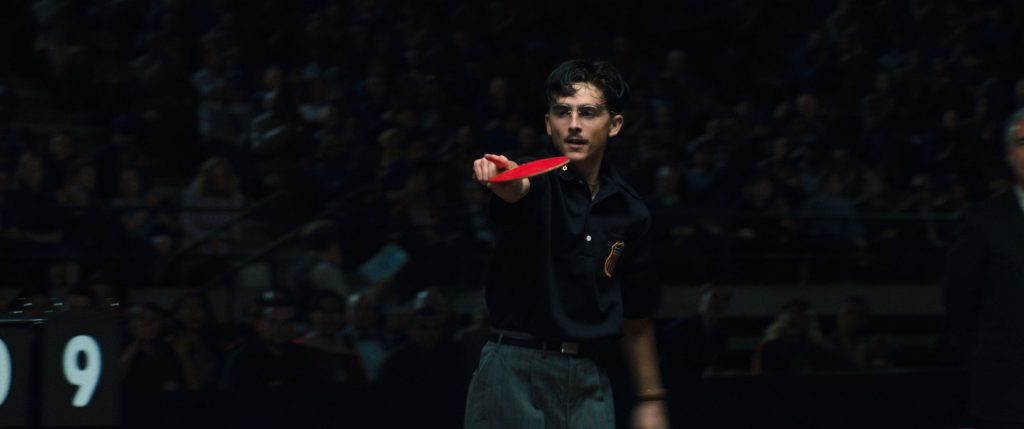
“It’s a performance that requires heavy lifting from Chalamet,” says Karen Gordon at Original Cin. “His Marty is brash and seemingly incapable of filtering his thoughts. He crosses lines constantly, leading him to do things like destroy his relationship with the head of the international table tennis federation (admittedly an arrogant effete), say outlandish and offensive things to reporters and proposition a once famous actress (Gwyneth Paltrow), who is not only much older, but is married to a rich, arrogant businessman (a very impressive acting debut by Kevin O’Leary, sigh).”
“The film moves with strange manic energy — I wanted to slap Marty as well as applaud him — yet it rarely flags,” adds Peter Howell at the Toronto Star. “The momentum continues even as Safdie indulges in a secondary narrative about dognapping the cherished mutt of a gangster (Abel Ferrara) that runs so long it threatens to overwhelm the main story. Safdie also slips in a baffling Holocaust flashback, involving a concentration camp inmate and a beehive in a forest, a jolt that feels less like a history lesson than a shard of ancestral memory poking through Marty’s manic hustle.”
“Marty Supreme is an astonishing film,” says Marc Glassman at Classical FM. “Like Uncut Gems, Josh Safdie’s previous film, which was co-directed with his brother Benny, this is a propulsive film, filled with tension and beauty in each frame. He’s a genuine auteur, though he seems to love to collaborate. Wherever we are—a shoe store, a ping pong tournament, a crowded restaurant, a theatre—Safdie makes us aware of their tactile dimensions and meaning to the story. He keeps us enmeshed in a drama that could play out successfully or end up as a disaster.”
“What makes Safdie’s observations of his protagonist—loosely based on American table tennis player Marty Reisman—so invigorating is the speed at which things go from bad to worse,” writes Courtney Small at That Shelf. “Exploring the toxic side of American entitlement, Marty is like a virus that cannot help but infect even those he seemingly cares about. He is the type of person who acts as if he is the most important person in the room, even when he is broke and avoiding his various responsibilities.”
“Chalamet took ping pong lessons, and it shows,” writes Gilbert Seah at Afro Toronto. “The matches are well executed and totally believable, not to say exciting to watch. The casting of Kevin O’Leary as Rockwell is nothing more than inspirational casting, as is director Abel Fererra as the mobster who owns the black dog.”
“It’s a true banger of a star turn that’s bound to be remembered in years to come like early Brando or De Niro performances are,” says Pat Mullen at That Shelf, who gets some words from Timothée Chalamet and Gwyneth Paltrow: “I feel this lifestyle and the demands that come with it are too bizarre to do anything but wanna be the best. And Marty Mauser is that role,” says Chalamet, riding a wave of the same frenetic energy that propels the film. “It would be bizarre for me to talk about it like this if we were talking about Little Women or something. If I say, ‘I wanna be best Laurie ever.’ You’d be like, ‘What the fuck?’ And then Christian Bale would snipe me or something. But with a movie like this, it fits the tone.”
No Other Choice (dir. Park Chan-wook)
“There are mistaken identities, accusations of adultery, mis-assumed suspects, and an ending of the be-careful-what-you-wish-for variety,” writes Jim Slotek at Original Cin. “Well shot, well acted and with locations that vary from brutalist factory sites to beautiful nearby forests, No Other Choice is both believable and absurd as it unfolds. But its social relevance remains spot-on.”
“The film is a wicked and occasionally hilarious satire based on the novel The Ax by Donald Westlake. Director Chan’s film takes its time to establish the plot, but it is all worth it in this deliciously wicked thriller,” says Gilbert Seah at Afro Toronto.
“Park’s messaging might not exactly be subtle – up to and including a late-film moment during which artificial intelligence is introduced into the industrial machinations – but the director once again proves himself to be both a master when it comes to fusing one tone to the next,” says Barry Hertz at The Globe and Mail. “So much of No Other Choice is horrifying, yet every grim beat bounces off some unanticipated, wry surprise.” Hertz also chats with Park about his dark comedy.
Song Sung Blue (dir. Craig Brewer)
“Hudson is convincing as a feisty optimistic single mother of two who proves to be a practical and emotional match for Jackman’s Mike,” notes Marc Glassman at Classical FM. “When she suffers a physical crisis, Hudson takes us on her journey back to something resembling normalcy in a very convincing manner. Mike’s tale is dramatic; he’s an alcoholic with a bad heart. His struggles are writ large across most of the film’s strongest scenes. That the two make it together, if only for a time, marks this film as a true romance.”
“Song Sung Blue is a first-class Hollywood dramatization of the duo’s story,” notes Gilbert Seah at Afro Toronto. “It allows audiences to see and feel as the documentary can only achieve so much. Performances are extraordinary, from both Jackson and Hudson.”
“Even when the story – which, I must stress again, is 100 per cent real – stretches its levels of credibility to swerve into celebrity-cameo territory and then, jarringly enough, deep tragedy, its two stars hold the audience close and tight,” writes Barry Hertz at The Globe and Mail. “Jackman is such a finessed force of nature that he’s as good as you might expect, but Hudson – who never quite landed as juicy a part as in Cameron Crowe’s Almost Famous, which is now more than a quarter-century old – matches her co-star beat for beat, bar for bar. Good times, they never seemed so good.”
“It is pure schmaltz – actually the best schmaltz – oddly perfect for a Christmas Day release, marked by terrific performances, both dramatic and musical, by Kate Hudson and Hugh Jackman,” notes Jim Slotek at Original Cin. “Jackman in particular is note-perfect as a performer channeling his passion into a Neil Diamond tribute. He might as well be playing Diamond himself (and the ads for the movie are vague enough that some people might be fooled into thinking it’s a biopic).”
At POV Magazine, Pat Mullen speaks with director Craig Brewer and star Kate Hudson about adapting the documentary Song Sung Blue into a movie musical: “Craig didn’t really want me to get too close to Claire because he wrote a great script and didn’t want me to be on set saying things like, ‘Well, what about that story that Claire told me? Why isn’t that in the movie?’” says Hudson. “I think finding Claire’s voice was a mixture between honouring what Claire was for Mike, which is that she really was his support and harmonized him. It was all about picking him up and making him look the best he could possibly look and supporting him and loving him like crazy,”
The Voice of Hind Rajab (dir. Kaouther Ben Hania)
“One essential point here is that the audio of Hind Rajab’s pleas was already part of the public discourse around the Gaza war and the killing of more than 20,000 Palestinian children. After Palestine Red Crescent lost their connection to Hind, they posted her calls on social media, pleading for effort to find the child and the medics, whose corpses were found 12 days later after the IDF withdrawal,” writes Liam Lacey at Original Cin. “A second point is that the film, made in cooperation with Hind Rajab’s surviving family, is deliberately not sensational. There’s no bloodshed or onscreen explosions. The focus is one of four central characters, often using dialogue.”
“This suspenseful hybrid drama unfolds with razor-sharp precision as it uses found audio recordings to interrogate our collective failure to respond to the situation in Palestine. Ben Hania employs an ingenious hybrid model that builds upon her Oscar-nominated Four Daughters to inject a pulse-pounding film with a palpable sense of absence,” writes Pat Mullen at POV Magazine. “The world might have failed Hind Rajab, but this film ensures that her voice will be forever seared into your memory.”
2025 in Review
At The Gate, Andrew Parker lists the top 100 movies of 2025. Atop the list? Sinners: “Musicality exists within its bones. The history of generations pulses through its veins.” He also dunks the 10 worst films of the year. Atop the list? Bride Hard: “fails to generate a single laugh or smile,” writes Parker.
At CBC, Jackson Weaver lists the 25 best films of 2025 with Lurker scoring the top spot: “A haunting portrait of obsession, control and the sacrifices we make for greatness, Lurker is infinitely interesting. Boasting a spellbinding lead performance by Canadian Théodore Pellerin — and easily some of the best songs of the year — it follows a young man worming his way into the coterie of a rising pop star.”
At That Shelf, Jason Gorber, Pat Mullen, Courtney Small, and Rachel West pick the best films of the year. Gorber picks One Battle After Another, while Mullen lists Come See Me in the Good Light at the top: “This is a film about what it means to savour every moment you have left.” Small taps BLKNWS: Terms & Conditions: “An exhilarating and thought-provoking piece of cinema.” West, meanwhile, chooses Sirāt: “navigates the complexity of both the family you are born into and the one you choose.”
Cameron Catch-Ups
At the Toronto Star, Peter Howell speaks with James Cameron about Pandora, Canada, and the good old USA: ““Even now there are many, many people in the world of good conscience who are still trying to do the right thing,” Cameron tells Howell. “And I’m not going to let one boneheaded government quash my optimism around that. I think the rest of the world is just going to have to move ahead for the next three years without the United States … (and that includes) Canada, by the way. We’re not going to be the 51st state, damn it! We’ll fight to the last moose!”
At The Globe and Mail, Barry Hertz chats with James Cameron about Avatar: Fire and Ash and other big movies, and the awards circuit. “I don’t try to make a movie to appeal to that sensibility,” Cameron tells Hertz on the latter. “They don’t tend to honour films like Avatar or films that are science fiction. Denis Villeneuve, another Canadian filmmaker, made these two magnificent Dune films, and apparently these films make themselves, because he wasn’t considered for Best Director. It’s like, okay, you can play the awards game or you can play the game that I like to play, which is to make movies that people actually go to.”
TV Talk/Series Scribbles
At What She Said, Anne Brodie looks at the doc series Elizabeth Taylor: Rebel Superstar: “New insights and familiar biographical info make for a rousing doc.” And Rowan Atkinson rattles the nerves in Man vs. Baby: “Atkinson’s face is a goldmine of expression and hilarity as ever, but my nerves were shattered!”