
Reviews include Insidious: Out of the Further, Late Fame, and Spa Weekend.
TFCA Friday: Movie Reviews for July 10
July 10, 2026
Welcome to the TFCA weekly, a round-up of reviews and coverage by members of the Toronto Film Critics Association.
In Release this Week
Animals in War (dir. various)
“Animals in War illustrates the effect of the war from a different perspective, from that of animals, both wild and domestic,” says Glibert Seah at Afro Toronto. “It is an ambitious film that works primarily for the observation of the effects the war has on innocent creatures that have not identified what is going on.”
Evil Dead Burn (dir. Sébastien Vanicek)
“Evil Dead Burn never ventures anywhere near comedy, although it doesn’t abandon humour entirely. The problem is that the laughs it does pursue feel derived more from a sense of obligation rather than anything organic. An elderly woman living with dementia becomes the film’s recurring source of comic relief,” notes Thom Ernst at Original Cin. “While the performance itself can be appreciated, the joke feels surprisingly easy for a franchise that has traditionally found its humour in chaos rather than vulnerability. And the occasional cheeky aside from the Deadites is genuinely funny, but the humour is so out of step with the film’s oppressive tone that it feels destined for the outtakes reel.
“One would expect the spirit of the Evil Dead films to be consistent, but in the latest offering, there is hardly any of the Sam Raimi humour that characterized his films and made them into a cult following,” says Gilbert Seah at Afro Toronto. “Evil Dead Burn does maintain consistency in terms of killing, blood, and ultra-violence. The film is not short of horror set pieces, but many of these do not make any sense.”
Gail Daughtry and the Celebrity Sex Pass (dir. David Wain)
“It helps that Wain has travelled this yellow brick road before, with parodies of 1980s sex comedies (Wet Hot American Summer) and 1990s rom coms (They Came Together). He also worked with a lot of this film’s cast in the 1990s TV sketch comedy show, The State,” writes Chris Knight at Original Cin. “My advice is to see it in as crowded a theatre as possible, because despite the old saying, comedy loves company. The let it marinate for a few days and see if you aren’t also pestering friends and loved ones with retellings of some of its quirky bits and pieces.”
“In an ensemble that relishes quotable phrases (‘I like my women, like I like my men, chunky as f**k’), Slattery commands the frame as a bumbling martial artist and struggling actor who feels both effortlessly natural and riotously cartoonish, pivoting from showcasing a terribly inept Japanese accent to an excruciatingly drawn-out gag involving a door repeatedly crushing a foot,” notes Prabhjot Bains at Range. “But it’s Deutch who remains the film’s beating heart, as her exaggerated, yet earnest turn pushes every moment to the verge of collapse without ever undermining the narrative’s emotional core.”
“[A]n occasionally amusing but mostly insufferable attempt at a comedic romp that breaks the fourth wall and insists upon itself as being charming and goofy when it’s just self-indulgent and ridiculous,” counters Dave Voigt at In the Seats. “Rather than trying to get us invested in characters or even their situation, this film leans entirely too hard on the gimmicky premise that it’s built on. It sets up the tired couples joke about ‘celebrities you can sleep with’ and wastes no time taking it all from 0 to about 100mph in about a 5 minute span. There’s almost no character set-up, the reveals and the moments never feel earned, it’s all a race to get Gail to LA and we never actually care that her fiancé just banged Jennifer Aniston in the back of a book store because he was stupid enough to think that he could.”
“A lot is going on in Wain’s comedy, but everything turns out more hectic than funny,” admits Gilbert Seah at Afro Toronto. “Dialogue can be corny at times too. But director Wain does not care. At the ending, where Gail rejects the groom, she tells him that he is her world, but there is a universe out there to explore.”
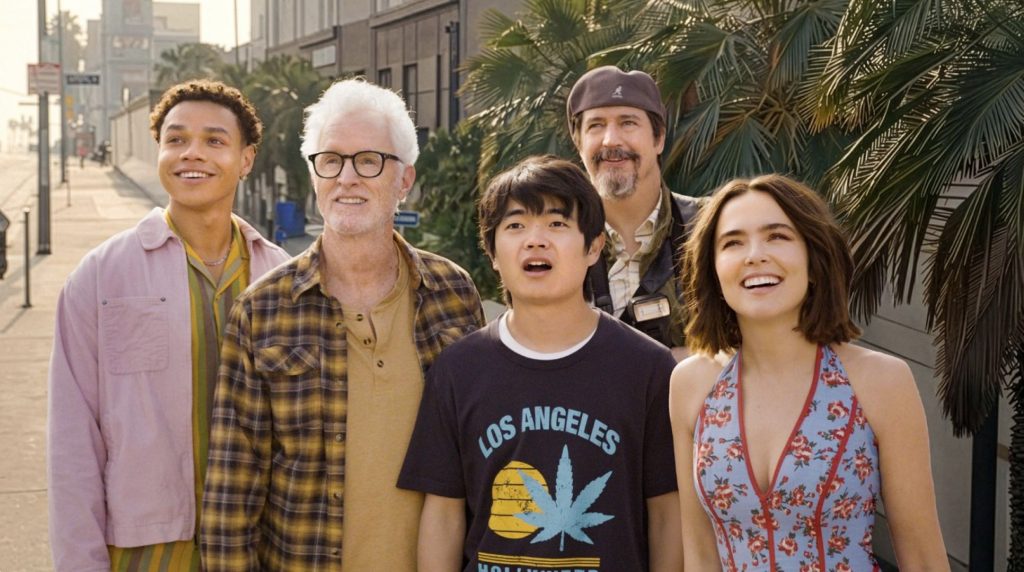
“At the core of Gail Daughtry and the Celebrity Sex Pass is Zoey Deutch, who makes her titular character lovable—against all odds. Gail is a stereotype writ large, the wide-eyes optimistic honest American girl, who only expects great things to happen in her life,” says Marc Glassman at Classical FM. “Thanks to her boyfriend’s behaviour, she goes on a quirky revenge mission, to find and have fun with Jon Hamm while still maintaining her happy, accepting demeanour. When confronted along the way by bizarre L.A. characters—a failed paparazzo, an overly aspiring talent agent, a miserable former TV star—she accepts them and includes them in her circle. And when she meets Hamm, she makes him real, too. It’s a nearly impossible role but Deutch pulls it off, making you accept her as a strange California character. It makes her sketchy journey work, which, in turn, makes the film likeable.”
“Tinseltown isn’t shocked by her quest — L.A. has seen weirder things — but that doesn’t mean the trek is going to be easy. It is, however, riotously funny, a bit raunchy and loaded with star cameos, among them ‘Weird Al’ Yankovic, Elizabeth Perkins, Henry Winkler, Paul Rudd, a Friends star and a couple of Mad Men who truly believe in selling the sizzle,” adds Peter Howell at the Toronto Star. “Deutch’s sweet-and-sassy lead performance and Wain’s wild comedy instincts make a potent combo. As a bonus, it’s a chance to see Jon Hamm be funny in something other than TV commercials.”
“Gail Daughtry and the Celebrity Sex Pass asks one life’s life toughest and most significant questions: If you could sleep with any celebrity guilt-free, who would it be? In 2026, that question proves especially thorny depending upon which episode of Heated Rivalry is next in the queue. For Gail Daughtry (Zoey Deutch), however, the sweetest pie hails from TV’s Mad Men era,” says Pat Mullen at That Shelf. “Gail Daughtry and the Celebrity Sex Pass delivers good silly fun in its purest form. It encourages audiences to let loose and embrace the stupid. But while it enjoys a side of broad comedy that audiences see too rarely these days—Stop! That! Train! and Scary Movie aside—the film also plays into the allure of celebrity as Gail reflects audiences’ romantic fantasies of Hollywood stars.”
IKKA (dir. Siddharth P Malhotra)
“IKKA is a fast-moving Bollywood crime drama that moves at breakneck speed (despite its running time of 2 hours and 20 minutes) and has the feel of those past 1960 cop thrillers,” notes Gilbert Seah at Afro Toronto.
IP Man: Kung Fu Legend (dir. Li Liming; July 14)
“The story involves him being framed and then convicted to prison,” explains Gilbert Seah at Afro Toronto. This is the main difference between the other IP Man films. But the storyline is not as important as the action pieces, which are the reason fans go see the franchise. The opening fight sequences are solid enough to impress and promise fans that more is to come.”
Moana (dir. Thomas Kail)
“As a musical, it is a minor one, and as a live-action film, it is also minor,” says Gilbert Seah at Afro Toronto. “There are many animated parts in the segments with CGI monsters, which makes one wonder why make a live-action remake if there is so much animation in the first place. The film is undoubtedly well put together, with the animated and live-action well integrated, but why go to all this effort in this very costly $200-$250 million production?”
“[L]ike so many other live action remakes, it’s not terrible in any obviously offensive sense — this is literally just Moana again, after all,” notes Jackson Weaver at CBC. “Moana again, though just slightly worse in every aspect — given its move from the medium it was designed for. A move into one that does nothing to serve the pacing, world-building and even humour that story was initially built for and out of. A move that results in worse visuals, painfully stilted movement, near-absent suspension of disbelief and a rehashed story necessarily drained of its original impact.”
Racewalkers (dir. Phil Moniz and Kevin Claydon)
“Racewalkers is almost quintessentially Canadian: the stakes are reachable and the villains—the Lesters pere and fils, are laughably bad. Ultimately, we’re asked to root for a duo to compete in one of the strangest Olympic sports. It’s a victory that’s all too achievable,” notes Marc Glassman at Classical FM. “Why do we laugh? It’s a topic that philosophers from Plato to the existentialists, typically duck. If they do, they write about the need to surrender control or to inflict non-lethal harm on another person. We may never know why we laugh but we do know when it happens.”
“The dumb, heartstring-tugging, underdog sports comedy genre seldom gets its due. But there are times – and these are among them – when a Cool Runnings or Dodgeball are exactly the kind of feel-good escape to the theatre we need,” says Jim Slotek at Original Cin. “It helps if the movie itself is one big sight gag. Racewalkers is a Canadian comedy set in the world of Olympic level race walking, possibly the most ungainly sport devised for international competition. As one character describes a newly discovered talent, “That guy looks like he needs to take a dump in a hurry!”
Rose of Nevada (dir. Mark Jenkin)
“In one achingly sad sequence he mails his pay and that note to his future wife at their future address, only to have it delivered there in a present he can’t escape. They go to sea again, but it’s still John Major at 10 Downing Street when they get back. Jenkin fills his film with portents of dread that flirt with the horror genre, like a warning scratched in the bunk on the Rose of Nevada, or the disturbing dreams suffered by Nick, and apparently only Nick,” says Chris Knight at Original Cin. “Sudden scene changes intensify the sense of dislocation, and there are motifs (boots hitting the ground, the drumbeat of a ship’s engine) that rattle away like a ticking clock. I also spotted at least one moment where time itself seemed to run backward, an eerie and suggestive shot.”
Shipwrecked: Nightmare at Sea (dir. Chiara Messineo)
“Everyone loves a good disaster story. The new feature documentary Shipwrecked: Nightmare at Sea has one- a modern-day one [of] Titanic proportions,” writes Gilbert Seah at Afro Toronto.
Steal this Story, Please! (dir. Carl Deal, Tia Lessin)
“This provocative doc charts Democracy Now! host Amy Goodman’s relentless pursuit of stories neglected by mainstream media. Bouncing around in time, the film traces her development from wisecracking youngster to student activist to independent journalist undeterred by armed soldiers and smear campaigns,” says Peter Howell at the Toronto Star. “This vital film touches on shrinking newsrooms, political assaults on the press and the high personal cost of speaking truth to power. It’s also unexpectedly funny, thanks to Goodman’s dogged questioning and deadpan takedowns of corporate execs. Coming at a moment when authoritarians target reporters and public trust in media ebbs to new lows, Steal This Story, Please! functions as both biography and battle cry.”
“Steal this Story, Please! makes the case that independent journalism is a calling,” writes Pat Mullen at POV Magazine. “This film by Tia Lessin and Carl Deal (The Janes) uses Goodman’s biography to ask why mainstream media all too frequently bends the knee to higher powers when it should be holding them accountable. Goodman might not be popular with everyone at the White House, especially now, but she can command a half-hour phone call with a president. This actually happens when Bill Clinton phones her during the 2000 election with a plea to let him share a ‘get out the vote’ message with her audience. She subsequently grills him on air for thirty minutes. She asks direct questions about why her listeners should heed his advice after two terms. Clinton labels her questions combative and adversarial. Goodman deems them her job.”
Wisteria (dir. Nina Moscone Marrese)
“Writer/Director Nina Moscone Marrese going full steam ahead here into some pretty heady material, especially considering that this is her first time in the director’s chair,” writes Dave Voigt at In the Seats. “We can’t knock ambition since some of the headier stories and films in the modern canon deal with the eternal nature of love and it crossing the ethereal boundaries, but it never lines up as neatly as you’d hope. There’s ultimately a lot of chafe here in a story that may have been better served as a long format short rather than a feature.”
File Under Miscellaneous
At POV Magazine, Pat Mullen looks at the canon of dramatic films inspired by documentaries, including a surprisingly great Grey Gardens and Music of the Heart: “Horror maestro Wes Craven makes a rare step away from slicing and dicing teenagers in this wholesome oddity in his oeuvre. The novelty delivers, though, as Craven directs Meryl Streep to an Oscar nomination in this touching story about a violin teacher who motivates inner city students through music,” writes Mullen. “The film draws inspiration from the Oscar-nominated 1995 documentary Small Wonders about Roberta Guaspari and her fight for music programs in education. Music of the Heart has a whiff of the 1990s’ race relations dramas that may seem a bit dated despite being made with best intentions. It’s basically Dangerous Minds with violins in lieu of gangsta rap. That said, it anticipates later hybrid works that cast people in the drama of their own lives by inviting many of Roberta’s own students to appear in the film, and Streep delivers a terrific performance that’s as good as every other credit on her resume.”
On the TFCA blog, Telefilm Canada Emerging Critic Award winner Nirris Nagendrajah looks at a thread that connects three new horror films: “In a recent wave of popular horror films that includes Curtis Barker’s Obsession, Adrian Chiarella’s Leviticus, and Kane Parson’s Backrooms, I was surprised to find what they all had in common—and perhaps this is the root of their widespread appeal—is that they are seemingly less interested in creating successive instances of fear as much as utilizing genre conventions in order to face the horrors of desire: for another life, for a body deemed too similar to one’s own, or for an ideal lover bending to one’s will.,” writes Nagendrarajah. “In their own ways, these filmmakers similarly tap into a sense of dissatisfaction latent in their characters to imagine new realms whose unfamiliarity allows for the certainty of their desires to be worked through despite the futility of such a task.”